
Quick Answer
Hardscape failures such as cracking, settling, pooling water, and irrigation conflicts usually start with decisions made before installation, not with the pavers themselves. Drainage direction, finish grade, base compaction depth, and irrigation zone placement determine whether a patio holds up. Choosing pavers before resolving those issues is what leads to expensive rework.
If you're planning a patio, walkway, or outdoor living area, the biggest mistake is treating it like a materials decision first. Why most hardscape projects fail before a single paver is installed comes down to site conditions, not surface appearance.
Homeowners usually start with color, pattern, and layout. That makes sense. But before any of that matters, the site has to be evaluated for drainage, soil behavior, base requirements, and conflicts with irrigation or nearby structures. Even design inspiration should come after the basics are understood, whether you're looking at a clean modern patio or reviewing patio ideas that fit a long-term outdoor plan.
The Real Reason Your Paver Patio Will Buckle and Sink
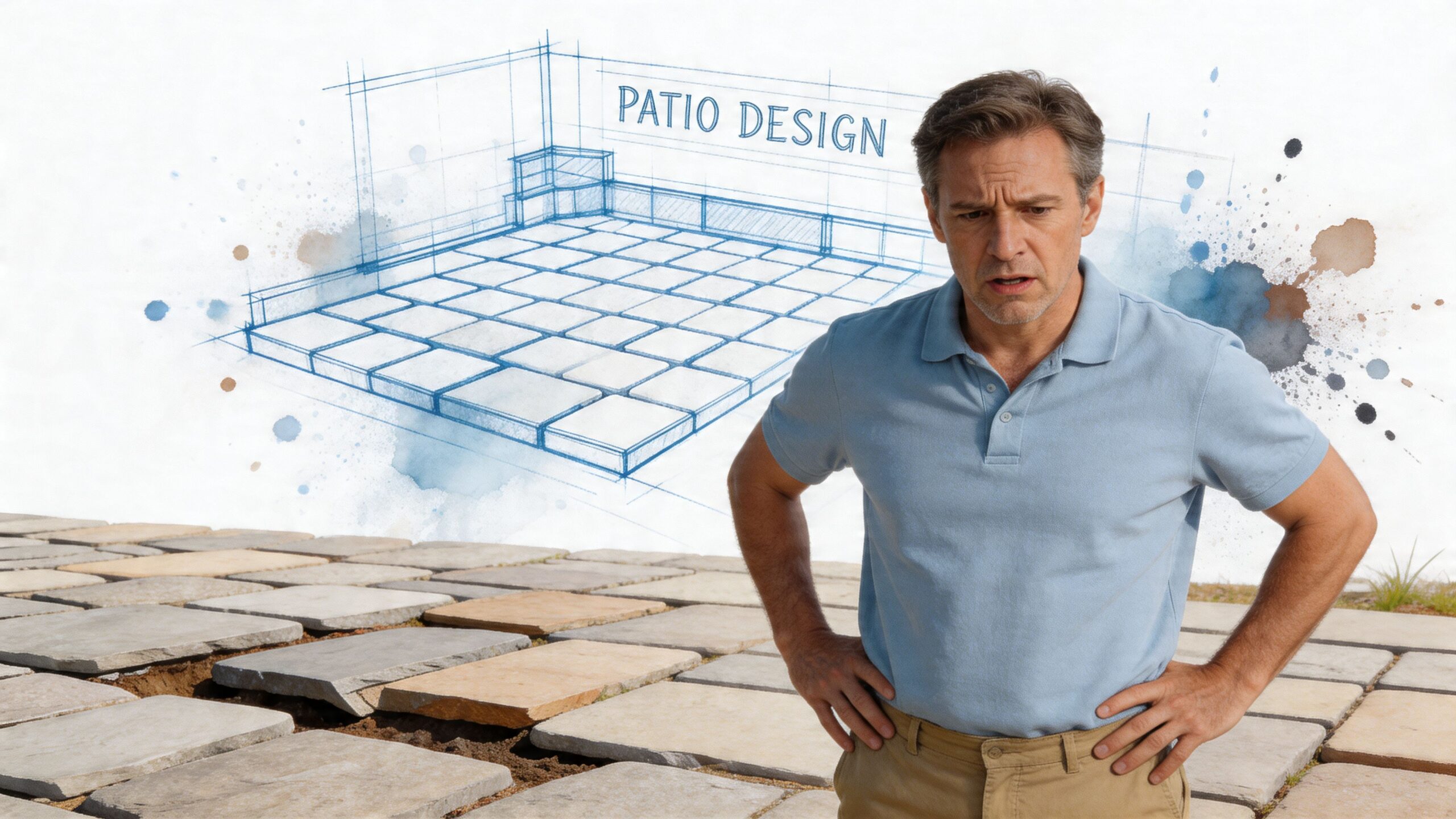
Most failed paver patios don't fail because the pavers were bad. They fail because the work underneath them wasn't designed or built for the site.
Poor base preparation is the #1 cause of paver and hardscape project failures, often before a single unit is installed, and in the Bay Area and Monterey County, inadequate subgrade compaction before paver placement leads to 80-90% of reported patio sinking cases according to this breakdown of common paver installation failures.
The surface gets blamed for what the base caused
When a patio sinks at one corner or a walkway starts rocking underfoot, people usually look at the top layer first. They ask whether the pavers were too thin, whether the joint sand washed out, or whether the installer rushed the laying pattern.
Those can matter, but they aren't usually the first cause. The underlying problem starts below grade, where excavation depth, soil condition, base material, and compaction decide whether the finished surface has support.
Practical rule: If a quote spends more time on paver style than on excavation, compaction, and drainage, it probably isn't addressing the part of the project that determines service life.
Cheap base material creates expensive movement
A lot of failures trace back to the wrong aggregate. Generic gravel and quarter minus fines are often treated like interchangeable base materials. They aren't.
The better-performing approach is a layered base built with compacted subgrade, the right crushed road base or crushed rock, and bedding sand, with each layer compacted properly. If you want a plain-language look at the mechanics, this guide on how to compact soil for a rock-solid foundation is useful because it explains why loose soil and rushed compaction keep moving long after the crew leaves.
In California soils, that distinction matters even more. Clay-heavy ground, seasonal moisture shifts, and seismic movement expose weak preparation fast.
Patio planning isn't separate from the rest of the property
Patios don't exist in isolation. Grade transitions, driveway edges, planter borders, and drainage paths all affect whether a hardscape remains stable. That's one reason surface choices often need to follow the site plan, not the other way around.
A crushed surface can be a better fit in certain areas when water movement, slope, or flexibility matter more than a fully interlocked paver field. That's part of why some property owners compare pavers with alternatives like crushed granite driveways before they lock in a layout.
Why Most Hardscape Projects Fail Before a Single Paver Is Installed
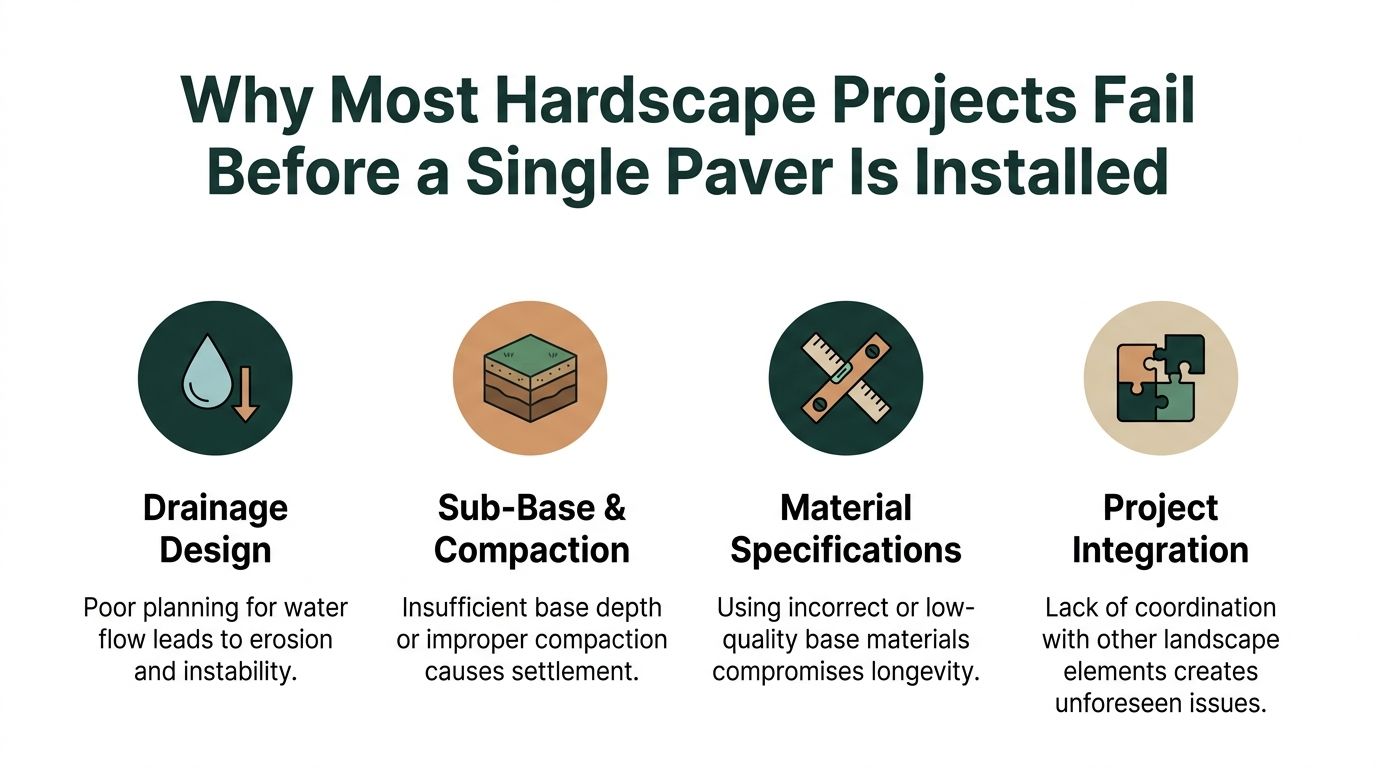
A hardscape project is decided early. Not cosmetically, but structurally. By the time pavers show up, most of the important choices should already be settled.
Technical guidance for paver systems calls for 6-12 inches of excavation for patios and 12-18 inches for driveways, with compaction reaching 95-98% Proctor density. Failure analyses also show 75% of sinking pavers trace back to bases under 4 inches thick, and uncompacted bases can settle 1-3 inches within two years under normal foot traffic according to this hardscape failure analysis.
Drainage and finish grade come first
Water doesn't need much space to create problems. If it can't move away from the house and off the hardscape in a controlled way, it will work into the joints, along the edges, or under the base.
That weakens the support layer over time. The surface may still look good right after installation, which is why drainage mistakes are easy to miss until the first wet season exposes them.
A proper plan answers a few basic questions before layout is finalized:
- Where does runoff go: The contractor should be able to point to a defined discharge path, not just say the patio will "shed water."
- How does the finish grade relate to the house: Hardscape should move water away from foundations, door thresholds, and low wall lines.
- What happens at the edges: Uncontrolled edge runoff often undermines the perimeter first, especially where patio borders meet planting beds or bare soil.
Water always wins the argument. If the design doesn't give it a path, the site will create one.
Base depth has to match soil and load
Not every hardscape carries the same demand. A backyard seating area and a driveway do not use the same section depth, and they shouldn't be quoted as though they do.
Load matters. Soil type matters. Moisture behavior matters. A contractor who installs the same base detail everywhere is solving for speed, not for site conditions.
What usually works
A durable paver system is built in layers. The native soil is shaped and compacted, then the base aggregate is placed and compacted in lifts, then bedding sand is added before the pavers are set.
The key is that each layer has a job:
| Layer | What it needs to do | What goes wrong if it's skipped or rushed |
|---|---|---|
| Subgrade | Provide a stable platform | The whole system settles unevenly |
| Base aggregate | Distribute load and resist movement | Pavers dip, spread, or sink |
| Bedding sand | Create a uniform setting bed | Surface becomes uneven or rocks underfoot |
What doesn't work
Crews run into trouble when they treat excavation depth as optional, use rounded gravel instead of angular base, or compact too much material at once. Loose lifts hide voids. Thin base sections can look fine on day one and still fail later.
That's also why "we'll fix it with more sand" is usually not a real repair. Sand can hide a symptom. It doesn't rebuild a failed foundation.
Irrigation conflicts get discovered too late
Hardscape planning often ignores irrigation until demolition starts. That's backward.
Existing lines may run through the new patio footprint. Valves may sit where steps or retaining walls are being planned. Spray coverage that worked before construction may overshoot onto new paving afterward. Once the design is already approved, every one of those conflicts becomes more expensive and more awkward to solve.
Common problems include:
- Cut lines during excavation: Existing lateral lines are easy to hit when no one mapped the system first.
- Wet edges next to hardscape: Irrigation aimed at nearby planting beds can keep one side of the base too wet.
- Poor zone logic after renovation: New planting areas may need different watering than older sections, but the system wasn't redesigned to match.
This isn't only about avoiding broken pipes. It's about preventing chronic moisture where the base needs to stay stable.
Material selection comes after site requirements
Property owners often want a square-foot price before anyone has confirmed what the site needs. That's understandable, but a hardscape budget built that way isn't reliable.
A price attached to pavers alone doesn't tell you enough. If one site needs deeper excavation, more base, grade correction, drainage work, or irrigation revision, then the paver itself is only one piece of the cost and one small piece of the risk.
Field note: A low number can mean the contractor left out the difficult part, not that they found a smarter way to build it.
That changes how you should read proposals. If two contractors are quoting what looks like the same patio, but one includes drainage corrections and irrigation modifications while the other doesn't mention them, they are not pricing the same project.
How to Vet a Hardscape Quote That Prevents Future Failure
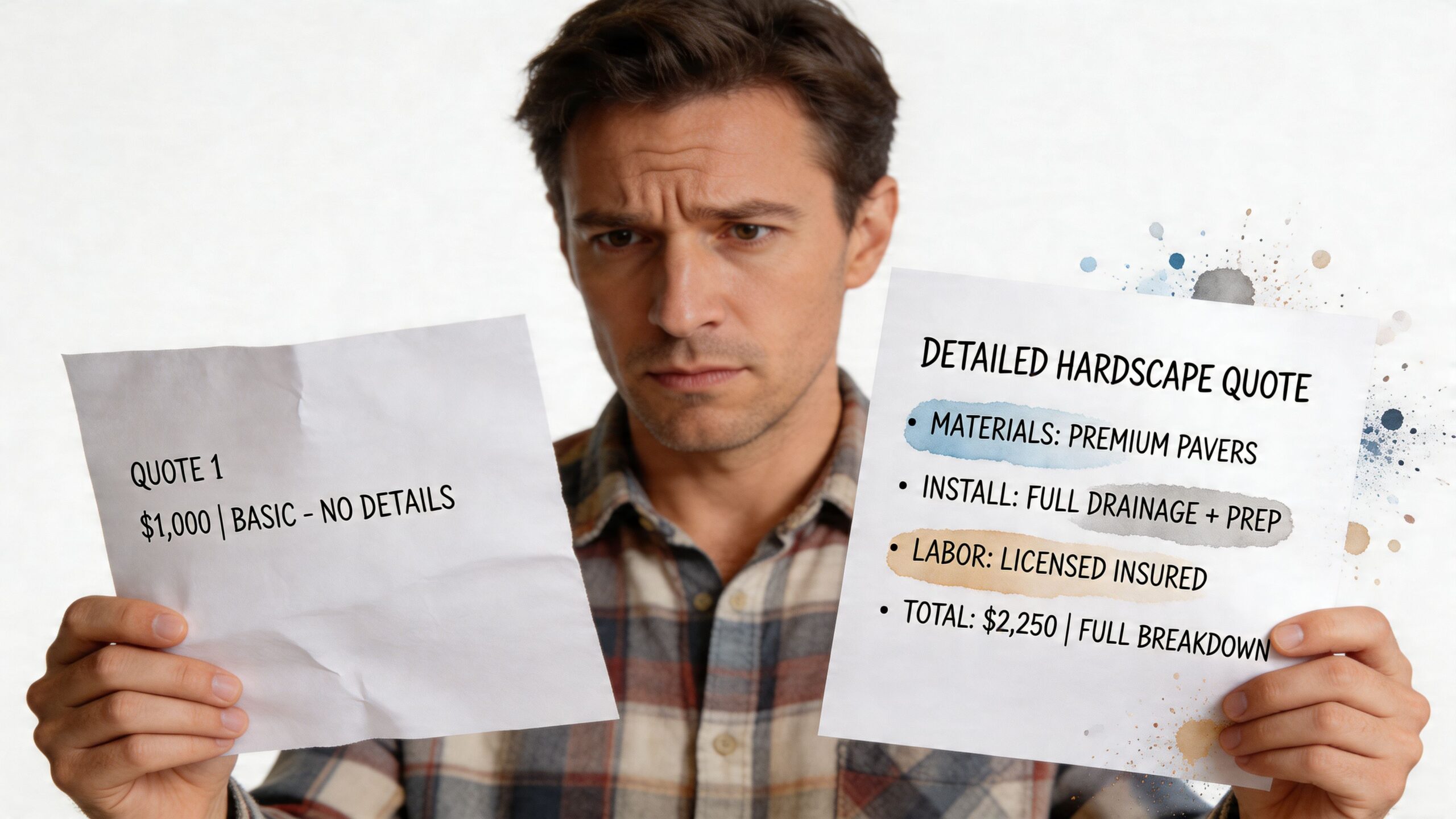
A hardscape quote should tell you how the site will be prepared to support the surface. If it only lists pavers, square footage, and a total, it is pricing the visible finish while leaving the failure points undefined.
That is how homeowners end up comparing numbers that are not for the same job.
In the field, the trouble usually starts before the first bucket of soil comes out. One contractor assumes standard excavation and base depth. Another expects soft spots, drainage corrections, or grade changes and includes them. Both proposals may say "paver patio," but one is pricing a finish layer and the other is pricing a buildable site.
In our experience with California soils, one property can drain well and compact cleanly while the next holds water, pumps under load, or needs over-excavation in isolated areas. A useful quote accounts for that uncertainty. A weak one hides it until the change orders start.
A useful quote answers specific questions
A serious quote explains what the contractor plans to build under the pavers and how that plan fits the property. It does not need stamped engineering for every backyard patio, but it should show that someone evaluated the site conditions instead of dropping in a stock assembly.
Look for these details in writing:
- Excavation scope: How much material is being removed, and what happens if the crew hits soft or unsuitable subgrade.
- Base specification: What aggregate is being installed, the target depth, and how compaction will be handled in lifts.
- Drainage plan: How the finished surface will shed water and whether drains, swales, or grade corrections are part of the scope.
- Irrigation revisions: Whether buried lines, sleeves, valves, or nearby planting areas require adjustments.
- Edge restraint and transitions: How the new hardscape ties into concrete, lawn, planting beds, steps, or walls.
Those details matter because the site drives the assembly. The paver is the wear surface. The base, grade, and water management decide whether it stays flat.
Price comparisons only work when the scope matches
Low numbers get attention. Scope keeps patios from failing.
A contractor who leaves out drainage, extra excavation, or irrigation revisions can look thousands cheaper on paper. That does not mean the project costs less. It means the difficult parts have not been priced yet.
Read the quote like a site plan, not a shopping list. If you want a clear example of that approach, this page on Monterey County outdoor design and construction planning shows how good contractors treat exterior work as coordinated site construction rather than isolated surface installation.
The better question is not which quote is lowest. It is which quote shows that the contractor understands what this property needs.
Red flags worth slowing down for
Some warning signs are easy to spot once you know what to look for:
| Red flag | Why it matters |
|---|---|
| No mention of drainage | Water movement has not been planned |
| The same base detail for every project | The quote was likely copied from a standard template |
| No allowance for subgrade problems | Extra costs may appear after demolition starts |
| No note about irrigation conflicts | Buried utilities may be discovered mid-job |
| Fast estimate after a short walk-around | The scope may be too thin to trust |
If a contractor cannot explain the water path, base build-up, and transition details in plain language, the quote is still at the materials-first stage. A quote that prevents failure starts with the site.
Your Pre-Installation Checklist to Ask Any Contractor

A good planning conversation is specific. If you ask broad questions, you'll get broad answers. These four questions force the discussion onto the parts of the project that usually decide whether the hardscape lasts.
Where does water go on this site after rain or irrigation
Ask the contractor to walk the path physically. Not in general terms. On your actual property.
If the answer is vague, the drainage plan probably hasn't been developed. You want to hear where the finished surface sheds water, where that water is directed next, and how nearby beds or downspouts affect the design.
What base depth and compaction standard are you using, and why
This question tells you quickly whether the contractor is building for your site or using a default template.
The answer should connect three things: your soil, the expected load, and the planned use of the area. A patio, walkway, and driveway should not automatically receive the same recommendation. The explanation should also make clear how compaction is handled during installation, not just that it will be "packed down."
If the contractor can't explain why a given base depth fits your soil and use case, they're asking you to trust a guess.
Are there irrigation lines in the footprint, and how will the zones be adjusted
This question saves a lot of mid-project surprises. Existing irrigation often needs to be rerouted, protected, capped, or redesigned when hardscape expands into planted areas.
You also want to know what happens to adjacent planting beds after the project is done. If the irrigation still sprays onto the new surface or keeps one edge saturated, the design work isn't finished.
Does this project trigger California water efficiency requirements
For permitted exterior work in California, water-use rules can affect the irrigation plan and documentation. Ask directly whether MWELO compliance is part of the scope and whether the total developed area affected is 500 square feet or more, because that threshold can change permit submittal requirements.
This isn't a minor paperwork detail. If it comes up after design approval, the scope may have to change to address irrigation zoning, plant selection, and permit coordination.
A short way to keep the conversation grounded
Write the answers down and compare them line by line across bids. That matters more than comparing totals first.
Use this quick reference when you're meeting with contractors:
- Water path: Ask where runoff goes during rain and irrigation cycles.
- Base logic: Ask what depth and compaction standard are being used, and why.
- Irrigation conflicts: Ask what lines, valves, or zones will be changed or protected.
- Permit impact: Ask whether California water-efficiency requirements apply to the project scope.
How Our Professional Process Mitigates These Risks
Projects hold up better when the planning process is structured. That means the conversation starts with site conditions, use, water movement, and construction requirements before materials are finalized.
The process begins with an on-site review of the area being changed. Grade relationships, drainage direction, access, existing hardscape, irrigation infrastructure, and surrounding site conditions all need to be understood together. That is where design decisions become practical instead of decorative.
From there, the design phase has to coordinate hardscape with the rest of the property. A patio layout affects runoff. Drainage solutions affect planting areas. Irrigation revisions affect both compliance and long-term performance. That connection is why it helps to review how drainage and irrigation zoning affect hardscape design before the finish materials are selected.
The process matters as much as the product
A professional workflow reduces avoidable changes during construction. It also makes estimates more accurate because the scope is defined around the site, not around assumptions.
That usually includes:
- Site evaluation first: Existing conditions are reviewed before layout and material decisions are locked in.
- Design coordination: Hardscape, drainage, irrigation, and adjacent softscape elements are planned as one system.
- Review before installation: Questions about grade, access, permits, or construction details are settled before excavation starts.
- Final walkthrough: The completed work is checked against the agreed scope and site function, not just appearance.
Good projects are predictable before they begin
The goal isn't to make hardscape planning complicated. It's to make it complete.
When the base, grade, water path, and irrigation plan are addressed early, the finished patio or walkway has a much better chance of performing the way the property owner expects. That is what a professional process is supposed to do. Remove preventable surprises before the first paver is ever delivered.
Frequently Asked Questions About Hardscape Planning
How long should the planning phase take before hardscape installation starts
Long enough to answer the site questions clearly. If drainage, grade, irrigation conflicts, and permit needs haven't been reviewed, the planning phase isn't done yet. Simple projects move faster than complex ones, but rushing this stage is where expensive revisions usually begin.
Can pavers be installed over an existing concrete slab
Sometimes, but it depends on the condition, elevation, drainage, and surrounding transitions. If the slab already holds water, has movement, or creates a bad finish height at doors and adjacent areas, building over it can transfer those problems into the new work. A slab is only useful if it supports the new design instead of limiting it.
Will permits be part of a hardscape project in Monterey County
Some projects need permits, especially when scope, drainage changes, walls, or related outdoor improvements trigger review. The right time to ask is before the design is finalized, not after. If permit documentation is needed, that should be built into the planning schedule from the start.
How does soil type affect the final project scope
Soil affects excavation depth, base design, drainage needs, and how much confidence you can place in the native subgrade. Clay-heavy areas, soft spots, and poorly draining sections usually require more careful preparation than stable, well-draining ground. That changes both construction detail and the level of site work involved.
What are the early signs of a poorly compacted base
The first clues are usually subtle. Minor low spots, edges that start to separate, pavers that rock underfoot, or water sitting where it should sheet off are all warning signs. When those show up early, the issue is often below the surface rather than in the paver itself.
Should I choose the paver style before getting a site assessment
You can collect ideas early, but don't lock in the product too soon. The site may need grade correction, drainage changes, or a deeper base than expected, and those decisions can influence layout, edge treatment, and overall budget. Surface choices make more sense once the property conditions are understood.
Can a hardscape project affect nearby planting and lawn areas
Yes. Excavation, grade changes, and new runoff patterns can change how surrounding areas drain and how irrigation should be delivered. That's one reason outdoor projects should be planned as part of the entire property, especially if you're also thinking about usability and resale, as discussed in whether an outdoor living area can increase home value.
Start Your Project with a Solid Foundation
The hardscape projects that hold up aren't the ones with the flashiest materials. They're the ones where the site was understood before the surface was chosen. That's the practical lesson behind why most hardscape projects fail before a single paver is installed.
If you're still early in planning, the most useful next step is a real conversation about drainage, grade, soil behavior, irrigation, and permit requirements on your property. In cases where an older slab or settled flatwork is part of the discussion, it can also help to understand repair options such as lift and level concrete so you know whether to rebuild, reuse, or remove an existing surface.
The important part is sequence. Resolve site conditions first. Pick finishes second.
If you're planning a patio, walkway, retaining wall, or outdoor living upgrade in Salinas or Monterey County, California Landscape & Tree Pros can help you evaluate the site before design choices lock in the wrong scope. Call (831) 998-7964 in Salinas or (831) 905-8018 in Monterey, or visit the team at 1184 Monroe St., Suite 6, Salinas, CA 93906. You can also learn more at californialandscapeandtreepros.com.