
Quick Answer
If a tree has serious structural defects, root problems, major lean, decay, or a history of dropping large limbs, removal before storm season is often the safest choice. If the risk isn’t obvious, get a professional assessment before winter weather arrives. Early action helps avoid emergency conditions, property damage, and post-storm delays. For local context, see this Monterey County storm season tree risk guide.
If you're asking should i remove a tree before storm season in california?, you're usually not asking about appearance. You're asking whether that tree could end up on your roof, across your driveway, or on a tenant's car when the ground gets soaked and the wind picks up.
In Monterey County, that question comes up every year as winter approaches. The hard part is that many dangerous trees still look "mostly fine" until the weather exposes the weakness.
The Escalating Risk of Tree Failure During California Storms
California doesn't need a hurricane to produce dangerous tree failures. A wet soil profile, repeated rain, and strong wind are enough to bring down trees that have hidden defects or overloaded canopies.
From 1980 to 2024, California had 46 confirmed weather and climate disaster events that each exceeded $1 billion in losses, including 4 severe storm events, according to the NOAA California billion-dollar disaster summary. That matters because storm damage isn't theoretical here. It's part of the operating reality for homeowners, HOAs, and commercial sites.
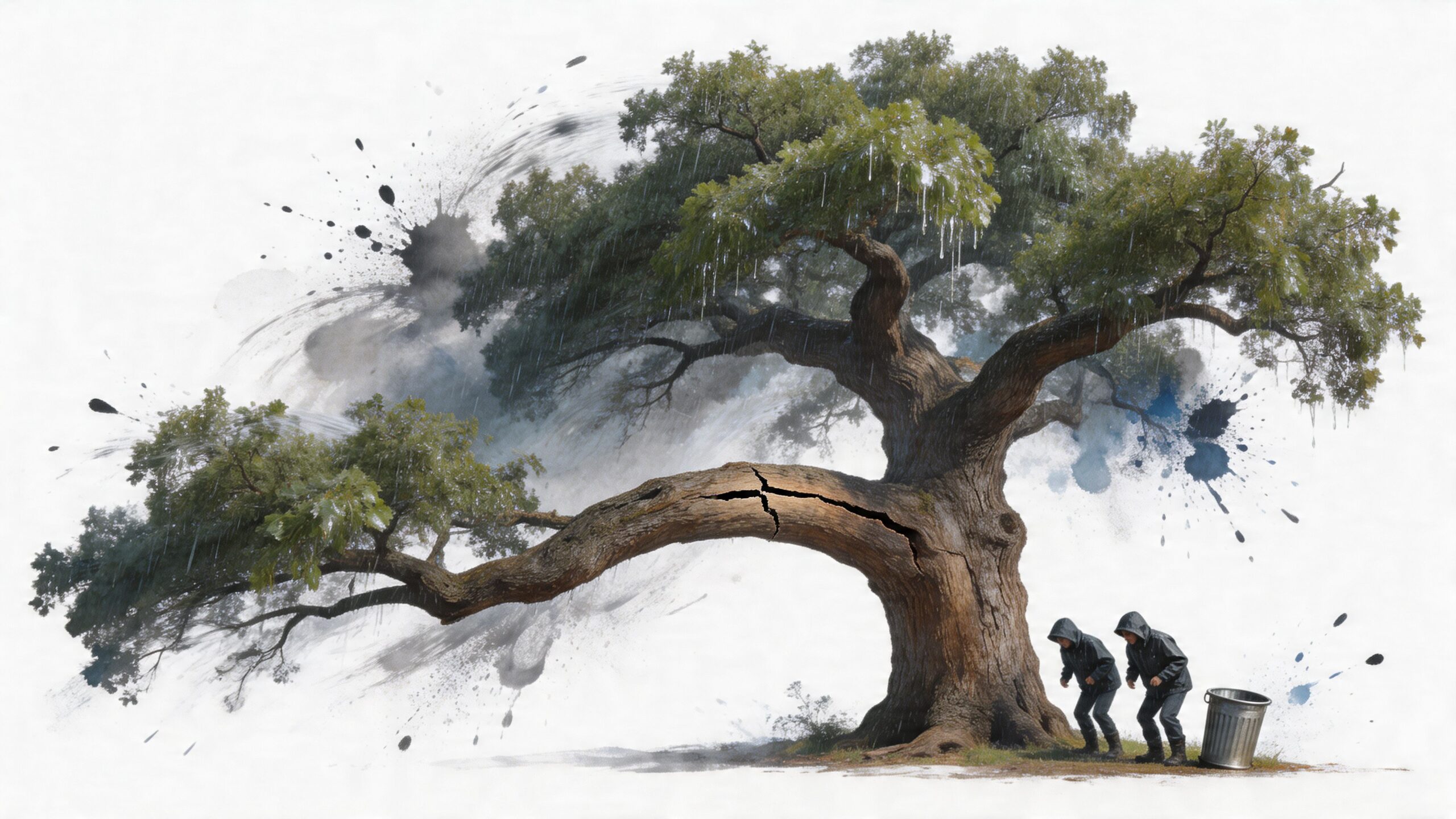
Why trees fail when storms hit
Wind alone doesn't tell the whole story. Rain changes the ground conditions first.
When soils stay saturated, roots lose some of the support they normally get from stable ground. Then wind loads the canopy, and the whole tree starts working like a lever. If the root plate is weak, the tree can uproot. If the root system holds but the structure is poor, large scaffold limbs can break instead.
A dense canopy also catches more wind. Broad, heavy limb tips exert force at weak branch unions, especially where trees were never structurally pruned or where codominant stems formed early and were left in place.
Practical rule: Trees usually fail where they were already weak. Storms expose the defect. They don't create it from nothing.
What storm season changes for property owners
The risk isn't limited to a full tree failure. Partial failures create plenty of damage on their own.
A dropped limb can crush fencing, damage vehicles, block access roads, tear service lines, or leave a building exposed to water intrusion. On managed properties, one failed tree can also create a second problem. Residents or customers lose access while cleanup, inspections, and repairs stack up behind each other.
That delay is common after major weather events. Property owners who wait until the storm arrives often end up competing for emergency crews and cleanup scheduling. That's one reason pre-season planning matters, especially if you're already seeing warning signs. This local overview of why winter storms increase emergency tree removal in Salinas reflects what crews deal with every winter.
Hidden defects are the real problem
Most owners don't miss the obvious dead tree. They miss the compromised live tree.
The tree still leafs out. It still gives shade. It may even look full and green from the street. But a live tree can still have a decayed trunk column, root damage from old trenching, included bark at a major union, or a slow lean that tells you the support system is changing.
That's why visual condition and actual risk aren't always the same thing.
A Property Owner's Checklist for Identifying a Hazardous Tree
A Monterey County property manager usually gets the first warning before a storm crew does. A limb starts hanging over tenant parking. Soil lifts on one side of the trunk. A tree that looked fine last winter suddenly has a long crack at a major union. Those are the moments to act, because the cost of a planned inspection or removal is usually far lower than after-hours emergency work, access control, vehicle claims, and cleanup after failure.
A site walk will not replace an arborist assessment. It will help you spot trees that need one now, before winter weather turns a maintenance issue into a budget problem.
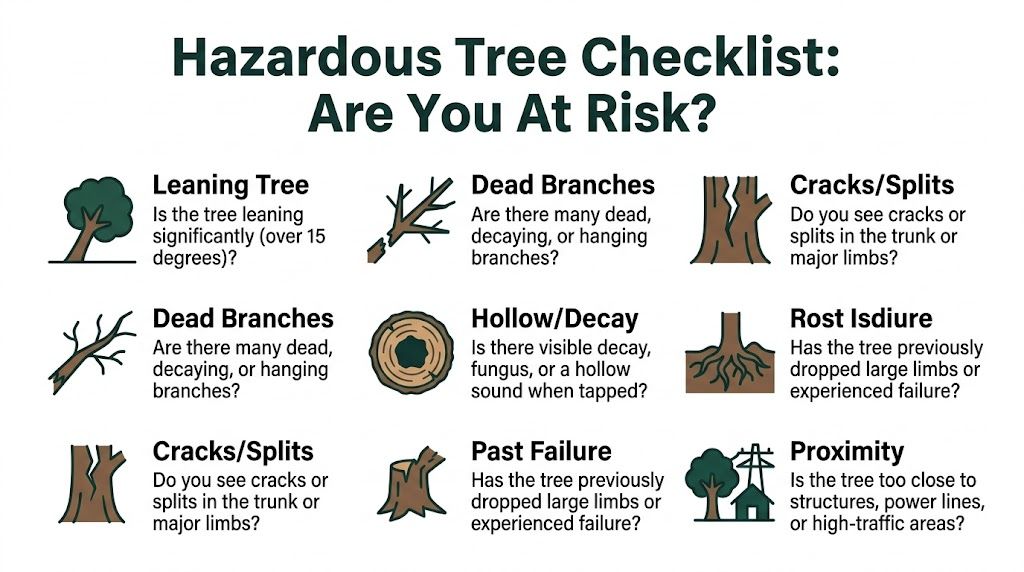
Leaning trunks and shifting root plates
Focus on change.
A tree with a long-standing natural lean may remain stable for years. A tree that recently shifted deserves immediate attention, especially if you see cracked soil, heaving roots, or a raised mound on the side opposite the lean. In the field, those signs often point to root plate movement, which means the failure process may already be underway.
For HOAs and commercial sites, this matters because root failure rarely gives much scheduling flexibility. Once movement starts, the decision often shifts from routine tree care to urgent risk reduction.
Cracks, splits, and weak trunk unions
Long vertical cracks in the trunk or scaffold limbs are serious defects. So are trunks with two large codominant stems joined by a tight V-shaped union with bark trapped inside the attachment.
I see these unions fail regularly in winter storms, especially on trees that carry long, heavy laterals over drive aisles, roofs, and pedestrian routes. One stem tears out, then the property owner is dealing with a larger wound, more canopy instability, and a more expensive removal than a pre-season correction would have cost.
A living tree can still present a high failure risk when the structure is compromised.
Dead wood and overextended branch ends
Dead limbs are common storm failures. Long branch tips with too much end weight are another problem, particularly where trees have been left to stretch over buildings, parked cars, sidewalks, and common areas.
The issue is not just appearance. It is load, stress, and target exposure. On managed properties, one failed limb can shut down spaces you need open, trigger tenant complaints, and create a chain of expenses that goes beyond the tree itself.
Decay, hollows, and fungal activity
A cavity does not automatically mean removal. The location, extent, and surrounding wood condition matter.
Pay close attention to these signs:
- Fungal growth near the base that may indicate internal decay or root problems
- Open cavities or hollow sections in the trunk or major limbs
- Soft or crumbly wood around wounds, old pruning cuts, or break points
- Bark separating from the trunk in areas where live tissue may be declining
On large eucalyptus and Monterey pine, internal decay can stay hidden until wind loads the canopy. At that point, property owners lose the cheaper options.
Past failures and nearby targets
Past limb loss is useful evidence. A tree that has already dropped a large branch may have unresolved structural defects, poor weight distribution, decay, or a bad site fit.
Then look at what the tree can hit. Risk is much higher over roofs, parking stalls, entry drives, play areas, service lanes, and public walkways than in an open part of the property. That target assessment is what separates a tree with defects from a tree that creates a real liability problem.
For a closer local reference, review this guide on warning signs before the next California wind event.
A practical checklist for owners and managers
Use this as a pre-storm screening list:
- Has the tree changed recently? New lean, fresh cracks, thinning canopy, or sudden deadwood matter more than old, stable conditions.
- Are roots showing signs of movement? Lifted soil, exposed roots, or mounding near the base raise concern fast.
- Is there a visible structural defect? Cracks, splits, cavities, and weak unions should be inspected promptly.
- Has the tree already failed once? Previous limb loss often points to a larger problem.
- What is the target below or nearby? The same defect carries a very different consequence over a parking lot than over unused ground.
- Can the issue be handled with pruning or support, or is removal more realistic? That decision affects both risk and cost, especially if storm demand drives up emergency pricing.
If you check more than one of those boxes, do not wait for the first major storm to answer the question for you.
High-Risk Tree Species and Site Conditions in Monterey County
Monterey County has its own mix of species, soils, and exposure patterns. A tree's risk profile in Salinas isn't exactly the same as one in inland heat, foothill wind, or a sheltered urban lot.
Some trees become problematic because of their natural growth habit. Others become risky because the site was never right for them in the first place.
Species that deserve closer attention
Eucalyptus often raises concern because mature trees can carry a lot of canopy mass and develop long, heavy limbs. On the right site and with proper management, some specimens remain stable for years. On the wrong site, especially near structures or where defects have been ignored, they can become poor storm candidates.
Monterey pine is another tree to watch closely in the local area. Pines can develop long lateral limbs, storm damage history, and hidden internal issues that don't always show clearly from a distance.
Oaks require a more careful discussion. Many are worth preserving when the structure is sound, but they need species-appropriate pruning timing and a realistic look at decay, root disturbance, and target area.
Site conditions often matter more than species
A well-structured tree in a good rooting environment can outperform a "better" species planted in a bad location. In Monterey County, these site issues come up repeatedly:
| Site condition | Why it matters |
|---|---|
| Poor drainage | Saturated soil can reduce root support during storms |
| Tight planting space | Restricted root growth can limit long-term stability |
| Slope or edge exposure | Wind loads increase and rooting can be uneven |
| Close proximity to buildings | Even a partial failure creates a high-consequence target |
| Past trenching or grade change | Root loss may not show up until weather stresses the tree |
When pruning makes sense and when it doesn't
Pruning is useful when the tree is structurally sound and the problem is branch weight, canopy density, dead wood, or developing structure. It can reduce loading and improve balance.
Cabling or bracing can help in select cases where the tree has value, the defect is limited, and the support system is appropriate for the structure involved. It is not a cure for advanced decay or failing roots.
Removal becomes the right call when the tree has a serious defect that pruning can't solve, when the target is high-value or high-occupancy, or when keeping the tree means accepting a level of risk that doesn't make sense. This local article on storm-safe tree planning is useful if you're weighing those choices.
If the defect is in the root system or lower trunk, canopy work won't fix the core problem.
For property managers, this matters because preserving a compromised tree can create a false sense of progress. The tree may look cleaner after pruning while the actual failure point remains untouched.
The Critical Decision When to Prune, Brace, or Remove
Most storm-season tree decisions come down to one question. Are you reducing risk enough to justify keeping the tree?
That answer changes based on structure, species, target area, and timing. A mature shade tree in open space can tolerate a different risk profile than a failing eucalyptus next to units, parking stalls, or a clubhouse.
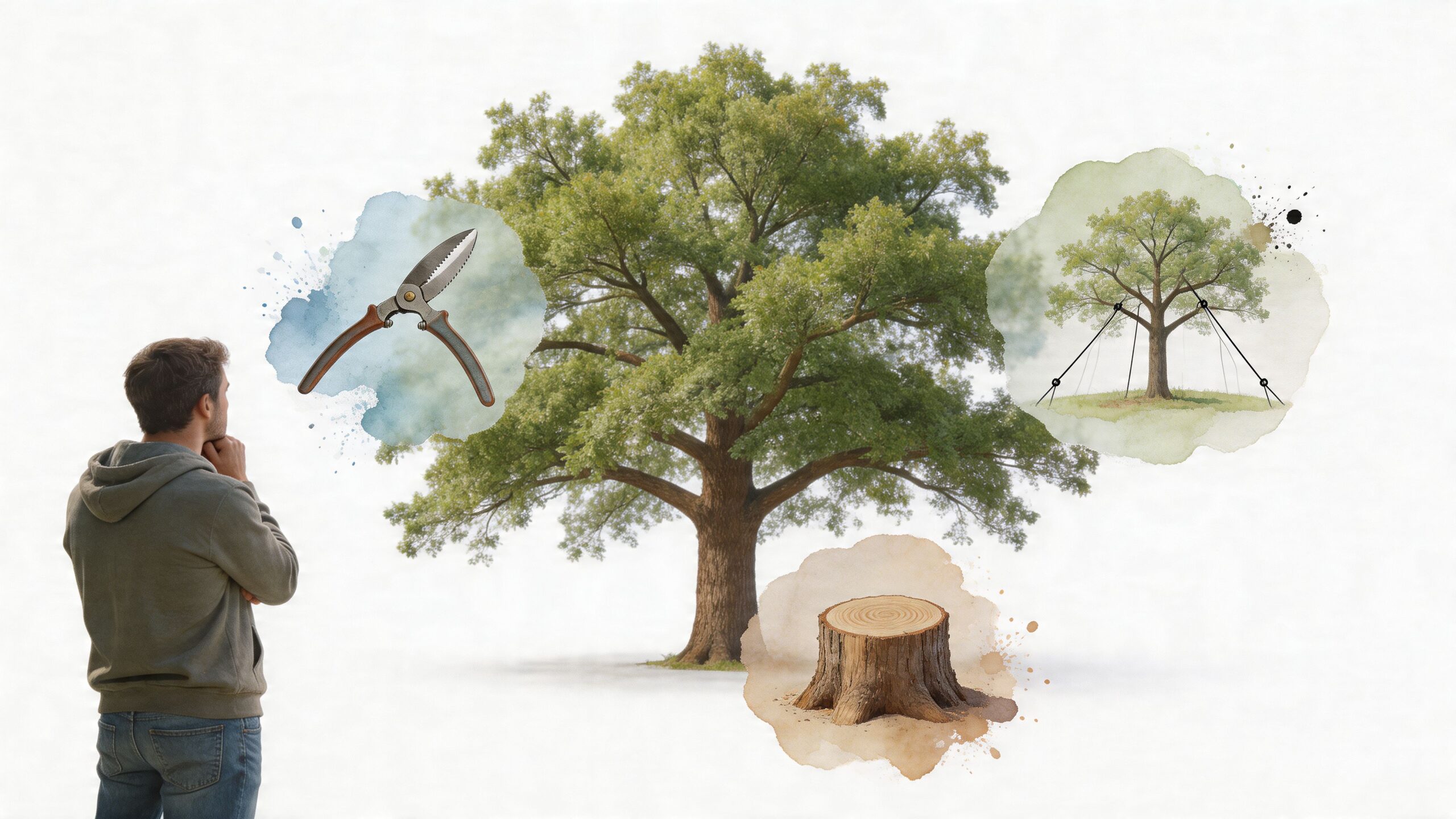
Choose pruning when the tree is sound enough to keep
Pruning works when the tree's main structure is still reliable and the risk comes from correctable canopy issues. Dead limbs, crossing branches, poor end-weight distribution, and dense growth are all examples.
For most California trees, the preferred pruning window is the dormant season in late winter to early spring, usually January through March, when trees are leafless and lighter, according to this guide on pruning for storm season preparation. It also notes that native oaks should be pruned during summer dormancy to reduce disease concerns.
That timing matters. Correct work at the right time can reduce stress and avoid pushing vulnerable new growth before harsh weather.
Use support systems only when the defect is limited
Bracing or cabling has a place, but it's often misunderstood. Support systems can help manage a weak union or reduce movement in a tree that still has good long-term value and acceptable root condition.
They don't reverse decay. They don't rebuild a failed root plate. They don't make a severely compromised tree safe just because hardware was added.
A simple comparison helps:
| Option | Best fit | Poor fit |
|---|---|---|
| Pruning | Dead wood, canopy imbalance, excess end-weight | Root failure, advanced trunk decay |
| Cabling or bracing | Limited structural weakness in an otherwise retainable tree | Severe lean, major decay, unstable roots |
| Removal | High-risk defects, high-value targets, poor long-term outlook | Trees with minor, manageable defects |
Remove when the defect controls the decision
If the base is compromised, the root system is failing, or the trunk has major structural loss, removal is usually the responsible recommendation. The same goes for trees with repeated failures over occupied areas.
Owners sometimes hesitate because the tree still provides shade, privacy, or visual screening. Those benefits are real, but they don't offset a known failure hazard over a roof, driveway, or common area.
Field judgment: If the consequence of failure is serious and the defect can't be corrected, removal is the safer plan.
For HOA boards and commercial managers, planned work is almost always easier to schedule, document, and control than an emergency response. If you're uncertain which side of the line your tree falls on, a formal evaluation matters more than guessing. A detailed local reference on tree risk assessment for residential properties can help frame that decision.
This is also the point where a licensed contractor with tree risk experience becomes important. California Tree Pros provides tree health assessments, permit assistance, pruning, removal, stump grinding, storm cleanup, and emergency response in Monterey County, which are the services most owners need when a tree shifts from an aesthetic element to a safety issue.
The Financial Case for Proactive Tree Management
A January wind event hits Monterey overnight. By 6:30 a.m., an HOA in Salinas has a failed pine across the entry drive, two damaged cars, and residents calling before the board has even met. At that point, the question is no longer what removal costs. The question is how expensive delay just became.
Tree decisions are budget decisions, especially for HOAs, retail centers, apartment complexes, and mixed-use properties where one failure can interrupt access, damage multiple assets, and create immediate liability concerns.
Compare planned cost to storm cost
The useful comparison is planned removal versus emergency response under bad conditions. Planned work happens with scheduling control, clear access, and time to get competing bids. Emergency work happens with blocked gates, wet ground, active weather, upset tenants or residents, and crews responding to multiple failures across the county.
For a commercial manager or HOA board, that difference shows up fast in the ledger. A proactive removal may be one approved project. A storm failure can mean after-hours response, traffic control, debris hauling, fence or roof repair, cleanup, temporary site restrictions, staff time, board communication, and an insurance claim that may still leave the deductible with the property.
I see this mistake often. Owners compare removal to zero. In practice, the decision is usually removal now versus a larger, less controllable bill later.
Owners often miss the full exposure
A fallen tree rarely creates one clean cost. It creates several costs at once, some insured, some not.
- Emergency crew rates during peak storm demand
- Damage to roofs, siding, vehicles, curbs, lighting, or fences
- Blocked access at drive aisles, fire lanes, entrances, or loading areas
- Resident and tenant disruption that pulls managers and boards into immediate response
- Cleanup and site repair after root lift, torn irrigation, or pavement damage
- Administrative time for incident reports, vendor coordination, insurance, and resident notices
For HOA properties in Monterey County, the blocked-access issue matters more than many boards expect. If one failed tree shuts the only entrance to a community or prevents service access to part of a property, the cost is not limited to tree work. It becomes an operations problem.
A Monterey County example
Here is the trade-off in plain terms. An HOA board in Monterey or Salinas may hesitate at a quoted removal price for a large tree leaning toward parking and a shared drive. If the inspection shows root failure, trunk decay, or repeated limb loss, keeping that tree is a financial gamble, not a savings decision.
If it fails during a storm, the property may face emergency removal, vehicle claims, access issues, temporary safety measures, and pressure from residents who want answers that morning. Even if insurance pays part of the loss, the board still deals with deductibles, claim history, vendor coordination, and delayed repairs. Planned removal usually costs less because the work is controlled. Emergency failure costs more because every part of the response is compressed and urgent.
Better records lead to better decisions
On larger properties, poor documentation is expensive. One manager labels a tree "watch," another budgets for pruning, and the board assumes the issue can wait another winter. That is how known hazards stay in place too long.
A structured estimating and documentation process helps boards and managers compare pruning, cabling, and removal on the same basis across the whole property. Tools such as Exayard landscaping estimating software can help organize scope, pricing, and multi-site planning so tree work is reviewed as part of annual risk control, not only after a failure.
Planned tree work gives owners time to review options, line up access, document the reason for the work, and control costs before a storm controls them.
For a single-family owner, the numbers are smaller but the logic is the same. If a tree already presents a credible target risk over a roof, driveway, or occupied area, waiting for storm season usually increases cost, not value.
Navigating Tree Removal Permits and Insurance in California
Even when removal is the right safety decision, property owners still need to handle the paperwork side correctly. That usually means checking local permit rules and understanding what insurance may or may not cover.
Permit requirements can vary by city, county, species, and tree size. A tree that can be removed on one property may require review on another.
Permit rules are local, not one-size-fits-all
In Monterey County, you should verify requirements with the local jurisdiction before scheduling removal or major pruning. That may involve the City of Salinas, another city authority, or county rules depending on where the property sits.
Protected trees, heritage trees, and trees in regulated zones often involve a review process. That's one reason permit assistance matters. It helps owners avoid doing urgent work the wrong way and dealing with enforcement later.
A good contractor should be able to explain the practical side of the process, including whether the tree appears likely to need documentation, photos, arborist input, or municipal review before work begins.
Insurance usually focuses on damage, not preventive work
A common misunderstanding is that insurance will pay to remove a hazardous standing tree because it looks risky. Coverage usually centers on resulting damage after a failure, subject to the policy terms and claim facts.
If you're trying to understand the general issue, this guide on when homeowners insurance covers fallen trees is a useful starting point. It helps illustrate why waiting for failure can leave owners dealing with coverage limits, deductibles, and uncovered preventive costs they assumed would be reimbursed.
Vet the contractor before the crew shows up
Before any tree removal starts, confirm that the company handling the work is set up for this type of risk. Check for:
- Valid California licensing for the work being performed
- Workers' compensation coverage so labor risk isn't pushed back onto the owner
- Liability insurance appropriate for tree operations
- Experience with permits and documentation when local rules apply
- Emergency readiness if conditions change or hidden defects appear during the job
Paperwork doesn't remove risk by itself. It does prevent avoidable administrative problems while you're already dealing with a hazardous tree.
Hiring a Licensed and Insured Tree Professional
Tree removal near homes, parked cars, fences, access roads, or shared-use spaces isn't general yard work. It's technical work with real consequence if the crew misjudges rigging, cutting sequence, drop zones, or structural condition.
That's why the hiring standard should be higher than "someone with a saw and a trailer."
What to ask before approving the work
Ask for the contractor's California license number. Ask whether they carry workers' compensation and liability coverage. Ask who is evaluating the tree and whether the crew is equipped for confined removals, storm-damaged wood, and properties with target exposure.
If the answer is vague, keep looking.
The contractor should also be comfortable explaining whether the tree looks like a pruning candidate, a support-system candidate, or a removal candidate. If every tree gets the same recommendation, that usually tells you more about the sales approach than the tree.
What separates a real tree contractor from a casual operator
Hazardous tree work often requires more than climbing and cutting. It may involve controlled rigging, traffic control coordination, stump grinding, debris handling, permit support, or emergency stabilization after partial failure.
The wrong operator may leave a half-finished hazard on site, damage the remaining grounds, or expose the property owner to insurance problems. That's especially risky on HOA and commercial properties where documentation and safety procedures matter.
Credentials matter because storm work leaves no margin
California Tree Pros operates under California Contractor License #1107800 and serves Salinas and Monterey County with tree removal, pruning, tree health assessments, storm cleanup, emergency response, stump grinding, and permit assistance. For owners, that kind of structure matters because storm-season decisions often need both field judgment and administrative follow-through.
When a tree is near a structure or common area, hire for risk control, not convenience.
A qualified tree professional should leave you with a clear explanation of the defect, the reasonable options, and the likely consequence of doing nothing. That's the standard property owners should expect.
Frequently Asked Questions About Storm Season Tree Safety
How do I know if I should remove a tree before storm season or just prune it?
If the problem is dead wood, excess end-weight, or canopy density, pruning may be enough. If the tree has root instability, major decay, a serious lean, or a structurally compromised trunk, removal is often the safer option. The decision should be based on the defect and what the tree could hit if it fails.
What's the best time to deal with a risky tree in Monterey County?
Before the winter storm pattern ramps up. Waiting until heavy rain and wind arrive usually means fewer scheduling options and more pressure to make a quick decision under bad conditions.
Can a healthy-looking tree still fail in a storm?
Yes. A tree can look green and full while still having decay, weak unions, root damage, or hidden structural loss. Appearance from the street isn't a reliable safety assessment.
Do HOA boards need to think about this differently than homeowners?
Yes. HOAs and commercial properties usually have more targets, more people on site, and more documentation needs. A tree over parking, sidewalks, units, or common areas should be evaluated with liability and access in mind, not just appearance.
Will insurance pay to remove a tree before it falls?
Usually, owners shouldn't assume that. Insurance often focuses on damage after a tree fails, not preventive removal of a standing hazard. Review your policy and ask questions before relying on coverage.
Is it safe to remove a storm-damaged tree myself?
Not if the tree is large, split, hung up, leaning, or near structures or utilities. Storm-damaged trees store unpredictable tension and compression, and those failures can happen fast during cutting.
Get a Professional Tree Assessment Before the Next Storm
If you're still asking should i remove a tree before storm season in california?, the safest answer is to base that decision on an actual risk assessment, not on guesswork. Deciding whether you should remove a tree before storm season in California is a job for experts who can evaluate structure, targets, and local permit requirements.
If you want a practical assessment of a tree on your property, contact California Landscape & Tree Pros for a consultation or estimate. Call (831) 998-7964 in Salinas or (831) 905-8018 in Monterey, or visit 1184 Monroe St., Suite 6, Salinas, CA 93906.