
Direct Answer: Over-pruning removes too much live canopy at once, stressing the tree and leaving it vulnerable to disease, pests, and structural failure. Common signs include lion-tailing, excessive water sprouts, and sunscald on exposed bark.
Most property owners assume that more pruning equals a healthier tree. But in Monterey County, one of the most common forms of tree damage isn’t storm damage or disease — it’s bad pruning by crews who cut too much, too fast, without understanding what the tree actually needs.
Over-pruning is a real problem here. The region’s mix of coastal oaks, eucalyptus, Monterey pines, and ornamental palms all respond differently to cuts, and what looks like a “clean job” to an untrained eye can quietly set a tree up for decline over the next two to five years.
This article covers the specific signs that a tree has been cut too hard, what that damage actually does to the tree’s biology, and how to tell whether your current maintenance approach is helping or hurting.
What Over-Pruning Actually Does to a Tree
A tree produces food through its leaves. When too much of the canopy is removed at once, the tree loses its ability to photosynthesize enough energy to sustain itself. As a result, it goes into survival mode — pulling stored energy reserves from the trunk and roots just to stay alive.
Most arborists and tree care professionals use the 25% rule as a general ceiling: removing more than 25% of a tree’s live canopy in a single pruning cycle puts it under significant stress. Some species, particularly Monterey pines and coastal live oaks, tolerate even less than that without showing signs of decline.
The damage isn’t always immediate. A tree that was over-pruned this spring may not show obvious symptoms until late summer or the following year. That delayed response is part of what makes it easy to miss — and part of why unqualified crews get away with it for so long before the property owner realizes something is wrong.
For more context on species-specific timing, When to Prune: A Monterey County Guide breaks down the seasonal windows that matter most in this region.
The Most Visible Signs Your Tree Is Being Cut Too Hard
Some of these signs show up within weeks of a bad pruning job. Others develop slowly over a full growing season. Either way, they’re worth knowing.
Lion-tailing is one of the most obvious. This is when a crew removes all the interior and lower branches, leaving foliage only at the tips — like a lion’s tail. The result is a top-heavy canopy with no interior structure to distribute wind load. Trees pruned this way are dramatically more likely to fail in a storm. Given how hard the Salinas Valley and Monterey Peninsula get hit during winter atmospheric rivers, this is a serious structural risk, not just an aesthetic one.
Water sprouts are another tell. These are thin, fast-growing vertical shoots that erupt from the trunk or major limbs after heavy cutting. The tree is essentially panicking, trying to regrow photosynthetic surface area as fast as it can. A few water sprouts are normal. Dozens of them clustered on main scaffold branches mean the tree was cut way too hard.
Other signs to look for:
- Sunscald or bark cracking on limbs that were previously shaded but are now exposed
- Dieback at branch tips — twigs dying back from the ends inward
- Yellowing or early leaf drop, especially mid-season when the tree should be at full leaf
- Unusual pest activity, particularly bark beetles targeting a stressed tree
- A canopy that looks sparse and thin compared to neighboring trees of the same species
If you’re seeing two or more of these signs together, the pruning likely crossed a line — and the tree will need time and careful management to recover.
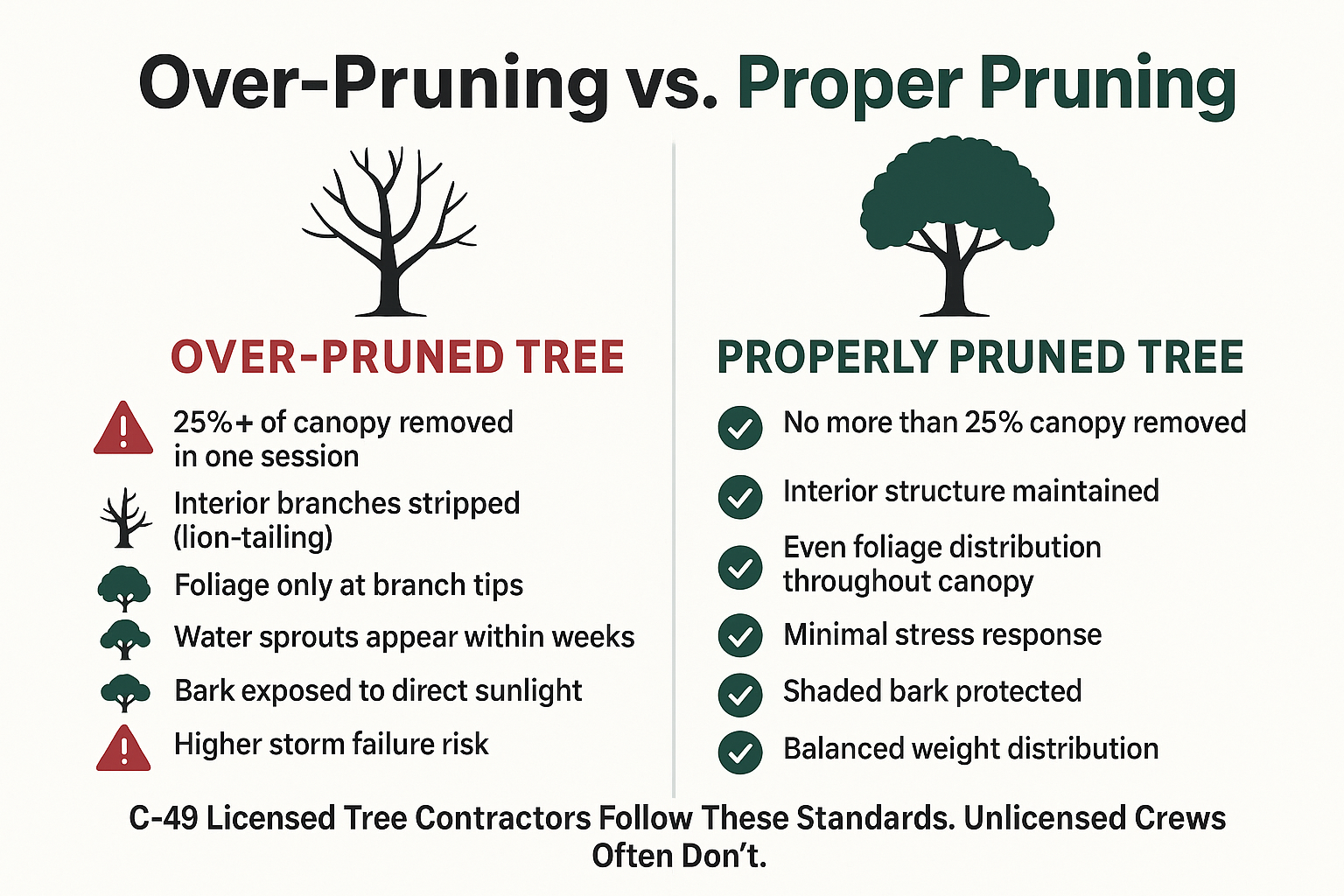
Over-Pruning vs. Proper Pruning: What the Difference Looks Like
This comparison shows the key differences between a properly pruned tree and one that has been cut too hard — from canopy structure to long-term outcome.
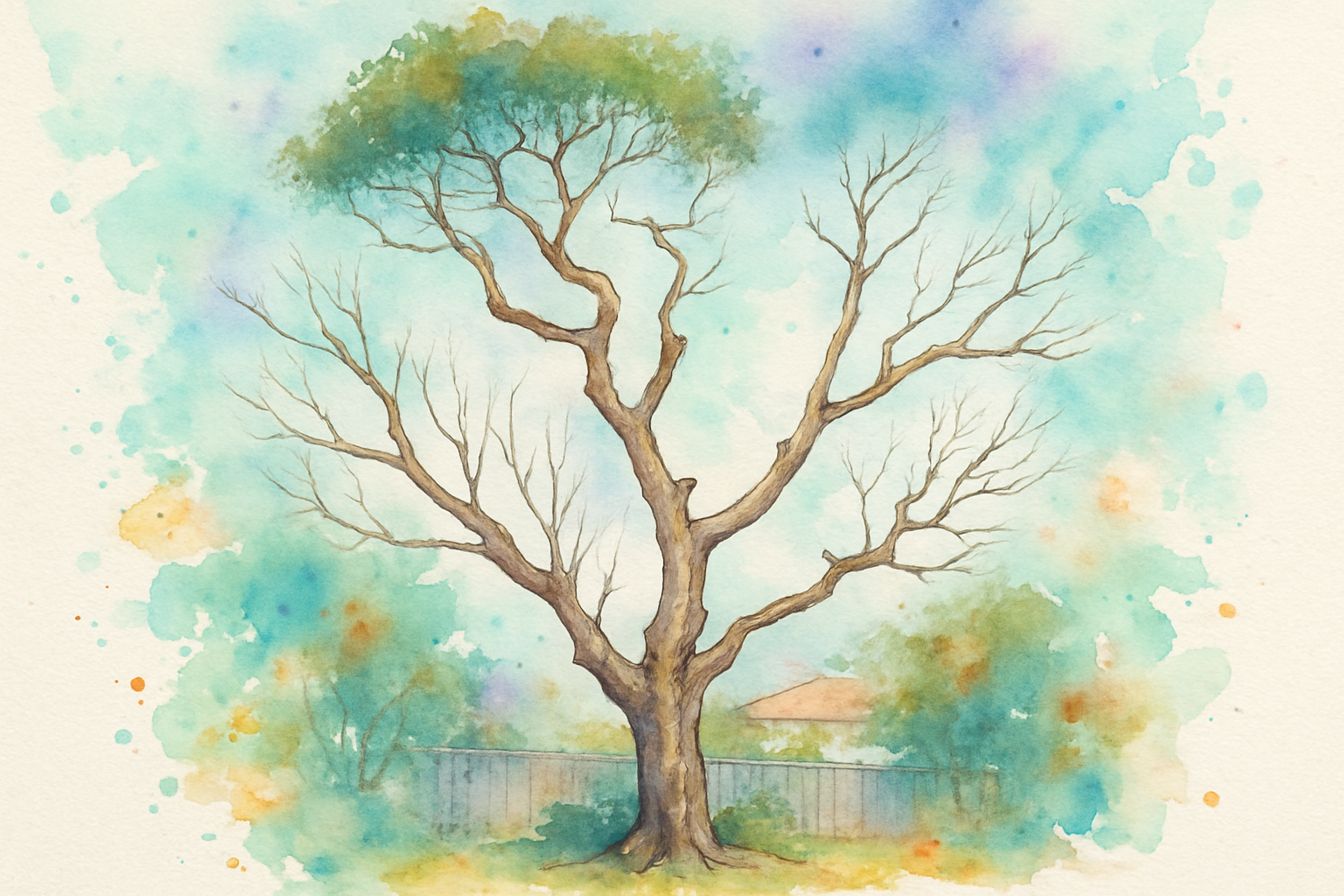
The Lion-Tailing Problem Is Especially Common Here
Lion-tailing isn’t just sloppy work — it’s a specific technique that some crews use intentionally because it looks dramatic, moves fast, and makes clients think a lot of work was done. In reality, it’s one of the most damaging things you can do to a mature tree.
In Monterey County, this practice shows up frequently on eucalyptus trees, which are already prone to brittle limb failure under the best conditions. A lion-tailed eucalyptus near a structure is a genuine liability. The same applies to the valley oaks and blue oaks found on properties throughout the Salinas Valley — heavy cuts to these slow-growing species can set them back by years.
A C-49 licensed tree contractor understands how to remove weight from a canopy without stripping its interior. That typically means lateral reduction cuts — shortening branch ends back to a healthy lateral rather than removing whole limbs — combined with careful thinning that opens airflow without gutting the tree’s structure.
How often do trees in Monterey County actually need trimming? covers the right maintenance intervals for common local species — which is just as important as the method itself.
How Common Species in Monterey County Respond to Heavy Pruning
Different trees tolerate pruning differently. Here’s a general guide to how common local species respond when cut too hard.
| Tree Species | Tolerance for Heavy Cuts | Common Over-Pruning Symptom |
|---|---|---|
| Coastal Live Oak | Low — slow to recover | Dieback, increased disease susceptibility |
| Monterey Pine | Low — can trigger beetle attack | Bark beetle entry, rapid decline |
| Eucalyptus | Moderate — regrows fast but weakly | Epicormic sprouts, brittle regrowth |
| Valley Oak | Low — very slow-growing | Years of reduced vigor, tip dieback |
| Canary Island Palm | Moderate — but over-trimming causes frond stress | Pencil-pointing, nutrient deficiency |
| Ornamental Plum/Cherry | Moderate | Water sprouts, increased pest pressure |
When Pruning Damage Becomes a Safety and Liability Issue
A stressed tree doesn’t just look bad — it becomes a structural risk. Limb failure is significantly more likely in trees that have been lion-tailed, topped, or stripped of more than a third of their canopy. And on a property in Carmel, Pacific Grove, or Pebble Beach where mature trees are both valuable assets and potential hazards over structures and walkways, that risk has real financial consequences.
Homeowners in Monterey County should also know that storm cleanup from a failed tree limb is far more expensive than the original pruning job. Depending on access and debris volume, emergency response work after a storm can run $1,500 to $6,000 or more — and most of that cost is avoidable with a proper pruning program from the start.
If a tree has already been severely over-pruned, the recovery path typically involves:
- Allowing two to three full growing seasons without additional major cuts
- Removing only dead wood, crossing branches, or hazard limbs during the recovery window
- Monitoring water sprouts and selectively thinning them rather than removing them all at once
- Consulting a licensed tree contractor to assess whether structural integrity has been compromised
For trees near structures or rooflines, a professional assessment before storm season is worth doing. Should I remove a tree before storm season in California? walks through the decision framework for trees that may already be at risk.
How to Tell If Your Current Crew Is Doing It Right
Not all pruning damage is obvious from the ground, and most property owners aren’t in a position to climb a tree and evaluate cut placement. But there are things you can watch for from a distance.
A licensed tree contractor should be able to explain why each cut is being made — not just point at a branch and say it needs to go. Ask them what percentage of the canopy they plan to remove. A professional should answer that question without hesitation.
Also watch for these red flags before any work starts:
- The crew carries no proof of a C-49 license or dismisses the question
- They quote a flat price based on “how many truckloads” rather than scope of work
- They suggest topping a tree to reduce its height — a practice condemned by every credible tree care standard
- They can’t describe a specific plan for where cuts will be made and why
For commercial properties and HOA communities in Monterey County, this kind of vetting matters even more. A single bad pruning decision on a shared property can affect dozens of trees and generate liability exposure that outlasts the original contract. What’s actually included in a commercial landscaping contract? is worth reading before renewing any maintenance agreement.
Frequently Asked Questions About Over-Pruning Trees
Can a tree recover from being over-pruned?
Yes, in most cases — but recovery takes time and depends on how severe the cuts were and the health of the tree before pruning. A tree that lost 30–40% of its canopy in one session may take two to three growing seasons to stabilize. During that window, it’s more vulnerable to pests, drought stress, and disease, so it needs to be left alone except for removal of dead or hazard wood.
What is tree topping and why is it harmful?
Topping is the removal of large upper branches or the entire top of a tree to reduce height. It’s one of the most damaging cuts possible — it leaves large wounds that don’t heal cleanly, triggers explosive but structurally weak regrowth, and dramatically shortens the life of the tree. No credible tree care standard endorses topping. If a crew suggests it as a routine option, that’s a reason to stop the conversation and get a second opinion.
How do I know if my tree was lion-tailed?
Look at the branch structure after a pruning job. If all the foliage is clustered at the outer tips — and the inner branches are stripped bare — that’s lion-tailing. A properly pruned tree should have foliage distributed through the canopy, not just at the ends. If it looks like a handful of green pom-poms on long bare sticks, the tree was cut too hard.
Does Monterey County have any rules about how much can be pruned from a tree?
Monterey County and several municipalities within it — including the City of Salinas and jurisdictions along the Monterey Peninsula — have tree ordinances that regulate work on protected and heritage trees. Some street trees require a permit before any pruning occurs. Removing a protected tree without a permit can result in fines and required replacement. A licensed contractor familiar with the local permit process will flag these requirements before any work starts.
Are water sprouts a sign of a dying tree?
Not necessarily a dying tree — but a stressed one. Water sprouts are the tree’s emergency response to losing too much canopy. They’re structurally weak and don’t replace the branches that were removed. A few scattered sprouts aren’t alarming. But dense clusters of them on main scaffold branches after a pruning job are a clear signal that too much was taken at once.
How often should trees in Monterey County be pruned to avoid over-pruning?
It depends on the species and the goal, but most mature trees in this region don’t need annual pruning. Every two to four years is more typical for maintenance pruning on established trees, with annual checks for dead wood or storm hazards. Pruning too frequently — even with light cuts — can accumulate into over-pruning over time. How often do trees in Monterey County actually need trimming? covers species-specific intervals in more detail.
Want a Second Opinion on Your Trees?
If your trees are showing signs of stress after a recent pruning job — or you’re not sure what your current crew is actually doing — California Landscape & Tree Pros holds both a C-49 Tree and Palm Contractor license and a C-27 Landscaping Contractor license, and serves residential and commercial properties throughout Monterey County and the Central Coast. Reach the Salinas office at 831-998-7964, the Monterey line at 831-905-8018, or request a free quote at californialandscapeandtreepros.com/request-a-quote/.