
California’s recent weather extremes, from heavy rains to high winds, have made tree safety a top concern for homeowners. To truly protect your property, you need to think beyond post-storm cleanup and embrace a prevention-first approach. Proactive care, like annual inspections and strategic pruning, can identify risks and strengthen your landscape long before a storm arrives, saving you from costly and dangerous damage.
Why Proactive Tree Care is Your Best Defense in California
Between atmospheric rivers and fierce wind events, California's weather is anything but predictable. Waiting until a storm is bearing down on you is a high-stakes gamble. Many homeowners get caught in a reactive cycle, only calling for help after a massive limb has punched a hole in their roof or a whole tree has come crashing down. That frantic, post-storm scramble is not only stressful, but it's also vastly more expensive than preventative care.
The secret to a truly storm-proof property is shifting your mindset from reaction to prevention. It's about building a landscape that's resilient by design. Tree care isn't just about aesthetics; it's a fundamental part of keeping your home and family safe.
The True Cost of Neglecting Your Trees
It’s easy to ignore a leaning tree or an overgrown canopy, but the financial and safety risks are very real. Across California, state safety data shows that falling trees and limbs are among the top causes of storm-related property damage each year, particularly in areas with mature or overgrown trees.
The good news? Statistics show that homeowners who perform annual pruning and inspections reduce their storm-related costs by up to 40%. That number tells a simple story: investing in proactive care now pays for itself by preventing a disaster later.
A Prevention-First Philosophy
At California Landscape & Tree Pros, we take a comprehensive, prevention-first approach to tree and property safety. Instead of just showing up for disaster cleanup, our certified teams use advanced assessment techniques to spot weaknesses before they turn into emergencies.
Our proactive approach includes:
- Advanced Assessments: We identify weak limbs, check for root instability, and spot overgrowth near structures before it becomes a hazard.
- Strategic Pruning: Beyond simple trimming, we emphasize structural pruning to thin canopies, allowing wind to pass through safely and removing branches that pose a clear danger.
- Cabling and Bracing: For valuable trees with structural issues, we can install support systems to strengthen them against severe weather.
- Drainage Planning: We look at how water moves around your property. Clearing debris from drainage areas improves stormwater flow and prevents soil erosion that can destabilize a tree's root system.
This approach not only protects your property but also extends the life and health of your trees. You can explore additional strategies to weatherproof your landscape in our comprehensive guide. By taking these steps, homeowners in Monterey County, Salinas, Seaside, and nearby communities can protect their property before the next storm season arrives.
Your Pre-Storm Tree Inspection Checklist
You don't have to be a certified arborist to spot trouble brewing in your trees. Homeowners should schedule annual tree inspections—especially before winter—to detect early signs of decay, fungal growth, or leaning. Think of it as a health check-up for your landscape; catching a problem before a storm can mean the difference between minor cleanup and major disaster.
Taking a proactive stance makes all the difference. Waiting until after the storm hits is a recipe for stress and expensive, emergency repairs. The flowchart below really drives this point home.
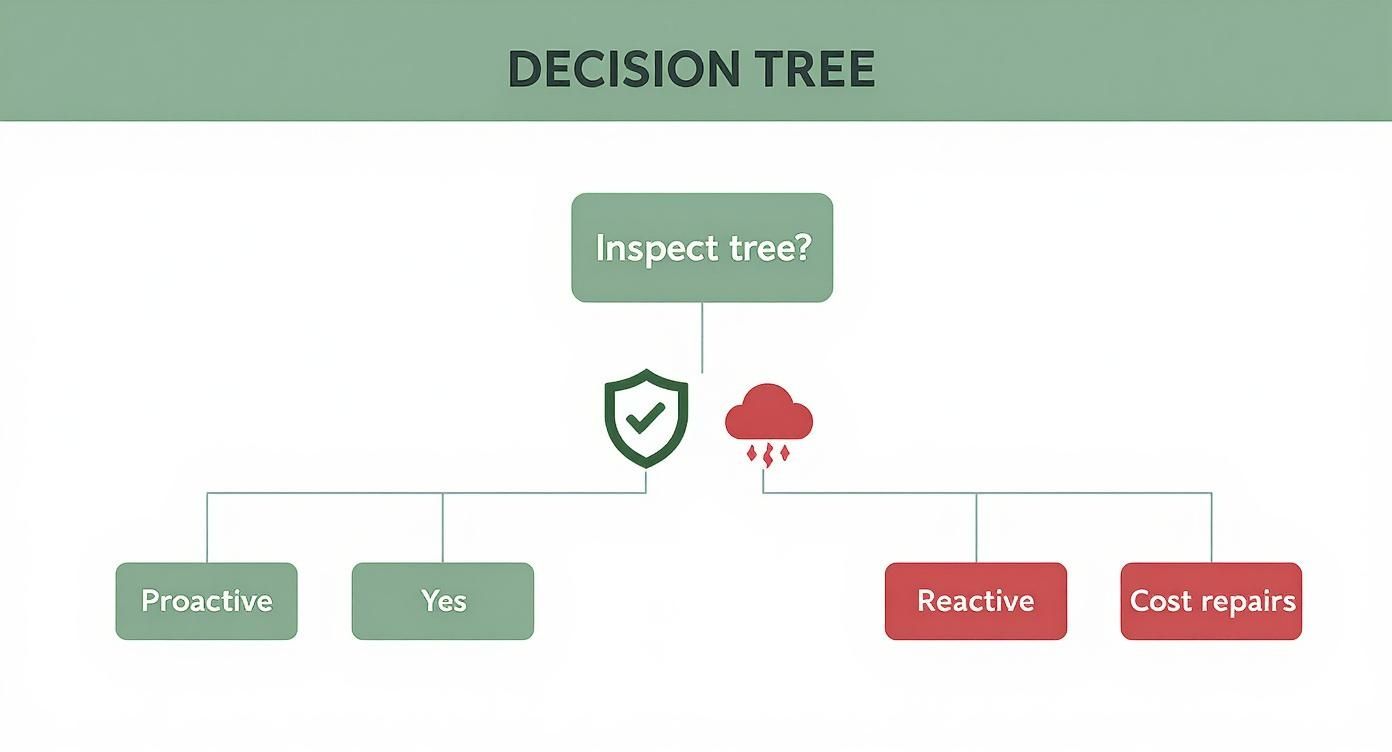
As you can see, a little bit of inspection now brings peace of mind later. Ignoring your trees? That's when things get costly.
What To Look For: A Ground-Up Approach
Your inspection should always start at the base of the tree and work its way up. A tree is only as strong as its foundation, and problems in the root zone are a serious red flag.
Here's what to keep an eye on:
- Fungal Growth: See mushrooms popping up on the trunk or around the roots? That’s often a telltale sign of internal decay.
- Cracks or Cavities: Obvious cracks compromise the tree's structural integrity. Big hollow spots are just as bad, pointing to rot deep inside the trunk.
- Heaving Soil: If the ground around the base looks like it's being pushed up or has developed cracks, the roots might be failing. The tree could already be in the process of uprooting.
Also, look for any sudden or dramatic lean. While some trees grow at an angle, a new lean, especially after heavy rain, is a major warning that the tree is unstable.
Examining The Trunk And Major Limbs
Next, move your focus up to the tree's main structure. The trunk and its largest branches take the brunt of the force from high winds, so their condition is critical.
Be on the lookout for:
- Deadwood: These are branches with no leaves (during the growing season), peeling bark, or a brittle appearance. Arborists call them "widow-makers" for a good reason—they can snap and fall without warning.
- Deep Cracks: Pay close attention to deep splits in the major limbs, particularly where they attach to the trunk. These are natural failure points.
- Included Bark: When two or more trunks grow together in a tight "V" shape, the connection is inherently weak and prone to splitting apart during a storm.
This isn't just theoretical. During the atmospheric rivers of 2023, winds gusting up to 90 mph brought down thousands of trees across the Monterey Bay and Santa Cruz mountains, causing massive property damage.
Assessing The Canopy And Overall Vigor
Finally, take a few steps back and look at the tree as a whole. The canopy—the upper leafy part of the tree—can tell you a lot about its overall health.
Notice if the canopy seems unusually thin, with sparse leaves or a lot of dead twigs at the top. This can indicate disease, pest issues, or even root damage. Also, is the tree’s growth lopsided? A tree that's heavily weighted to one side is unbalanced and more likely to topple in high winds. The right kind of pruning can often correct this.
To make this easier, I've put together a quick reference table to help you spot and prioritize these common issues.
Tree Hazard Identification Guide
| Hazard Sign | What It Looks Like | Risk Level | Recommended Action |
|---|---|---|---|
| Mushrooms at Base | Fungal growths on or near the trunk/roots. | High | Immediate professional assessment. Indicates root/butt rot. |
| Heaving Soil | Cracked or mounded soil around the tree's base. | High | Call a certified arborist immediately. The tree may be unstable. |
| Dead Branches | Brittle, leafless limbs with peeling bark. | Moderate to High | Have them professionally removed, especially if over a target. |
| Deep Trunk Cracks | Splits that penetrate the bark into the wood. | High | Urgent consultation with an arborist is needed. |
| Sudden Lean | A new or increased lean, especially after rain. | High | This is an emergency. Contact an arborist right away. |
| Thinning Canopy | Sparse leaves, dieback at the top of the tree. | Low to Moderate | Monitor and consult an arborist for a health diagnosis. |
This table is a great starting point, but remember that some problems aren't visible to the untrained eye. If your inspection turns up any of these warning signs, the next step is to get a professional opinion.
A certified arborist can give you a detailed assessment and might suggest solutions like corrective pruning or cabling to make a tree safe. For certain situations, especially in areas with specific local rules, you might need to navigate Monterey County tree health reports and permits, which is something a professional can also guide you through.
Strategic Pruning to Boost Storm Resilience
Once you’ve walked your property and identified potential trouble spots, it’s time to take action. This is where a skilled arborist’s work goes way beyond simple trimming. We're talking about strategic pruning—a critical step in building a landscape that can stand up to California's wild weather.
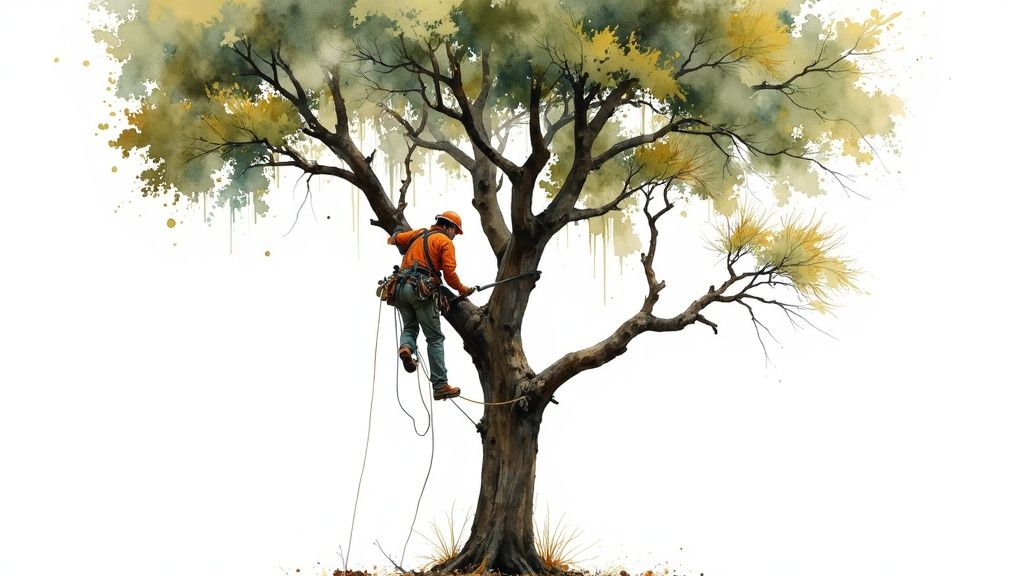
The goal here isn't just about making your trees look neat. It's about fundamentally improving their structure to reduce the sheer force they have to endure when a storm rolls in.
Reducing the "Sail Effect" with Crown Thinning
One of the best techniques in an arborist's toolkit is crown thinning. Think of a tree with a really dense, thick canopy. When a powerful gust of wind slams into it, that wall of leaves and branches acts like a giant sail, catching the full force and putting immense stress on the trunk and roots. That’s often what leads to a tree coming down.
Crown thinning is the art of selectively removing specific interior branches to open up that canopy. It doesn't really change the tree's overall size or shape, but it creates channels that allow wind to flow through the tree instead of pushing against it. The difference is huge. You’re drastically reducing the mechanical stress that can snap major limbs or even topple the whole tree.
But this is a precise science, not a job for a hedge trimmer. Proper crown thinning requires a deep understanding of tree biology. Taking out the wrong branches—or too many—can cause more harm than good.
Pruning for Safety and Structural Strength
Beyond managing wind, strategic pruning is all about addressing other critical safety issues. First up is getting rid of any dead, dying, or broken branches. We call them "widow-makers" for a reason, and they’re almost guaranteed to be the first things to fail in a storm.
A professional arborist will also focus on a few other key areas:
- Raising the Crown: This just means removing lower branches to create safe clearance over your roof, driveway, or backyard patio.
- Structural Pruning: For younger trees, this is crucial. It’s about correcting problems like co-dominant stems—those weak, "V-shaped" forks—and guiding the tree to develop a stronger, more resilient structure as it grows.
- Weight Reduction: Got a long, heavy limb hanging over your house? An arborist can selectively prune it to reduce the weight at the end, making it far less likely to break under its own weight, especially when it's soaked with rain.
We see it time and again: professional pruning is one of the most effective storm-proofing measures a homeowner can take. By thinning the canopy and removing hazardous branches, you dramatically lower a tree's wind resistance and reduce the forces that cause catastrophic failure during California's high-wind events.
When Pruning Isn’t Enough: Cabling and Bracing
Sometimes, you have a beautiful, mature tree with a structural flaw that pruning alone can't solve. But that doesn't automatically mean it has to come down. In many cases, we can use advanced techniques like cabling and bracing to preserve the tree while protecting your property.
- Cabling: We install high-strength steel cables in the upper canopy to support weak limbs or branches with poor attachments. These cables help redistribute the stress from high winds across the tree’s entire structure, so no single point takes the full hit.
- Bracing: For split limbs or trunks, we can install threaded steel rods directly through the weakened area. This provides rigid support and stops the crack from spreading further.
These are highly technical solutions that absolutely must be done by a qualified arborist. When installed correctly, they can add decades to the life of a cherished tree, turning a potential liability back into a beautiful, safe asset.
If you're in Monterey County, exploring professional tree pruning and removal services is a great way to get a clear picture of what solutions might be right for your property’s unique trees and challenges.
When Tree Removal is the Safest Option
It’s tough to part with a mature tree, but sometimes it’s the only responsible call. While we can often save trees with careful pruning and support systems, there comes a point when a tree becomes more of a liability than an asset, especially with the wild weather we get in California. Knowing when to make that hard decision is a crucial part of keeping your home and family safe.
A tree's health can decline slowly over years, but a single storm can push it over the edge. This is especially true for trees already stressed by drought or fire. Wildfires have recently scorched over 1.73 million acres of California's forests, leaving behind countless trees with burned trunks and damaged root systems. These weakened trees are just waiting for a storm to bring them down. You can read more about the connection between fires and tree risk on WRI.org.
Definitive Signs a Tree Must Be Removed
Some problems just can't be fixed with a trim or a cable. If you spot any of these red flags, it's time to get a certified arborist on the phone to talk about removal.
- Advanced Decay: Take a close look at the base and trunk. If you see large cavities, mushroom-like fungal growth, or wood that’s soft and crumbly, and it covers more than 50% of the tree's circumference, its internal structure is failing.
- Major Root Damage: Was there recent construction or trenching near the tree? Has soil eroded away from the base? Severed roots mean a weak anchor. If you see the ground heaving or cracking around the base, that’s a tell-tale sign the roots are letting go.
- A Severe and Worsening Lean: Lots of trees have a natural lean and are perfectly stable. The danger sign is a change. A tree that suddenly starts leaning, or an old lean that’s getting more dramatic, is a serious threat, particularly if it's leaning toward your house or power lines.
A dead or dying tree is not just an eyesore; it's a liability. Dead trees are brittle and unpredictable. They lose all their flexibility and can snap or uproot in winds that a healthy tree would easily withstand, making them one of the most urgent hazards you can have on your property.
Why DIY Tree Removal Is a Dangerous Gamble
Let’s be blunt: trying to take down a large tree yourself is one of the most dangerous things you can do as a homeowner. It might look straightforward on YouTube, but professionals rely on years of training, specialized rigging, and heavy equipment to control the fall of something that weighs several tons. The risk of getting it wrong is just too high—from a limb crashing through your roof to a life-altering injury.
This is a job for a licensed, insured, and experienced tree service, period. They have the expertise to handle the job safely and are also well-versed in local regulations. Many California cities have ordinances that protect certain trees, and you often need a permit for removal. A true professional handles all of that for you.
Navigating Local Permit Requirements
Here in Monterey County and across the Bay Area, local rules often determine which trees can be removed and the proper process to follow. A certified arborist will know these ordinances inside and out. They can assess your tree, handle the permit application, and ensure all the work is done by the book.
After the tree is safely on the ground, the job isn't quite finished. Professional stump grinding and lot clearing are the final steps to fully reclaim your yard and make it safe. You can discover more about stump grinding and lot clearing services that help restore your landscape.
Navigating the Aftermath of a Storm
The storm has passed, and the quiet that follows can be unsettling. When you step outside, the scene might be overwhelming—a landscape of downed branches, scattered debris, and maybe even a tree that didn't make it. Knowing what to do in those first critical hours is key to keeping everyone safe and starting the recovery process on the right foot.
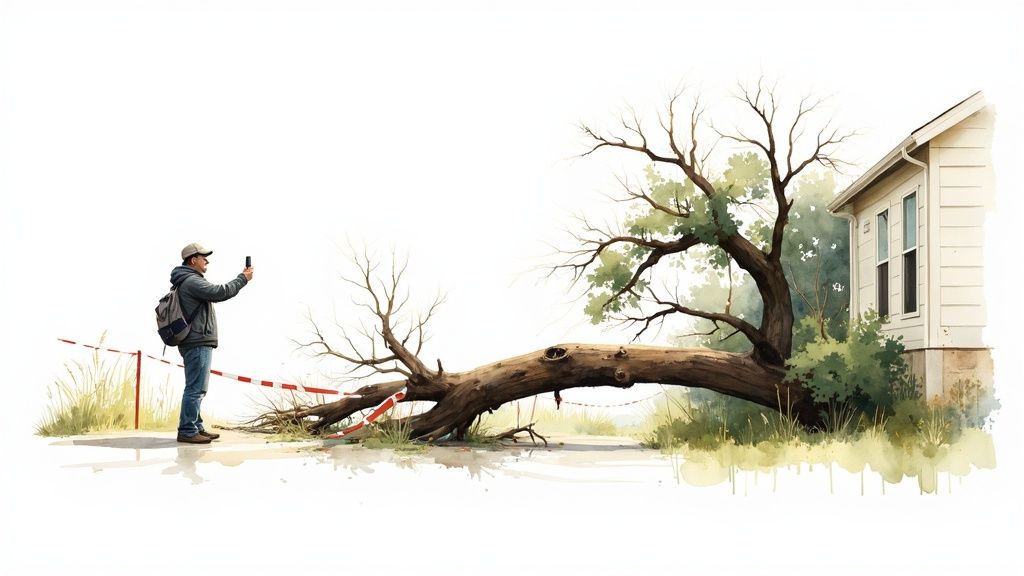
Before you even think about picking up a single leaf, your absolute first priority is safety. Storms leave behind hidden dangers that aren't always immediately obvious.
Safety First: Assess Your Property Carefully
Start with a slow, careful look at your property from a safe distance. The biggest threat? Fallen power lines. Treat every single downed wire as if it's live and extremely dangerous. Power lines can get tangled in tree branches or be completely hidden in puddles, so be incredibly cautious.
Keep your eyes looking up, too. Scan for large, broken limbs that are still caught in the tree canopy. Arborists call these "hangers" or "widow-makers" for a good reason—they can break free and crash down without any warning. Never walk directly underneath a damaged tree. If you spot any immediate threats to your home or nearby power lines, your first calls should be to your utility company and a professional tree service.
Document Everything for Insurance Claims
Once you've determined it's safe to move around, your next job is to become a detective. Before anything is touched or moved, you need to document every single bit of damage. This is a non-negotiable step for getting your insurance claim approved without a hitch.
Grab your smartphone and go to town. Take way more photos and videos than you think you'll need, capturing the scene from multiple angles. Get wide shots to show the overall context and then get up close to detail the specific points of impact.
Be sure to capture:
- Any fallen tree or limb and the damage it caused to your roof, fences, or car.
- Cracked siding, broken windows, or damage to sheds and patios.
- The point where the tree failed—for example, a rotted section or a split trunk.
- Damaged personal property like outdoor furniture or grills.
This visual proof creates a clear, undeniable record for the insurance adjuster, which can make the entire claims process go much smoother and faster.
Avoiding Post-Storm Scams
Big storms, unfortunately, bring out the vultures. Unlicensed, uninsured operators, often called "storm chasers," flock to hard-hit neighborhoods. They'll likely knock on your door offering a quick cleanup for a suspiciously low price. The catch? They almost always demand cash up front, do a terrible job (if they finish it at all), and then disappear, leaving you with a bigger problem and a lighter wallet.
Be extremely wary of anyone pressuring you into an immediate decision or demanding a large cash payment before any work begins. A legitimate professional will never operate that way.
Always ask for a contractor's license number and proof of insurance, and insist on a detailed, written contract before you agree to anything. A reputable company will provide a clear estimate and all the professional documentation you need. When you’re dealing with a disaster, you need to rely on trusted experts. For those in the Monterey area, getting familiar with professional Monterey County emergency tree services connects you with qualified teams who are ready to respond safely and effectively.
Understanding Your Insurance Coverage
Homeowner's insurance can feel like a maze, but knowing the basics will help you set realistic expectations. In most cases, if a tree on your property falls and damages a "covered structure"—like your house, garage, or fence—your policy will likely cover the cost of removing that tree from the structure and repairing the building itself.
Here's the part that surprises many homeowners: if that same tree falls into your yard and doesn't hit anything, the cleanup cost is usually on you. And if your neighbor's tree falls onto your property? Believe it or not, it's typically your insurance that covers the damage to your home. It’s always smart to have a quick chat with your agent before a storm to review your policy and understand your specific coverage limits and deductibles.
Frequently Asked Questions About Tree Safety in California
How often should I get my trees professionally inspected?
For most homeowners, an annual inspection by a certified arborist is the best practice, ideally before the winter storm season. This allows you to identify and address potential hazards proactively. If you have large, mature trees near your home or after a major weather event, more frequent inspections may be wise.
Are certain trees in the Monterey Bay Area more prone to storm damage?
Yes, some species are more vulnerable. Monterey Pines can become top-heavy with shallow roots, making them susceptible to uprooting in saturated soil. Eucalyptus trees are known for "sudden limb drop," which is exacerbated by storms. In contrast, native trees like a healthy Coast Live Oak are incredibly resilient due to their strong wood and deep root systems.
What does homeowner's insurance typically cover for tree damage?
Generally, if a tree falls and damages a covered structure (your house, garage, fence), your policy will likely cover the cost of removing the tree from that structure and repairing the damage. However, if a tree falls in your yard without hitting anything, the cleanup cost is usually your responsibility. It's crucial to review your specific policy with your insurance agent.
Is it safe to do major tree pruning myself?
While trimming small, accessible branches is manageable, any major pruning or work at height should be left to certified professionals. Arborists have the training, safety equipment, and knowledge of tree biology to make precise cuts that protect the tree's health and prevent accidents. Improper pruning can create new hazards and harm the tree.
What is the "sail effect" and how does pruning help?
The "sail effect" describes how a dense tree canopy catches wind like a sail, putting immense stress on the trunk and roots. Strategic pruning, known as crown thinning, selectively removes interior branches to create channels for wind to flow through the tree. This technique dramatically reduces wind resistance and is one of the most effective ways to prevent a tree from failing in a storm.
Homeowners in Monterey County, Salinas, Seaside, and nearby communities can take steps now to protect their property before the next storm season. California Landscape & Tree Pros offers expert tree inspections, pruning, and emergency response services designed for the region’s unique weather conditions. Visit us online to schedule your consultation today.