
Quick Answer
TL;DR: To know if your commercial grounds care provider is doing the work, move from visual spot-checks to documented verification. Audit service logs against the contract, require timestamped photos, track labor and performance data, and schedule walkthroughs with a checklist. When labor on a job runs 20 to 30% over estimate, that can signal inefficiency or scope drift that needs review (SynkedUp, 2024).
You usually start asking this question after a few things line up in the wrong direction. Beds look uneven. Turf quality slips in the same corners every week. Calls take longer to return. The invoices still arrive on time.
If you're asking how do i know if my commercial grounds professional is doing the work?, the answer isn't to rely on gut feel. It's to build a simple accountability system that compares what was promised, what was documented, and what occurred on the property. Most disputes don't begin with one dramatic failure. They start with vague scope, loose reporting, and too much trust placed in verbal updates.
Lay the Groundwork Before the Contract Is Signed
A service contract usually fails long before the first missed mow or unweeded bed. It fails when the scope is vague enough that both sides can claim they were right.

If you want to know whether a grounds care vendor is doing the work, start before the agreement is signed. A clean contract gives you something to verify against later. A loose one leaves you arguing about what "included maintenance" was supposed to mean.
Industry operators that run on measurable service standards tend to outperform firms that rely on informal oversight, according to NALP industry statistics. For a property manager, the takeaway is simple. Choose a company that already manages by documented expectations, because that discipline usually shows up in scheduling, reporting, and follow-through.
Define the scope in site terms, not sales terms
Write the contract so a new manager could walk the property and know exactly what is covered. Break the site into named areas. Main entrance, monument sign, parking lot islands, detention basin edges, loading zone, trash enclosure, tenant patio, back slope, irrigation controller zones, and any area with visibility or liability risk.
Avoid phrases like "full service maintenance" or "general care." Those terms sound complete, but they create room for dispute.
If you need a model to write a clear scope of work, use one, then adapt it to your site map, service frequency, approval process, and ownership structure. Good scopes define boundaries, recurring tasks, exclusions, and who has authority to approve extras.
Set measurable service standards
A manager-level contract does more than list tasks. It sets standards you can inspect and enforce.
Include items such as:
- Service frequency: exact service day, expected visit cadence, and weather delay procedure
- Completion standards: what acceptable mowing, edging, blowing, pruning, weed control, and litter pickup look like on your property
- Response times: how quickly irrigation breaks, storm damage, or safety hazards must be reported
- Communication rules: who sends updates, who receives them, and when missed service must be disclosed
- Approval thresholds: what dollar amount or task type requires written authorization before billing
Owners and managers often lose control without clear distinctions. Recurring work and extra work need to be separated in plain language. Seasonal color change-outs, irrigation repairs, drainage correction, tree risk work, and storm cleanup should never be left to assumption.
If two people can read the contract and picture different results, the wording is not ready.
Require documentation before there is a problem
Documentation should not appear for the first time after a complaint. Put the reporting requirement in the agreement from day one so it is routine, not personal.
For recurring service, require a detailed reporting package on an agreed schedule. That package should include date of service, arrival and departure times, crew count, areas serviced, tasks completed, tasks deferred, reason for any skipped item, and timestamped photos from fixed reference points. Remote managers should also require issue notes for irrigation failures, damaged plant material, trip hazards, blocked drains, or access problems.
That reporting structure gives you remote verification without having to be on site every visit. It also gives the vendor a fair record when work was completed correctly but later disturbed by weather, tenants, or third parties.
For project work, add a separate closeout requirement. Enhancements, tree work, and corrective repairs should end with a walkthrough, punch list, and sign-off. If you are reviewing vendors for broader site care, this checklist of commercial landscaping services in Salinas is a useful reference for what should be defined in advance.
Ask how they track labor, routing, and skipped work
You do not need access to the vendor's whole operating system. You do need a clear answer to three questions. How do they confirm the crew arrived. How do they record what was completed. How do they flag work that was not done.
Those answers tell you a lot about whether you are hiring a process-driven contractor or a company that relies on memory and callbacks. I would rather hear a plain explanation of crew check-in, route logs, and photo documentation than a polished sales pitch about customer service.
Ask for samples. One completed service report, one missed-service notification, and one example of a change order are usually enough to show how the company operates.
Use SLA language that holds up in a dispute
Service level language keeps small issues from turning into personal arguments. It gives both sides a shared standard.
A contract table like this works well:
| Contract item | Weak version | Strong version |
|---|---|---|
| Service visits | Weekly maintenance | Service every Tuesday. If weather or access prevents service, vendor notifies manager the same day and provides rescheduled date within the same service week |
| Bed care | Weed control included | Remove visible weeds from all designated beds during each scheduled visit and document untreated areas with reason and photo |
| Irrigation review | Monitor system | Perform visual irrigation inspection during routine visits. Report broken heads, leaks, overspray, and controller issues within 24 hours |
| Extra work | As needed | Work outside recurring scope requires written approval from authorized property representative before billing |
That level of detail protects both sides. The vendor knows the target. The manager has a clear basis for approval, correction, or withholding payment on disputed extras.
Vet communication habits before you vet promises
Technical ability matters. So does the way the account manager communicates when something goes wrong.
Ask how missed visits are reported, how complaints are documented, and how quickly someone with authority gets involved. Review a sample photo log and a sample monthly summary. If the company cannot show you its process before the contract starts, expect confusion once the season gets busy.
Good vendor relationships are built on proof, not reassurance. The contract should make that proof routine.
Creating Your On-Site Inspection and Verification System
A crew finishes its Tuesday visit. By Thursday, a tenant emails photos of weeds by the rear entrance and grass clippings against the curb. The invoice says the full scope was completed. That is the kind of dispute a verification system should prevent.
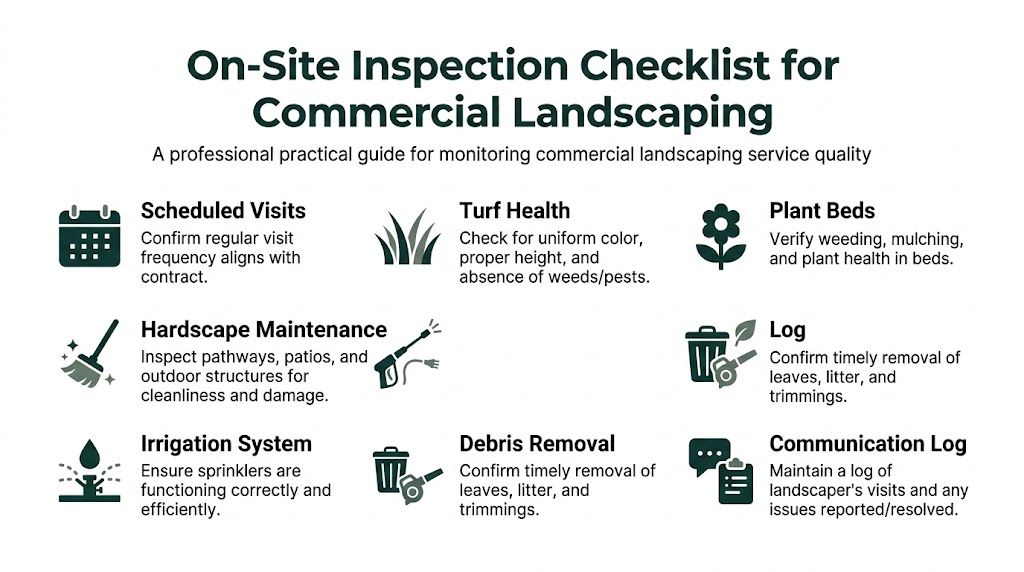
A good inspection system gives you three things. A repeatable way to check the site, documentation that stands up in a contract discussion, and a fair record of what the vendor did well and where it missed. That is how property teams hold a service provider accountable without chasing crews around the parking lot.
Build one inspection form tied to your scope
Use one form for every walk. If each manager checks the property differently, results turn into opinions instead of evidence.
A practical model is area based, not task based. Break the property into zones such as front entry, monument sign, parking islands, dumpster enclosure, tenant walks, retention area, and back lot. Then score each zone against the actual scope and service level. A security patrol checklist template is a useful format reference because it shows how consistent routes, timestamps, and area-by-area checks create cleaner records.
Your inspection form should answer questions like these:
- Visit confirmed. Was the crew on site on the scheduled day and within the approved service window?
- Turf quality. Was grass cut evenly, with trimmed edges, no missed strips, and no heavy clippings left on pavement?
- Bed condition. Were weeds removed, edges defined, mulch kept in place, and trash cleared from planted areas?
- Pavement cleanup. Were curbs, walks, loading areas, and entries blown clean after service?
- Watering issues. Are there signs of leaks, broken heads, runoff, overspray, or dry stress?
- Shrub and tree work. Are pruning cuts clean, clearance maintained, and visibility at signs and walks preserved?
- Carryover items. Were last visit's punch list items corrected?
Keep scoring simple. Pass, fail, not in scope, and needs follow-up usually works better than vague notes.
Set a verification standard for off-site oversight
Remote management fails when photos are random and service logs are generic. Require proof that matches the map, the date, and the scope.
For each visit, require fixed-point photos from the same locations and in the same order. Label them by zone. If a crew could not complete an item because of parked cars, locked gates, or weather, the record should say that clearly and show it in a photo. The goal is boring consistency. Same angles, same file names, same order, every visit.
For larger sites, add:
- Timestamped arrival and departure records
- Zone-based photo sets tied to the contract map
- Exception notes with reason and planned return date
- A monthly open-issues log with status, not just a photo folder
Tree-heavy properties need their own verification line items. If your scope includes pruning, clearance, or hazard monitoring, use standards that match a defined commercial tree maintenance program instead of burying tree work inside a general mowing report.
Review trends monthly, not only when someone complains
Reactive complaints create messy conversations. A monthly review keeps the discussion tied to records.
Bring the inspection forms, the vendor's visit reports, and one running issue log organized by date and zone. Review recurring misses first. Then review response time, return visits, and unresolved exceptions. Account management earns or loses trust during this process.
I prefer a short monthly scorecard with a few manager-level KPIs:
- On-schedule visit completion
- Open issue aging
- Return trip completion time for missed scope
- Photo log compliance
- Irrigation issue reporting time
- Quality score by zone
Do not overload this. If you track fifteen measures, no one uses them. Five or six clear service indicators are enough to spot weak supervision, rushed crews, or a scope that no longer matches site conditions.
Match repeat defects to the operating problem behind them
Patterns matter more than isolated defects. One missed corner can happen. The same missed corner for four visits points to route pressure, weak supervision, or a checklist that never included that area.
| What you see | What it usually points to |
|---|---|
| Rear beds stay weedy while front entry looks fine | Crew is protecting visible areas and rushing low-traffic zones |
| Grass along curbs is uneven every visit | String trimming is inconsistent or the route is too compressed |
| Debris remains behind enclosures and retaining walls | Cleanup standard is unclear or no one inspects hidden areas |
| Dry spots continue after reported repairs | Water checks are superficial or repair follow-through is weak |
| Shrubs are cut into rough shapes | Pruning is being done for speed instead of plant health |
That diagnosis matters because the fix changes with the cause. More crew time solves one problem. Better supervision or retraining solves another. A manager who can separate those two gets better results and fewer arguments.
Organize evidence so it is usable in a dispute
Phone photos dumped into a camera roll do not help much. Build a property file.
Store records by month, then by zone. Name files with the date, area, and issue. Keep one issue log that shows when the problem was observed, when it was reported, what response was promised, and when it was corrected. If billing, service quality, or damage becomes disputed, you can pull a clean record in minutes instead of reconstructing events from emails and text messages.
That level of organization protects both sides. The vendor gets clear, dated feedback. The property team gets proof tied to the contract, not memory.
Interpreting the Signs and Recognizing Red Flags
A property can look acceptable from the parking lot and still be under-serviced.

That is why red flags should be read against the scope, the schedule, and the vendor's records. One messy week after storms is understandable. A repeating pattern with thin documentation is an accountability problem.
What the grounds are telling you
Uneven mower lines, ragged turf edges, recurring weeds in secondary beds, and plant stress near hardscape usually point to one of two issues. The crew is rushing the route, or the account manager is not checking quality after the work is done.
Irrigation problems are often even clearer. Runoff on sidewalks, overspray on storefront glass, and dry material in the same zone week after week usually mean inspections are being reported more consistently than they are being performed. Poor shrub cuts tell a similar story. Torn tissue, flat tops, and random shapes usually reflect speed, not plant care.
The job at this stage is not to become an arborist or irrigation tech. It is to sort normal wear from recurring service failure. If the same issue appears in the same area over multiple visits, your concern shifts from appearance to contract compliance.
Red flags show up in records before they show up across the site
On better-run accounts, documentation gets more specific when a problem appears. On weak accounts, it gets thinner. Service notes turn generic. Photos get tighter so they avoid surrounding conditions. Completion reports stop matching what your staff sees onsite.
That pattern matters, especially on remote properties where you rely on verification instead of personal walkthroughs. A useful model is a route-based inspection process, similar to a security patrol checklist template. The point is not security. The point is disciplined, repeatable proof by zone, time, and task.
Watch for these signs:
- Missed service dates with no advance notice or recovery date
- Completed-task reports that do not match current site conditions
- The same irrigation, cleanup, or pruning issue appearing in the same zone
- Vague explanations such as staffing issues, weather, or access problems repeated for weeks
- Invoices that blur routine contract work and extra work
- Photo reports that only show front-facing areas and skip side yards, enclosures, back lots, or utility corridors
Some categories deserve their own standard
Tree care is a common example. A crew can keep turf acceptable and still perform poor pruning, miss deadwood, or create clearance issues around signage and drives. Those items should not be buried inside a general grounds report. If mature trees are part of the scope, compare the vendor's work against a clear explanation of proper commercial tree maintenance for Salinas properties.
How to tell a strained account from a failing one
The difference usually comes down to response quality.
| Healthy vendor behavior | Troubled vendor behavior |
|---|---|
| Acknowledges missed items without prompting | Waits for your team to prove the miss |
| Ties corrections to a date, zone, and crew action | Offers broad assurances with no specifics |
| Separates scope gaps from service failures | Mixes routine work, extras, and excuses |
| Provides before-and-after proof for remote verification | Sends selective photos or none at all |
Good vendors have rough weeks. Poor vendors create rough months, then try to manage them with short emails and vague closeout notes. The red flag is not one imperfect visit. It is a pattern of incomplete work, weak proof, and no durable correction.
A Step-by-Step Guide to Addressing Performance Issues
Monday morning starts with a complaint from a tenant about weeds at the rear loading area. The vendor’s report says the property was serviced on Friday. If that gap sits in phone calls and memory, it turns into an argument. If it goes into a dated record tied to the contract, it becomes manageable.

Start with one formal notice tied to the scope
Send one clear email that documents the issue without editorial language. Include the service date, the areas affected, your photos, and the exact scope items or service levels that were missed. Ask for two things in writing. Confirmation of receipt and a correction plan with dates.
This works better than a quick call because it fixes the facts early. It also shows whether the vendor can respond like an operator instead of a salesperson.
Use a simple structure:
- Subject line. Property name, date, and service deficiency
- Observed issue. What was missed or left incomplete
- Affected areas. Specific zones, not general descriptions
- Contract reference. Scope line, map zone, or reporting requirement
- Required response. Correction date, root cause, and proof of completion
If the issue involves trees, pruning clearance, or deadwood, call that out as a separate deficiency rather than folding it into general grounds care. That keeps the correction standard clear and avoids vague closeout language. If you need a reference point for that scope, use this guide to proper commercial tree maintenance for Salinas properties.
Ask for the operating explanation, not another apology
If the same tasks keep slipping, ask how the property is being staffed, routed, and verified. The goal is not to audit the vendor’s whole business. The goal is to confirm whether your site is getting the crew time and supervision the contract assumes.
Good questions are specific:
- Who was assigned to the property on the missed dates?
- How many crew hours were scheduled versus completed?
- Was any area skipped because of access, equipment failure, weather, or route compression?
- What proof can they provide for completion by zone?
- What change will prevent the same miss next visit?
Weak accounts often show themselves. A capable vendor can explain a miss, separate a true access problem from poor execution, and state exactly what will change on the next service. A struggling vendor sends broad assurances and hopes the issue fades.
Escalate to a cure notice when the pattern continues
If the first written notice does not produce correction, use the contract’s cure process. Keep it formal and narrow. List the unresolved items, reference the earlier notice, attach the supporting records, and state the deadline allowed under the agreement.
A proper cure notice should include:
- Unresolved deficiencies by date and area
- Prior notice history
- Photos, logs, or inspection notes
- Required correction deadline
- Contract language tied to default, credits, or termination rights
Do not overstate the case. Stick to performance, documentation, and deadlines. That protects your position if the account improves, and it protects you if it does not.
Hold one review meeting, then memorialize every commitment
One onsite meeting or video walkthrough is usually enough after formal notice. Walk the open items zone by zone. Confirm what counts as complete, who is responsible, and when proof will be delivered. Then send a same-day recap.
The recap should name each item, each area, each due date, and the required evidence. For remote oversight, require timestamped photos from all listed zones, not just high-visibility frontage. For repeat misses, require a short service log that identifies crew arrival, completion time, and any blocked areas.
This step matters because verbal agreement is not accountability. Written commitments tied to dates and proof are accountability.
If the vendor corrects the work and stays consistent for the next few cycles, the relationship can recover. If the same deficiencies return, you now have a clean record that supports service credits, replacement, or termination under the contract.
Enforcing the Contract and Exploring Your Options
A vendor can sound cooperative in meetings and still miss the mark on the property. At that point, the contract has to control the next step.
If written notice, a cure period, and one documented review meeting did not correct the pattern, shift from discussion to enforcement. Pull the default, termination, payment, access, and closeout sections and read them line by line. The question is simple: what rights did the agreement give you, and what proof does it require you to show before you use them?
That is where many commercial managers find themselves at a disadvantage. They know the work is inconsistent, but they cannot tie the failures to the scope, service frequency, or response times the vendor agreed to. A clean paper trail fixes that. It also keeps the dispute centered on performance instead of personalities.
What to assemble before you replace a vendor
Before sending termination notice, build a complete file that another manager, regional director, or attorney could follow without extra explanation.
Include:
- The full agreement with exhibits, addenda, pricing sheets, and any approved scope changes
- Inspection reports and KPI scorecards by date, zone, and service cycle
- Service logs and visit records showing what was scheduled, completed, skipped, or deferred
- Photos and video labeled by date, area, and issue type
- Emails and notices that show the history of complaints, responses, cure deadlines, and missed commitments
- Open proposals, extra work requests, and disputed invoices
- Site access details such as gate codes, watering windows, badge requirements, and restricted service hours
This file does two jobs. It supports termination for cause if the contract allows it, and it shortens the handoff to the next grounds care provider so service does not fall apart during transition.
Use the contract to control the exit, not just to end the relationship
Termination is only one option. Depending on the agreement, you may also have the right to apply service credits, withhold disputed amounts, remove part of the scope, place the account on a short review period, or convert to a convenience termination with proper notice. The right choice depends on risk.
If the main issues are appearance and routine completion, a short monitored period may be worth trying. If the misses involve irrigation oversight, trip hazards, blocked sightlines, code exposure, or repeated failures after notice, replacement is often the cleaner business decision.
Review operational requirements before the handoff as well. Equipment restrictions, noise limits, service windows, and municipal rules can affect pricing and crew planning. If your site is in a market where clients or tenants are asking about equipment compliance, address that during transition and review current requirements around commercial electric equipment rules for maintenance vendors.
End service in a way that protects the property
Send notice exactly as the contract requires. Then schedule a final site review, confirm what materials or records must be returned, collect keys, cards, and access credentials, and identify which invoice items remain approved, disputed, or pending correction.
Keep the closeout factual. Confirm the final date of service, the condition expectations through turnover, and any active risks the next provider needs to see on day one. A professional exit protects your position and gives the replacement vendor a fair chance to stabilize the property fast.
Frequently Asked Questions About Commercial Landscaper Accountability
How often should my grounds care provider communicate with me?
Set the expectation before service problems start. For commercial grounds maintenance, communication should follow a schedule and a trigger list.
At minimum, require confirmation of completed visits, notice of weather delays, reporting on irrigation or safety issues, and a clear record of anything skipped or deferred. If you only hear from the vendor after a complaint, account management is already weak.
Should I pay an invoice if the work looks incomplete?
Match the invoice against the contract scope, crew logs, photos, and your inspection record. Approve what was completed. Put disputed items in writing the same day and ask for correction, backup, or a revised bill.
That keeps the conversation factual and gives you a clean paper trail if the issue turns into a contract dispute.
What counts as normal maintenance and what should be a separate work order?
Use the scope of work as the dividing line. Recurring services usually include mowing, edging, blowing, weed control, bed care, and routine site checks if those items are listed. Extra work usually includes storm cleanup, drainage corrections, major pruning, irrigation part replacement, erosion repair, and one-time cleanups.
If a task falls into a gray area, the contract should say who approves it, how pricing is issued, and whether the crew can proceed to prevent damage or safety exposure.
What if weather interrupts a scheduled visit?
A weather delay is acceptable. Silence is not.
The provider should tell you what could not be completed, why conditions were unsuitable, and when the make-up visit is scheduled. For sites with strict operating rules, include equipment and service-window expectations in that update, especially if you are reviewing electric equipment requirements for commercial maintenance vendors as part of compliance.
How detailed should a monthly report be?
Detailed enough that another property manager could pick up the file and know what happened without calling the vendor. Good reporting includes visit dates, service areas completed, skipped items with reasons, open site issues, recommended corrective work, and photos taken from the same reference points each month.
That is how remote verification works. A polished summary with no specifics does not help you enforce an SLA.
Can I hold a grounds maintenance provider accountable if I manage the property from another city?
Yes, if the verification process is built into the account from day one. Require timestamped photos, mapped service zones, written visit notes, issue logs, and scheduled review calls tied to KPIs such as completion rate, response time for corrective items, and irrigation issue reporting.
Remote oversight fails when the only proof is a verbal assurance that the crew was on site. Documentation closes that gap.
Build a Partnership Based on Trust and Transparency
Good commercial outdoor maintenance service isn't proven by a nice invoice or a friendly promise. It's proven by clear scope, repeatable reporting, and visible follow-through. If you're reviewing how do i know if my commercial outdoor maintenance provider is doing the work?, keep your standards practical and documented, then compare every visit to those standards. For a broader view of accountability and property value, this perspective on commercial landscaping ROI is worth reading.
Cited Sources
The references below support the accountability framework used throughout this guide, especially the parts on service standards, verification, and vendor performance review. For a related discussion on property value and service oversight, see this article on commercial outdoor maintenance ROI.
- NALP. "Green Industry Statistics." 2024. https://www.landscapeprofessionals.org/LP/LP/Media/landscape-industry-statistics.aspx
- Granum. "3 Business Metrics to Grow Your Operations." 2023. https://granum.com/resources/3-landscape-business-metrics-to-grow-your-operations/
- Schill Landscaping. "Signs to Switch Landscaping Company." 2023. https://schilllandscaping.com/blog/signs-to-switch-landscaping-company
- Grounds Performance. "Guide to Evaluate Performance." 2024. https://www.landscapeperformance.org/guide-to-evaluate-performance
If you're looking for a commercial grounds care partner that values documentation, communication, and clear accountability, California Landscape & Tree Pros serves Salinas and Monterey County with professional grounds and tree care services. You can call (831) 998-7964 in Salinas or (831) 905-8018 in Monterey, or visit them at 1184 Monroe St., Suite 6, Salinas, CA 93906 to discuss your property.