
As drought conditions persist across California, are you tired of a thirsty lawn and sky-high water bills? Modern drought-tolerant design is the answer, transforming outdoor spaces into vibrant, uniquely Californian landscapes that are as stunning as they are sustainable. It’s a shift from seeing water conservation as a sacrifice to seeing it as an opportunity to create something truly special, native, and beautiful.
Beyond Rocks and Cacti: The New Drought-Tolerant Garden
With drought a constant reality in Monterey County and the Bay Area, homeowners are searching for sustainable ways to maintain beautiful landscapes while cutting back on water use. Native and drought-tolerant designs have moved from a niche interest to a top priority for eco-conscious property owners who care about both the environment and curb appeal.
Many articles focus narrowly on “low-water plants” but overlook the design balance needed to make these landscapes visually appealing and functional year-round. They also skip practical strategies like smart irrigation or soil health improvements that make a real difference. A truly water-wise landscape is a sophisticated, living system—a careful blend of the right plants, smart design, and efficient technology.
A Modern, Holistic Approach
A resilient California garden works with our local environment, not against it. California Landscape & Tree Pros brings a full-service perspective, combining thoughtful plant selection, efficient irrigation technology, and modern design to create landscapes that are both water-wise and welcoming. This modern approach integrates several key elements:
- Thoughtful Plant Selection: We focus on native plants already adapted to our wet winters and dry summers.
- Efficient Irrigation: Smart, weather-based systems deliver water precisely where and when it's needed.
- Modern Design Principles: We use layers, textures, and color to ensure year-round visual interest.
- Systemic Enhancements: Integrating mulch for moisture retention and permeable hardscapes to reduce runoff are crucial.
Water-efficient irrigation and native planting can reduce outdoor water use by up to 50%, saving thousands of gallons each season. This not only conserves resources but also reduces maintenance costs—an increasingly important factor for homeowners looking to invest wisely.
This integrated approach turns a thirsty, high-maintenance yard into a beautiful oasis that practically takes care of itself. It’s all about creating high-end outdoor living areas that work year-round by embracing our natural ecology. In this guide, we'll walk you through how to create a landscape that is native, natural, and beautiful—saving you water, time, and money along the way.
The Three Pillars of a Thriving Water-Wise Landscape
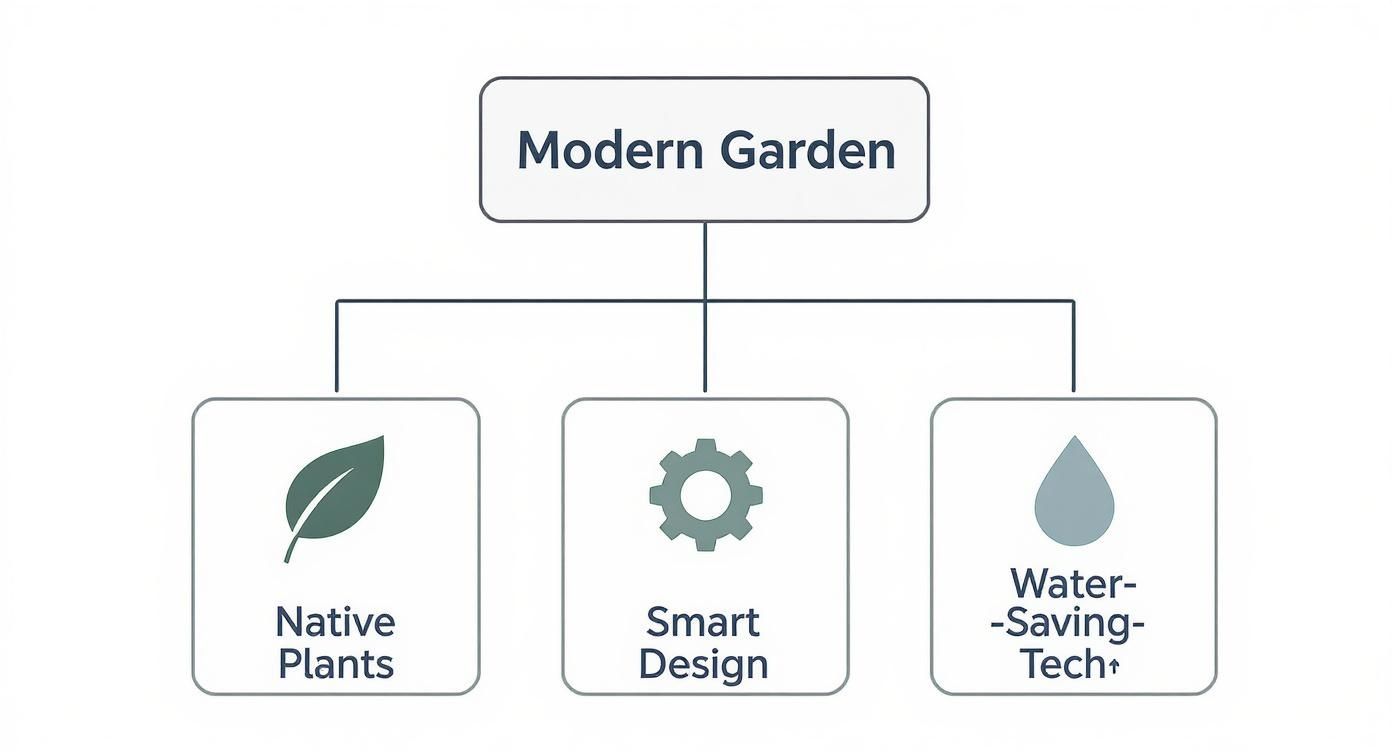
A truly resilient, beautiful, and drought-tolerant landscape is built on a simple yet powerful idea: creating a balanced system where every element works together. Instead of fighting against California’s climate, a modern water-wise garden embraces it. This approach stands on three essential pillars that transform a high-maintenance, thirsty yard into a thriving, nearly self-sufficient ecosystem.
When these three components—Native Plants, Naturalistic Design, and Water-Wise Systems—are woven together, they create a landscape that is both stunning and genuinely sustainable.
This infographic really captures the modern landscaping philosophy and its core components.
 drought-tolerant landscaping” />
It’s all about a visual hierarchy where native plants, smart design, and efficient technology are the foundational pillars supporting a modern, sustainable garden that just works.
Pillar 1: California Native Plants
The real secret to any successful drought-tolerant landscape here in the Bay Area starts with native plants. Think about it: these are the species that have spent thousands of years adapting to our specific local conditions—our unique soils, our rainfall patterns, and our long, dry summers. They are the true experts of survival in our backyards.
Unlike thirsty, non-native plants that demand constant pampering and intervention, California natives are naturally wired to conserve water. Many have incredibly deep root systems that seek out moisture far below the surface, while their foliage is often designed to minimize evaporation. Beyond their sheer resilience, they are critical to our local ecology, providing essential food and habitat for pollinators like bees, butterflies, and hummingbirds.
Pillar 2: Naturalistic Design Principles
The second pillar moves beyond what you plant to how you arrange it all. Naturalistic design is the art of mimicking the patterns, layers, and textures found in nature to create a landscape that feels cohesive and visually interesting all year round. This is the key to avoiding that sparse, disconnected "rock garden" look of the past.
Instead of planting in rigid, formal rows, a naturalistic approach is more like painting a picture:
- Layering: We combine groundcovers, perennials, shrubs, and trees of different heights to create a sense of depth and a lush, full feeling.
- Textural Contrast: Pairing bold, architectural succulents with soft, feathery grasses creates a dynamic visual appeal that’s anything but boring.
- Thoughtful Color Palettes: It's about using a mix of foliage and flowers that provide color and interest through every season, not just one big show in the spring.
This design philosophy ensures your garden is not only functional but also beautiful, with plants growing together in communities that support one another, just as they do out in the wild.
Pillar 3: Efficient Water-Wise Systems
The final pillar is the operational brain of your garden—the water-wise systems that make everything run with maximum efficiency. This is where modern technology and smart horticultural practices come together to make every single drop of water count. It’s a proactive approach that goes way beyond just turning on a sprinkler and hoping for the best.
A modern drought-tolerant landscape is a system designed for peak efficiency. It’s about building a healthy foundation with rich soil and mulch, and then using smart technology to deliver water precisely where and when it’s needed.
Key components of this system include enriching the soil with organic compost to improve water retention, applying a thick layer of mulch to reduce evaporation, and installing high-efficiency drip irrigation. These elements work in concert to create a closed-loop system that conserves moisture and encourages deep, healthy root growth.
This shift in thinking is catching on quickly. The residential segment is leading the charge, with projections indicating that this sector will command 48.9% of the landscaping services market share by 2025 as homeowners invest in these smarter, more sustainable outdoor spaces. You can find more details in this market report on landscaping services.
To really understand the shift, it helps to see the old and new approaches side-by-side.
Comparing Traditional vs. Modern Landscaping Approaches
This table breaks down the fundamental differences between the lawn-centric landscapes of the past and the sustainable, nature-inspired gardens we design today.
| Aspect | Traditional Landscaping | Modern Drought-Tolerant Landscaping |
|---|---|---|
| Primary Goal | Aesthetic appeal, often mimicking European styles (e.g., large lawns) | Ecological health, water conservation, and year-round beauty |
| Plant Selection | Focus on non-native, ornamental, and often thirsty plants | Emphasis on California natives and climate-appropriate plants |
| Water Usage | High; relies heavily on spray irrigation and frequent watering | Low; uses drip irrigation, smart controllers, and soil moisture retention |
| Maintenance | High; requires regular mowing, fertilizing, and pest control | Low; designed to be largely self-sustaining once established |
| Soil Health | Often ignored or depleted by chemical use | A top priority; improved with compost, mulch, and organic matter |
| Wildlife Support | Limited; may even deter local fauna | Actively supports local pollinators, birds, and beneficial insects |
| Design Style | Formal, rigid lines, and monocultures (e.g., a single grass type) | Naturalistic, layered, and diverse, mimicking natural ecosystems |
As you can see, the modern approach isn't just about saving water—it's about creating a living, breathing ecosystem that adds value to your property and the local environment. It’s a smarter, more rewarding way to garden in California.
Building Your California Native Plant Palette
This is where the fun really begins—choosing the plants that bring your vision to life. Forget those generic, one-size-fits-all plant lists you see at big box stores. In the diverse microclimates of Monterey County and the Bay Area, a thoughtful approach is everything. Modern drought-tolerant landscaping isn’t about just dotting a few succulents around a bed of rocks; it's about creating a living, layered community of plants that work together.
Think of it like building a great team. You need your reliable, all-star players, your flashy, seasonal performers, and your hard-working ground crew. By grouping plants that share similar needs, you build a cohesive landscape that's not just beautiful but also incredibly resilient and low-maintenance.
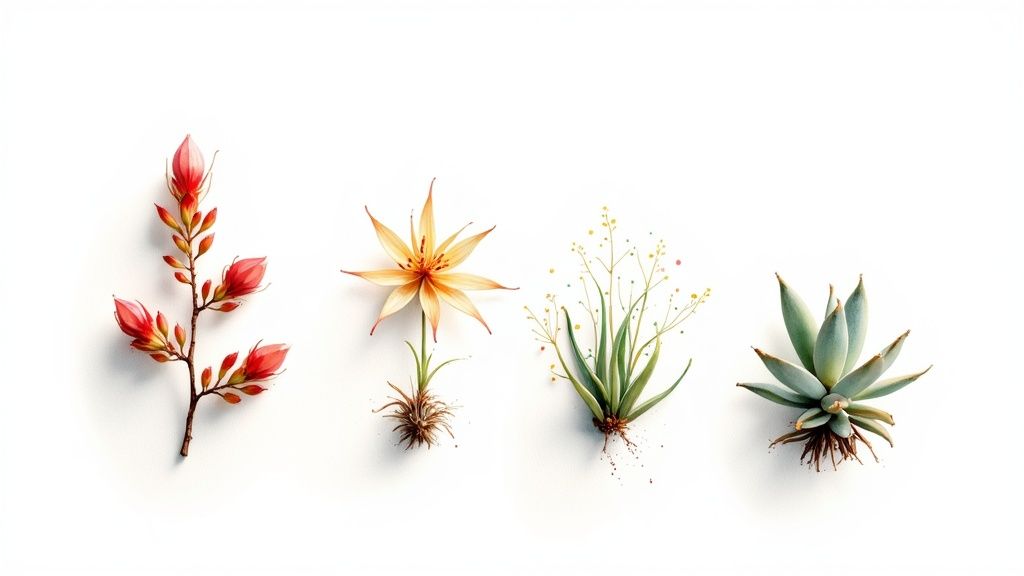
Foundational Shrubs: The Backbone of Your Garden
First things first, you need structure. Foundational shrubs are the workhorses of your garden. They provide the year-round greenery, create privacy, and give the entire landscape its shape. For a California garden, you can't go wrong with these two icons.
-
Ceanothus (California Lilac): These are quintessential California shrubs. With their stunning bursts of blue and purple flowers in the spring, they’re practically buzzing with happy pollinators. Best of all, they’re tough as nails and need almost zero summer water once they're established. They come in all sizes, from low-growing groundcovers to towering shrubs, so there's a Ceanothus for every spot.
-
Manzanita (Arctostaphylos): If you want year-round beauty, look no further. Manzanitas are famous for their smooth, mahogany-red bark and delicate, bell-shaped flowers that appear in the dead of winter. They provide a critical, early-season food source for hummingbirds and look fantastic even in the dry heat of August.
These shrubs are the "bones" of your design, creating a strong framework you can build upon.
Perennials: For Seasonal Color and Life
With your structure in place, it’s time to weave in the color and movement. Perennials are what make a garden feel alive, attracting bees, butterflies, and other welcome visitors. It's a huge part of how sustainable landscaping is transforming California yards—by turning them back into functioning ecosystems.
-
California Fuchsia (Epilobium canum): This plant is a hummingbird magnet. Just when everything else is starting to fade in late summer, it erupts with brilliant, trumpet-shaped red flowers that last well into the fall. It’s incredibly water-wise and provides that critical pop of late-season color.
-
Sages (Salvia): The Salvia family is a gift to California gardeners. You get incredible variety, from the fragrant, deep purple flowers of Cleveland Sage to the vibrant red of Hummingbird Sage. They’re aromatic, thrive on neglect, and bloom for months on end.
The golden rule of sustainable design is simple: right plant, right place. A plant that loves the cool coastal fog in Monterey might bake in the inland heat of San Jose. A professional assessment looks at sun exposure, soil type, and even air circulation to make sure every single plant is set up to thrive.
Groundcovers: The Living Mulch
Next, let's look down. Forget endless wood chips—hardy native groundcovers are the ultimate lawn alternative. They do it all: suppress weeds, keep the soil cool and moist, and create a lush, green carpet without the constant watering and mowing.
-
Yarrow (Achillea millefolium): This native forms a soft, fern-like mat that's surprisingly tough. It can even handle a bit of foot traffic. The flat-topped flower clusters are a buffet for all sorts of beneficial insects.
-
Dwarf Coyote Brush (Baccharis pilularis 'Pigeon Point'): If you need to cover a slope or a large, tough area, this is your plant. It’s an evergreen workhorse that grows fast, controls erosion, and asks for very little water in return.
Architectural Plants: For a Modern Edge
Finally, every great design needs a few showstoppers. Architectural plants have bold, sculptural forms that create stunning focal points and add a contemporary feel. They provide a beautiful contrast to the softer shapes of perennials and grasses.
-
Agave: Varieties like the hardy Agave parryi bring a dramatic, sculptural element with their tight, blue-gray rosettes. They are the very definition of low-maintenance and deliver a powerful, modern punch.
-
Red Yucca (Hesperaloe parviflora): Don't let the name fool you; it's not a true yucca. Its graceful, grass-like leaves are joined by towering spikes of coral-pink flowers that last for months. It adds height and texture, and hummingbirds absolutely can't resist it.
By layering these elements—structure, color, groundcover, and accent—you create more than just a collection of plants. You build a vibrant, self-sustaining landscape that truly belongs in California.
Designing a Smarter Landscape System
Picking the right native plants is a great start, but true drought-tolerant design goes beyond swapping plants. It’s about integrating smart strategies and materials to create a complete system, designed from the ground up to thrive on less water. This isn't just about planting; it's about engineering an environment where every component actively conserves water and boosts plant health.
The Power of Healthy Soil and Mulch
If you do only one thing, get your soil right. Think of your soil like a sponge. The hard, compacted clay common in our region is like a dry, crusty sponge; water just hits it and runs right off. But when you amend it with organic compost, you turn it into a soft, absorbent sponge that grabs onto water and holds it where plant roots can find it later.
With healthy soil in place, protect it with mulch. A thick layer, usually 3-4 inches deep, acts as the garden’s shield. It insulates the soil from the intense California sun, keeping roots cool and dramatically cutting down on evaporation while also suppressing weeds.
Integrating Permeable Hardscapes
Every yard has hard surfaces—patios, walkways, driveways. Traditionally, these are made of solid concrete, which sends precious rainwater straight into the storm drain. The smarter approach is to use permeable hardscapes that let water trickle through and soak back into the ground.
A few popular options include:
- Decomposed Granite (DG): Perfect for creating a natural, rustic look for pathways and seating areas.
- Permeable Pavers: These have small gaps between them filled with gravel, allowing water to drain through to the soil below.
- Gravel or River Rock: Great for designing dry creek beds that can channel and absorb runoff during a storm.
When you use these materials, you’re not just building a patio; you’re creating an active part of your landscape’s water-capture system.
The global shift toward drought-tolerant landscaping is undeniable. Practices like xeriscaping, which emphasize water conservation through smart design, can reduce outdoor water use by up to 50% compared to conventional lawns. This trend is complemented by a growing adoption of smart irrigation systems, a market expected to hit $5.8 billion by 2030. You can explore more on these lawn care industry statistics and trends and see how homeowners are embracing efficiency.
Strategic Layouts with Hydrozoning
Finally, a smart design arranges plants in a way that just makes sense. We call this hydrozoning—grouping plants with similar water and sun needs together. You wouldn't plant a thirsty, shade-loving fern right next to a sun-baked agave; one of them would always be unhappy.
By creating distinct zones, you can tune your watering to the precise needs of each group. A "low-water zone" full of established natives might only need a deep soak once in a while, while a "medium-water zone" near the house gets a bit more. This simple strategy stops the wasteful "one-size-fits-all" watering approach and ensures every plant gets exactly what it needs. When combined with professional planning for irrigation and outdoor lighting in Monterey County, hydrozoning becomes a powerful tool for building a beautiful and incredibly efficient landscape.
Using Smart Technology for Ultimate Water Efficiency
Choosing native plants and designing a thoughtful layout gets you halfway to a truly water-wise landscape. But to take your efficiency to the next level, technology is the missing piece. Smart irrigation is the brain of your landscape, ensuring not a single drop of water goes to waste.
This isn't your parents' old sprinkler timer that clicks on at 5 AM, rain or shine. A modern smart irrigation system is more like a personal assistant for your garden, constantly checking the weather and making intelligent decisions on the fly.

From Guesswork to Precision with Smart Controllers
At the heart of any modern irrigation setup is the weather-based smart controller. This device taps into local weather stations for real-time data on temperature, humidity, wind, and rainfall, then fine-tunes your watering schedule daily.
- Heatwave rolling in? The system will automatically add a little extra watering time.
- Unexpected shower in Salinas? It will pause the next scheduled cycle.
- Classic cool, foggy morning in Monterey? The controller dials back the watering duration.
This automation takes all the guesswork out of the equation. No more running out in your pajamas to turn off the sprinklers during a downpour or forgetting to adjust the schedule when the seasons change.
When you pair smart irrigation with a native plant palette, the results are stunning. We've seen homeowners reduce their outdoor water consumption by up to 50%, which translates to thousands of gallons saved and a much smaller utility bill.
This tech-forward approach is a perfect example of how smart landscaping starts with water-wise design. It allows California homeowners to enjoy lush, beautiful gardens while working with our environment, not against it.
Delivering Water Where It Counts with Drip Irrigation
Of course, the smartest controller can't help if your delivery method is wasteful. That’s why we always pair smart tech with high-efficiency drip irrigation. Traditional pop-up spray heads are notoriously inefficient, losing much of the water they throw to wind and evaporation.
Drip irrigation is the elegant solution. It’s a network of tubing with small emitters placed right at the base of each plant. The system delivers water slowly and directly into the soil where the roots are. This allows for deep absorption with almost no waste, saving water and encouraging plants to grow deeper, stronger roots, making them even more resilient.
The Benefits of a Fully Integrated System
Combining a smart controller with a drip irrigation network gives you a powerful, self-regulating ecosystem. For homeowners here in the Bay Area, this synergy unlocks serious advantages:
- Major Water Savings: You're only using the exact amount of water your plants need, which you'll see reflected on your bill.
- Healthier Plants: Deep, direct watering promotes robust root systems, leading to healthier, more vibrant plants.
- Less Work for You: With less overspray and runoff, you’ll spend far less time pulling weeds or dealing with fungal issues.
- Complete Convenience: The system practically runs itself, leaving you more time to actually sit back and enjoy your garden.
By embracing these modern tools, you can have a landscape that’s native, natural, and beautiful—all while being as water-efficient as possible.
How a Professional Brings It All Together
Taking these ideas and turning them into a living, thriving landscape is where real skill comes in. California Landscape & Tree Pros uses a tech-driven planning process that allows clients to visualize how sustainable choices can still achieve high-end aesthetics. Working with an experienced team ensures every piece of the puzzle—from soil analysis to plant placement—fits together perfectly.
It all starts with a deep-dive site analysis. A pro doesn't just look at your yard; they read it, assessing unique microclimates, sun patterns, soil composition, and water movement. This isn't about guesswork; it's about building a foundation for success based on the real conditions of your specific space.
From Blueprint to a Beautiful Reality
With that foundational knowledge, we can start visualizing the future. Modern design tools allow us to create realistic previews of your finished landscape, taking the uncertainty out of the process. You get to see exactly how the layout, plant combinations, and hardscape will look before we even break ground.
An experienced contractor also handles behind-the-scenes complexities, like navigating local water restrictions and permitting—a crucial benefit for homeowners in Monterey County and the Bay Area. They know which native plants will genuinely flourish in your microclimate and how to properly install and calibrate a smart irrigation system for peak efficiency. This professional oversight is what makes the difference between a pretty yard and a high-performing ecosystem.
A professionally designed and installed sustainable landscape is a serious investment in your property's future. It not only increases curb appeal and value but also creates a resilient, low-maintenance outdoor space that you can enjoy for years—all while making a real impact on water conservation.
Ensuring Your Landscape Thrives for Years to Come
A professional's role doesn't end when the last plant is in the ground. A new landscape is a living system that needs the right care to mature properly. Expert guidance on its evolving needs is the key to protecting your investment.
Understanding the right landscape maintenance and plant care in Monterey County ensures your garden continues to grow healthier and more beautiful over time. Ultimately, this approach transforms your property from a simple yard into a stunning, sustainable oasis that works with our California environment, not against it.
Your Top Questions About Drought-Tolerant Landscaping, Answered
Making the switch to a water-wise garden is one of the smartest moves a California homeowner can make. This isn't about creating a sparse, dusty yard; it's about embracing a modern approach that's both beautiful and sustainable. Here are answers to some of the most common questions we hear.
Will my yard look dry and boring?
Not a chance. Forget the old-school image of rocks and cacti—today's drought-tolerant landscapes are lush, vibrant, and full of life. We use an incredible palette of California native plants that bring color, texture, and interest all year long, ensuring your yard looks gorgeous and alive in every season.
How much water will I actually save?
The savings are dramatic. By swapping out a thirsty lawn for natives and an efficient irrigation system, you can cut your outdoor water use by 50% or more. For most homes, that adds up to thousands of gallons saved each season and a much smaller water bill.
Is this going to be expensive to install?
There is an upfront cost, but think of it as a long-term investment that pays you back. You’ll save on water bills, fertilizers, and general upkeep. On top of that, many local water districts in California offer generous rebates for lawn removal, which can significantly reduce the initial installation cost.
What kind of maintenance am I looking at?
A native garden is a low-maintenance garden. Once established, these plants are in their element—adapted to our soil and weather. You can say goodbye to constant pruning and fussing and spend more time relaxing and enjoying your beautiful space.
Can I still have a garden full of color?
Absolutely. California's native plants are bursting with color. We have access to incredible species, from the brilliant blues of the California Lilac (Ceanothus) to the cheerful orange of the California Poppy. A good designer can create a planting plan that ensures something is always blooming, with a stunning display of color that shifts with the seasons.
Monterey County and Bay Area homeowners can consult local professionals who understand California’s drought conditions and design stunning, sustainable landscapes that thrive in every season—without wasting a drop. Ready to see how a native, natural, and beautiful oasis can thrive in your own yard? The team at California Landscape & Tree Pros specializes in creating these stunning, water-wise landscapes.