
Think your commercial landscape is just another line item on the maintenance budget? That outdated view is costing you. For Monterey County and Salinas property owners, strategic landscaping is a high-performance investment in 2026, and the secret is shifting focus beyond maintenance to unlock measurable returns that strengthen your entire asset.
Unlocking the Real Value of Your Commercial Landscape
For years, the standard advice for commercial clients has been to focus on price, routine maintenance cycles, and basic services like mowing and pruning. This frames landscaping as a fixed overhead cost—a necessary evil you’re constantly trying to shrink.
But this model is fundamentally broken. Our research shows that most providers fail to address accountability, leading to missed tasks, skipped service items, and poor communication. For property managers, this means frustration, unkept landscapes, and no clear proof of where their money is actually going. It's a vicious cycle of underperformance that directly drags down property value and tenant happiness.
The truth is, a well-executed, system-driven landscape program does far more than just keep things tidy. It actively generates value.
Shifting From a Cost Center to an Investment
The expert pivot is treating a landscape like any other high-performing asset on the balance sheet. It all comes down to a structured approach—one built on clear systems, consistent communication, and verifiable results. It’s time to demand more from both your property and your landscape partner.
At CLTP, we apply structured commercial service protocols that deliver:
- Maintenance Checklists for Every Visit, guaranteeing every contracted task gets done, every time.
- Photo Documentation and Transparent Reporting that gives you visual proof of work and consistent, easy-to-understand updates.
- A Single Point-of-Contact for Property Managers, eliminating the communication runaround.
This system removes guesswork. It turns your landscape budget from a risky expense into a predictable, powerful investment. When you have the data to back it up, you can finally measure the real returns your property is generating.
A well-managed landscape program is one of the few operational expenses that can directly increase asset value, lower utility costs, and boost tenant retention simultaneously. It’s a proactive strategy for growth, not a reactive cost to be managed.
Think about it: you invest in a thoughtful commercial landscape installation, and it starts paying you back in ways that go far beyond just looking good. In fact, a 2023 report by the National Association of Realtors found that a landscape upgrade can yield a return on investment of over 100%. The market is waking up to this reality. To make sure your own design choices align with this investment mindset, explore the valuable strategies in our in-depth guide on smarter landscape design choices.
To put it simply, the perspective has to change. This isn't about spending less; it's about investing smarter.
Shifting Your Landscape Mindset From Cost To Investment
| Factor | Traditional View (Cost) | Modern Approach (Investment) |
|---|---|---|
| Primary Goal | Minimize monthly expense. Find the cheapest provider. | Maximize long-term asset value and tenant satisfaction. |
| Key Metrics | Price per mow. Cost of seasonal cleanups. | Tenant retention rates. Property valuation increases. Water savings. |
| Provider Role | A vendor who performs basic tasks. | A strategic partner who proactively identifies opportunities. |
| Communication | Reactive. You call them when there's a problem. | Proactive. They provide regular reports with photo proof. |
| Outcome | Declining curb appeal, unpredictable results, hidden costs. | Enhanced property value, lower operational costs, high ROI. |
Adopting an investment mindset isn't just a semantic change. It’s a fundamental shift in strategy that positions your landscape as a critical component of your property’s overall financial health and market appeal.
Why The Standard Landscaping Model Is Failing Your Property
If you manage a commercial property, HOA, or retail center anywhere in Monterey County, this story probably sounds familiar. You hire a landscaping company based on a rock-bottom bid. The promise of a pristine property sounds great, but it doesn't take long for that initial optimism to sour into a cycle of headaches.
The issues usually creep in slowly. A missed mowing here, a pruning task skipped there. Your calls get vague replies, and you end up spending more time chasing down your "professional" landscapers than doing your actual job. This isn't just about a bad crew; it's a deep-seated flaw in the industry's entire approach.
The Accountability Gap in Commercial Landscaping
The real heart of the issue is a massive accountability gap. Most traditional landscaping contracts are built around the lowest possible price and a vague checklist of services. This setup treats your landscape like a line-item expense to be minimized, not what it actually is—a critical asset that drives your property's value.
This model practically encourages cutting corners. When the only goal is to win the lowest bid, companies are forced to slash labor hours and skip vital tasks just to protect their razor-thin margins. The result? A slow, steady decline in your property's curb appeal and a total lack of transparency into what you're actually paying for.
This is a classic tale in our industry. So many landscape installation plans fall apart not because the design was bad, but because the execution and accountability just weren't there. We see it all the time, and you can dive deeper into this common problem in our guide on why most landscape plans fail in California.
The standard landscaping model is built for the provider's efficiency, not the client's ROI. It thrives on ambiguity, creating a system where property managers pay for services they can't even be sure were completed.
That lack of proof is where the real damage happens. Without clear reports or a responsive point of contact, how can you know if your budget is being spent wisely? You’re left with a landscape that fails to impress tenants and that nagging feeling you’re not getting the service you were sold.
The Real-World Consequences for Your Property
This broken system has real, costly consequences that go way beyond a messy lawn. For properties in competitive markets like Salinas and Monterey, these failures hit your bottom line directly.
- Deteriorating Curb Appeal: When service is inconsistent, you get overgrown shrubs, patchy grass, and a generally neglected look that actively turns away potential tenants and customers.
- Increased Tenant Complaints: A poorly kept landscape is often the first thing tenants notice and complain about. This erodes satisfaction and can even contribute to higher vacancy rates.
- Wasted Budget: You’re paying for a complete service but getting patchy, unreliable work. Your budget is literally being thrown away on a program that isn't protecting—let alone enhancing—your property.
- Hidden Liabilities: Ignored trees can become serious safety hazards. Poor irrigation can lead to water damage or create slip-and-fall risks, opening your property up to expensive legal trouble.
In the end, the standard model leaves property managers in a constant state of frustration. It traps you in a reactive loop of chasing down your vendor and fielding complaints. The industry’s obsession with price has created a system that completely fails to deliver what you actually need: reliable, verifiable results that produce a clear commercial landscaping ROI.
How Real Accountability Finally Delivers Measurable Results
If you've ever felt trapped in a cycle of inconsistent service and watching your property's appeal slowly fade, you're not alone. This isn't just bad luck—it's the predictable outcome of the old "low-bid" model.
Breaking free means making a critical shift away from vague promises to a structured, disciplined approach to landscape management. When you do this, landscaping stops being a gamble and starts becoming a reliable asset. The solution isn't about making things more complicated; it's about replacing guesswork with hard data and ambiguity with undeniable proof of performance.
The Power of Checklists and Photo Proof
The bedrock of this system is simple: unflinching consistency. This is achieved with detailed maintenance checklists used on every single visit. Forget the old "mow and blow" handshake deal. Every task—from pruning specific shrubs to checking irrigation heads—is documented and checked off. This straightforward tool ensures nothing gets missed.
But the checklist is only half the story. To truly close the accountability loop, every completed task is backed by photo documentation. You get visual proof sent right to your inbox, showing the work that was done. This immediately ends frustrating arguments and gives you concrete evidence of performance. For property managers wanting to fold this level of verification into their larger workflow, many of the best property management apps now offer powerful tools for tracking service completion across all your vendors.
A system-driven landscape program moves accountability from a conversation to a verifiable process. Checklists ensure tasks are done; photo proof confirms the quality of the work.
Your Single Point of Contact
The second key is streamlined communication. You get a single point of contact—no more chasing down different crew leads or leaving voicemails at a central office. You'll have one dedicated manager who knows your property inside and out, understands your specific goals, and is personally responsible for making sure the system works.
This two-part system—verifiable tasks and a clear line of communication—creates the data-driven foundation you need to finally prove the truth about commercial landscaping ROI in 2026.
- Eliminate Risk: You're protected from underperforming crews and the "surprise" deficiencies that always seem to pop up after months of neglect.
- Gain Predictability: Your property gets a consistent, high standard of care, ensuring its curb appeal stays top-notch week in and week out.
- Prove Value: You now have the documentation to show ownership or your HOA board exactly how the landscaping budget is being used to protect and grow the property's value.
Ultimately, this methodical system is what turns your outdoor space from a budget headache into a reliable, high-performing asset. To see exactly how these principles are put into practice, you can learn more about our structured commercial landscaping services built around this very idea of accountability.
Where to Put Your Money: Key Investments That Drive Commercial Landscaping ROI
Knowing where to put your landscaping dollars is the difference between a sunk cost and a high-performing asset. To see a strong ROI in 2026, you have to think beyond just mowing and pruning. The real value comes from strategic upgrades that actively cut operating costs, make your property look incredible, and keep you in line with today's environmental standards.
An investment-first mindset demands a system that tracks what’s being done and proves the work was completed. The workflow below shows how this simple, transparent process turns your landscaping budget into tangible results you can see and measure.
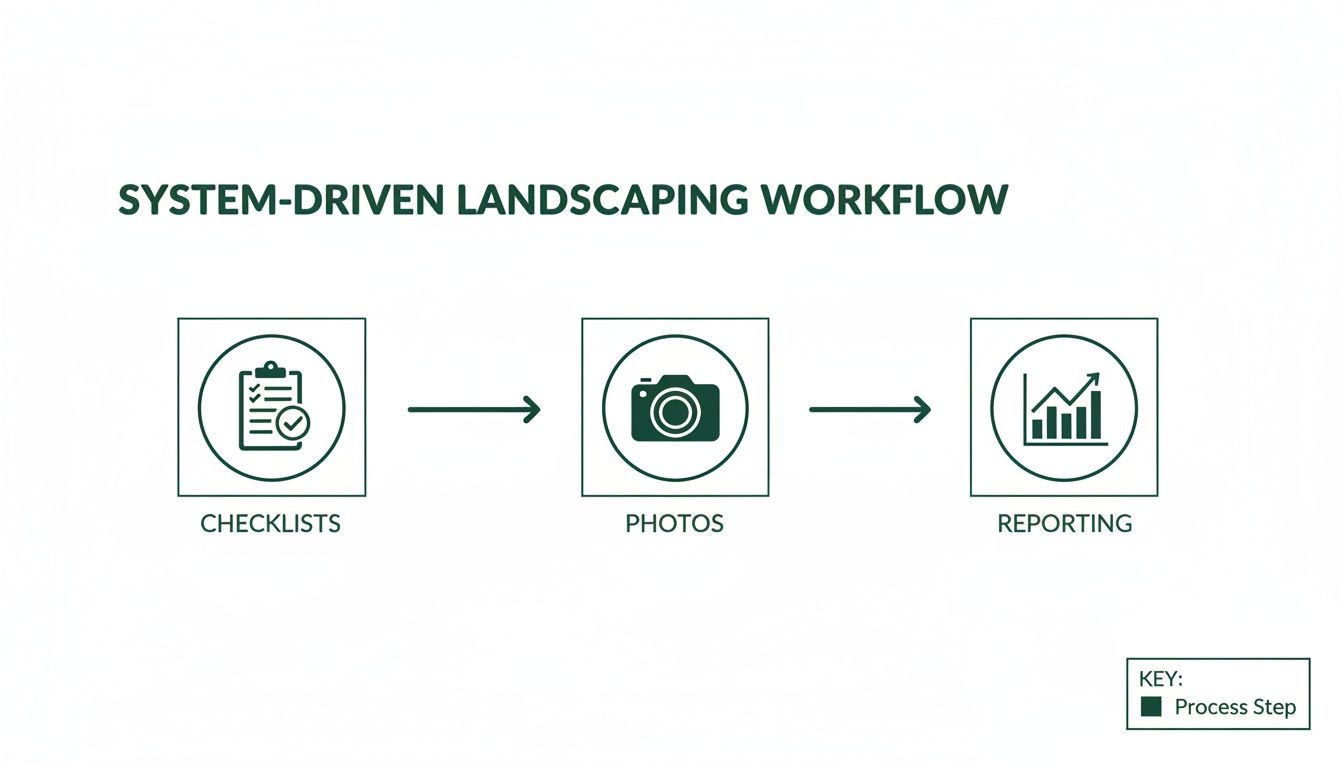
When you move from a simple checklist to photo verification and clear reporting, you create the accountability needed to ensure every dollar you invest is actually doing its job.
Focus On Sustainable Upgrades
The quickest and most significant returns almost always come from sustainable landscaping upgrades. These are direct financial wins that show up on your monthly utility bills. For properties in places like Monterey County, where water is both precious and expensive, these investments are an absolute must for smart budget management.
Here's where to start:
- Water-Wise Irrigation Systems: Upgrading to smart controllers and high-efficiency nozzles can slash your water consumption. These systems use real-time weather data to water only when necessary, preventing waste.
- Drought-Tolerant Plantings: Replacing thirsty turfgrass with native or climate-friendly plants drastically cuts your water bill and frees up your budget from constant maintenance.
These upgrades create a landscape that’s tough, beautiful, and self-sufficient—all while actively lowering your operating expenses. To see how these systems work in our local climate, you can find more on our specialized services at https://californialandscapeandtreepros.com/monterey-county-irrigation-outdoor-lighting/.
High-Impact Commercial Landscape Investments
This table shows where your budget can make the biggest difference, outlining the typical costs and the real-world benefits you can expect.
| Investment Area | Typical Upfront Cost | Expected ROI | Primary Benefit |
|---|---|---|---|
| Smart Irrigation Retrofit | $3,500 – $10,000+ | 150% – 250% (in 2-3 years) | Drastically reduces water bills and labor costs |
| Drought-Tolerant Conversion | $5 – $15 per sq. ft. | 100% – 200% (in 3-5 years) | Lowers maintenance needs and water consumption |
| LED Landscape Lighting | $2,000 – $7,000+ | 50% – 100% (via property value) | Enhances security, safety, and nighttime curb appeal |
| Proactive Tree Management | $1,500 – $5,000 (annual plan) | Mitigates Risk (>$10k per incident) | Prevents liability and protects valuable tree assets |
As you can see, these aren't just expenses; they are strategic investments that pay for themselves through savings, increased value, and risk reduction.
Integrate Modern Technology
Technology is no longer a luxury in landscaping—it's a core driver of efficiency and compliance. This is especially true here in California, where new regulations are fundamentally changing how commercial landscapes are managed.
California’s 2024 ban on new gas-powered equipment is the perfect example. Getting ahead of the curve and switching to a high-performance electric fleet isn't just about compliance. It completely eliminates fuel costs, cuts down on noise that bothers tenants, and positions your property as a modern, responsible place to be.
The move to electric equipment isn't just about following rules. It’s a strategic decision that lowers your long-term maintenance costs, shrinks your carbon footprint, and makes your property more attractive in a competitive market.
Smart irrigation controllers are another game-changer. These systems give you remote access and detailed water usage reports, allowing you to manage everything from your phone or computer. This level of control is essential for spotting leaks the moment they happen and fine-tuning performance to get maximum savings.
By focusing your budget on these key areas, you stop just maintaining your landscape and start growing it into an asset that actively improves your bottom line. For a wider view on how different improvements can impact your property's financials, it's worth checking out other upgrades that increase home value and boost ROI in 2026.
What a Proactive Landscaping Program Actually Delivers
Let's get past the abstract ideas and talk about real-world results. When you shift from simply "mowing and blowing" to a system-driven, proactive landscape program, the benefits show up everywhere—from your curb appeal to your budget's bottom line. A measurable, system-driven landscape program boosts tenant satisfaction, reduces utility and maintenance costs, strengthens property value, and eliminates the risk of “surprise” deficiencies from underperforming providers.
Direct Financial Gains and Lower Costs
The first and most immediate win from a well-run landscape program is the impact on your operational budget. Proactive management is all about prevention—catching small issues before they blow up into expensive emergencies. This approach leads directly to lower, more predictable costs.
A proactive landscape program transforms your budget. Instead of a slush fund for putting out fires, it becomes a predictable investment in preventing them in the first place. That simple change is where a strong ROI begins.
This disciplined strategy helps you slash utility bills—especially crucial with water costs in Monterey County—and eliminates those surprise invoices for emergency repairs that always seem to derail your budget.
Happier Tenants and Customers
"Curb appeal" isn't just jargon; it’s a powerful driver of satisfaction for your tenants and clients. For an HOA, a retail center, or an office park, the landscape is the very first impression you make. An outdoor space that looks consistently cared for sends a clear message: this property is well-managed and the people here matter. This has a direct impact on retention and helps attract a higher caliber of occupant.
A Higher Property Value and Easier Marketing
A meticulously managed landscape is one of the most cost-effective ways to boost your property's appraisal value. It’s a bright, shining signal to appraisers and potential buyers that this asset has been maintained with a high standard of care. When it's time to sell or lease, a property with knockout curb appeal just leaps off the page, leading to a faster sale at a higher price.
Avoiding Critical Risks and Liabilities
Finally, a system-driven program is your best line of defense against hidden liabilities. A vendor who cuts corners or skips routine checks is leaving behind ticking time bombs. For example, neglected trees can quickly become a safety hazard, while poorly maintained walkways can create slip-and-fall risks. A true professional partner actively hunts down and fixes these problems before they happen.
A Practical Guide to Smarter Landscaping in Monterey County and Salinas
For anyone managing a commercial property in Monterey County or Salinas—from hotels and HOAs to retail centers and offices—you need transparent, reliable landscaping support. To keep properties looking their best, you need more than a simple mow-and-blow service; you need a system-driven landscaping program.
This is where local expertise becomes non-negotiable. The real ROI on commercial landscaping in 2026 for properties here on the Central Coast comes from partnering with someone who gets our unique challenges, from tight water restrictions to the constant churn of new environmental regulations.
Staying Ahead of Local Regulations with a Proactive Partner
Keeping up with California’s environmental laws is a huge piece of the puzzle for local property managers. California’s 2024 ban on new gas-powered equipment, for example, is putting real pressure on commercial sites to update their landscaping systems. A truly forward-thinking partner doesn’t just react to these changes—they help you get ahead of them.
This means having a clear plan to transition to quiet, efficient electric equipment, turning a regulatory headache into a tangible asset that adds value.
For properties in Monterey County, compliance isn't just about avoiding penalties. It’s about being an environmental leader and protecting your asset from future operational costs and even tougher rules down the road.
Our systematic approach is built specifically for the local market. We use detailed checklists and photo documentation to give you the transparency you deserve, so you can see exactly how your investment is paying off. Our crews have deep expertise in Monterey County landscape maintenance and plant care, so we know the native plants and microclimates that make our region so special.
Ready to see what your property is truly capable of? Contact California Landscape & Tree Pros today to schedule a comprehensive consultation. Let’s build a smarter, more valuable landscape for your Monterey County property.
Frequently Asked Questions About Commercial Landscaping ROI
We know you've got questions about how a system-driven approach to landscaping really works and what it means for your bottom line. Here are answers to some of the most common inquiries we receive from property managers.
1. How soon can I expect to see a return on my landscape investment?
While major enhancements like new hardscapes boost property value immediately, you'll see operational ROI—like lower water bills from smart irrigation—within the first few billing cycles. Benefits like increased tenant retention build over 6-12 months.
2. Is a system-driven approach more expensive than a standard maintenance contract?
Initially, the contract price may be comparable or slightly higher, but the total cost of ownership is significantly lower. Our approach eliminates the hidden costs of inconsistent service, property degradation, emergency repairs, and tenant turnover that plague low-bid contracts.
3. How does photo documentation actually help me?
Photo documentation provides undeniable proof of service. It allows you to verify that every checklist item was completed to standard, giving you peace of mind and concrete data for board meetings or ownership reports. It's accountability you can see.
4. Can you help our property comply with California's new equipment regulations?
Absolutely. We specialize in helping Monterey County properties transition to compliant, efficient electric equipment. We can develop a phased plan that aligns with your budget and ensures you meet all state and local environmental regulations seamlessly.
5. What's the first step to understanding my property's true landscape ROI?
The first step is a comprehensive property assessment. We evaluate your current landscape's health, identify areas for high-impact improvements, and create a data-driven plan to maximize your return. Contact us to schedule your complimentary consultation.