
Direct Answer: Stump grinding removes the visible stump but leaves the root system underground. Those roots gradually decay over several years and do not typically cause structural problems.
A lot of homeowners in Monterey County assume stump grinding takes care of the whole problem — stump gone, roots gone, yard ready. That’s not quite how it works, and the gap between that assumption and reality is where a lot of post-removal headaches start.
Stump grinding removes what you can see. The root system stays in the ground. And depending on the tree species, soil type, and how much of the property the roots covered, that matters more than most people expect.
This article focuses on two things that actually affect your next decision: what those roots do underground after grinding and how that changes what you can plant or build on that spot. Skip the fluff — here’s what you actually need to know.
The Roots Stay Behind — Here’s What That Means
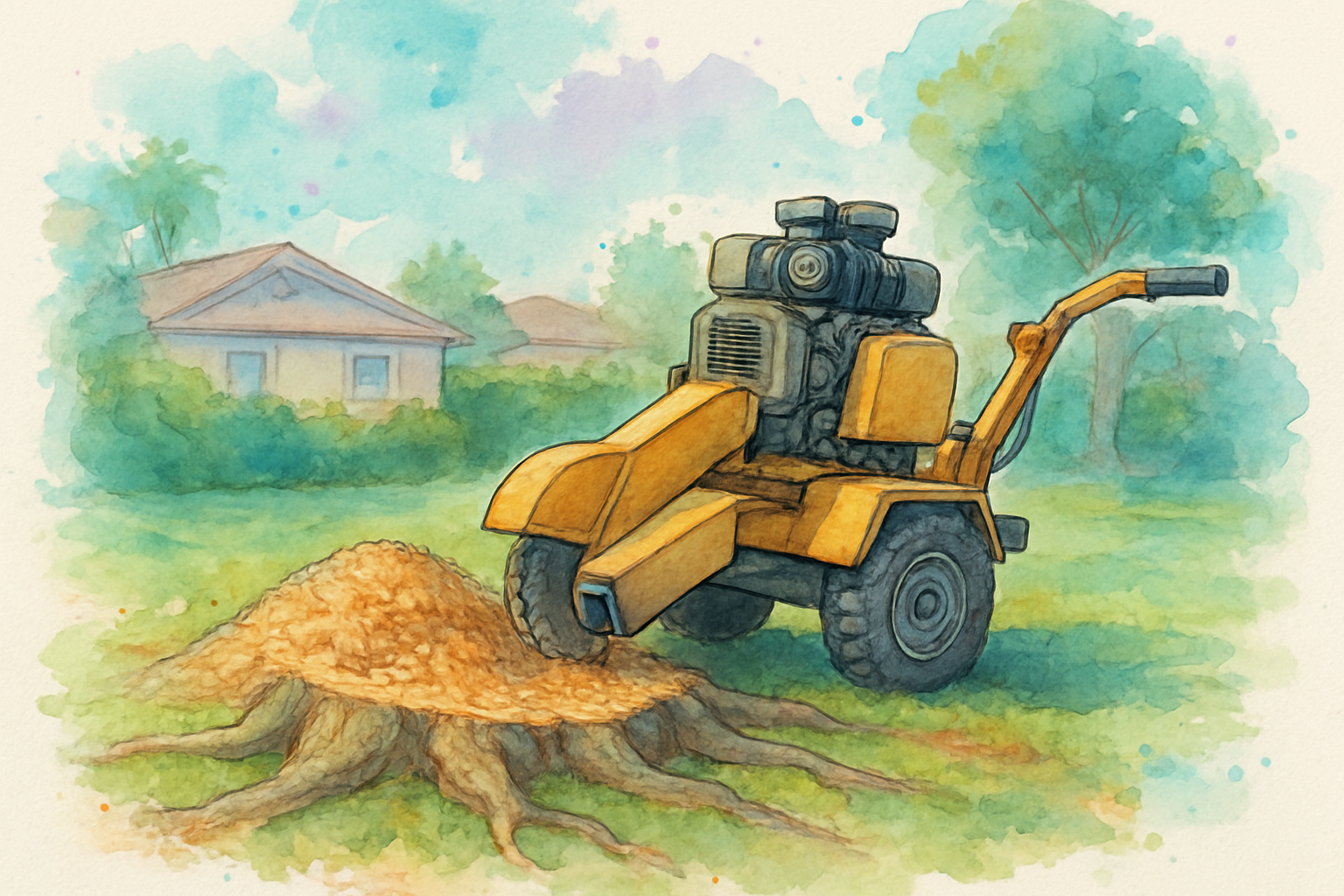
When a stump grinder runs over a stump, the cutting wheel grinds the wood down 6 to 12 inches below grade, sometimes deeper on request. That’s enough to eliminate the visible stump and let you re-sod or plant over the area. But the main lateral roots — the ones that can extend outward two to three times the tree’s original height — stay completely intact underground.
For a mid-sized oak or eucalyptus that stood 40 feet tall, that means roots potentially spreading 80 to 120 feet in every direction. Most of that lateral root mass won’t cause visible problems. But it’s there, and it matters when you’re planning what comes next.
Two things happen to those roots over time:
- Decay begins immediately once the stump is ground and the tree can no longer move nutrients through its system
- Surface roots close to the grind zone soften and sink as the wood breaks down, which can create small depressions in the lawn over 1–3 years
- Deeper tap roots on species like pine or large oak take significantly longer — sometimes 7 to 10 years to fully decompose in Monterey County’s cooler coastal soils
- Fungal activity increases as decay accelerates, which is normal and actually healthy for soil biology
The decay timeline is heavily influenced by the tree species, soil moisture, and whether the root zone gets regular water. In Salinas and the inland Monterey County valleys, where summer soils dry out significantly, decay tends to move slower than in wetter, coastal areas like Carmel or Pacific Grove.
When the Remaining Roots Actually Cause Problems
Most of the time, underground roots from a ground stump just sit there and rot quietly. But there are situations where they create real issues worth knowing about before you commit to what comes next.
Surface root heaving is the most common complaint. If the tree had aggressive shallow roots — Monterey cypress, some species of pine, certain ornamental trees common in coastal subdivisions — those surface roots can lift paving, crack concrete borders, or create tripping hazards as they shift during decomposition. This is less about the roots growing and more about the soil settling unevenly as the wood breaks down.
Sprouts are a separate concern. Some tree species generate new growth from the surviving root system after the stump is removed. Willow, mulberry, and some elm species are common offenders in this region. Those sprouts aren’t dangerous, but they’re persistent — cutting them back without treating the root system just delays the problem. A licensed contractor can apply a stump treatment at the time of grinding to prevent regrowth on susceptible species.
If you’re planning to install hardscape — a patio, walkway, or retaining wall — near a recently ground stump, the location of the original root mass matters for your design. As roots decay, they leave voids in the soil. Those voids can cause settling under pavers or concrete slabs if the hardscape footprint overlaps the root zone. It’s a solvable problem, but it has to be planned for. If you’re curious how this affects project sequencing, why most hardscape projects fail before a single paver is installed covers the underlying reasoning.
For tree removal and root issues near structures, understanding the full risk picture matters. Should I remove a tree before storm season in California? lays out the broader decision-making process when timing and risk intersect.
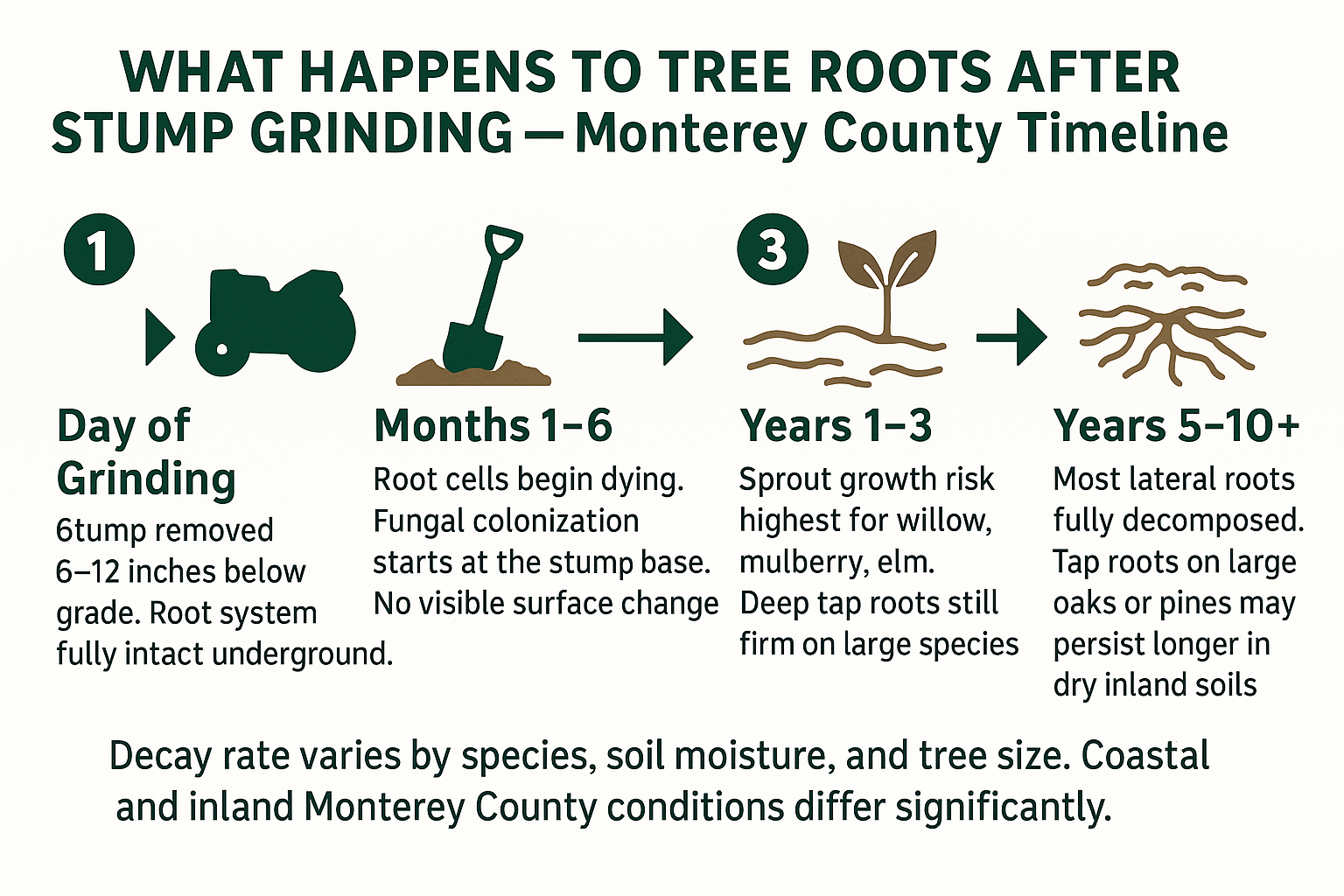
Root Decay Timeline After Stump Grinding
This timeline shows roughly what happens underground in the years following stump grinding, based on common tree species and Central Coast soil conditions.
Root Behavior by Common Tree Species in Monterey County
Different tree species leave very different root systems behind. This table covers species commonly removed in Monterey County and what to expect post-grinding.
| Tree Species | Root Spread Tendency | Decay Timeline | Sprout Risk After Grinding |
|---|---|---|---|
| Monterey Cypress | Aggressive lateral spread, shallow | 5–8 years | Low |
| Blue Gum Eucalyptus | Very wide spread, deep tap root | 7–12 years | Moderate — treat at time of grinding |
| Valley Oak / Coast Live Oak | Deep, wide lateral system | 8–12 years | Low |
| Monterey Pine | Moderate lateral, deep tap root | 6–10 years | Low |
| Willow (various) | Dense, shallow, aggressive | 3–6 years | High — treat root system at time of grinding |
| Ornamental Mulberry | Shallow, wide-spreading | 4–7 years | High — regrowth common without treatment |
| Italian Stone Pine | Moderate, surface-prone | 5–9 years | Low |
What You Can Plant or Build on a Ground Stump Site — and When
The most common follow-up question after stump grinding is whether the spot is ready for something new. The short answer: it depends on what you want to put there.
For grass or ground cover, the area is usually plantable within a few weeks of grinding. The wood chip debris left behind actually makes decent mulch if mixed into the soil, though it can be nitrogen-poor as it breaks down. Mixing in a nitrogen-rich amendment helps grass establish faster. Most residential lawns in Salinas and the Monterey Peninsula can be re-seeded or sodded within 30 to 60 days of grinding without issues.
For a new tree, the timing changes significantly. Planting a new tree directly into the old root zone creates two problems: the decaying roots compete with the new tree for soil oxygen, and the settling soil as roots break down can leave the new tree’s root ball in an unstable position. A general rule of thumb is to wait at least one full growing season — roughly 12 months — before planting a new tree in the same footprint. Moving the new planting 3 to 5 feet away from the old stump center is a better option if the layout allows it. For more detail on this specific decision, can I plant grass or a new tree where a stump was ground down? walks through the variables.
For hardscape, give the root zone time to stabilize — at minimum one rainy season — before pouring concrete or setting pavers over the former root mass. If the project timeline doesn’t allow for that, a contractor can excavate the root zone, backfill with compacted base material, and proceed with hardscape installation on a stable foundation. That adds cost but removes the settlement risk entirely.
On larger lots or properties clearing multiple trees, the post-grinding root situation gets more complex. If you’re dealing with a significant land clearing scope, lot clearing services: a California property owner’s guide covers how professional contractors approach that kind of multi-tree site preparation.
The Cost Side: What Affects Stump Grinding Pricing in Monterey County
Stump grinding in Monterey County typically runs $150 to $500 per stump for residential work, with larger stumps on commercial properties or land clearing projects priced by diameter or as part of a broader scope.
Root-related factors that affect pricing:
- Grinding depth requested — standard is 6–8 inches; going to 12 inches or deeper for irrigation or hardscape prep adds cost
- Surface root exposure — stumps with heavy visible root flares require more time and grinder positioning
- Stump treatment for sprout prevention — typically adds $50 to $100 per stump on species with high regrowth risk
- Debris removal — the wood chip pile left behind can be spread on-site at no extra charge, or hauled off for an additional fee
- Access difficulty — in older Salinas neighborhoods with tight lot lines, or on hillside properties in Carmel Valley, equipment access adds time
For context on how pricing varies based on the full scope of tree work, why tree removal quotes vary so much and what the difference actually means breaks down the factors that separate a thorough quote from a lowball number.
Frequently Asked Questions About Roots After Stump Grinding
Will the roots keep growing after the stump is ground down?
No. Once the stump is removed, the tree can no longer photosynthesize or move energy to the root system. The roots stop growing and begin to decay. The one exception is sprout production from the root system on certain species — but that’s the roots trying to regenerate the tree, not the roots expanding further. A stump treatment applied at the time of grinding prevents this on high-risk species.
Can underground roots damage my foundation or pipes after grinding?
Roots from a dead tree are not actively growing toward anything. The concern about roots damaging foundations or pipes applies to living trees, where roots follow water and oxygen. After grinding, the root system is dying and presents no new risk to structures. If roots had already penetrated pipes or foundation cracks before removal, that’s a separate problem that existed before grinding and needs to be addressed directly — grinding alone doesn’t resolve pre-existing root intrusion.
How long before the wood chips and debris settle after grinding?
The chip pile left in the stump cavity typically settles 3 to 6 inches below grade over the first 6 to 18 months. Most contractors will either grade the chips flush with the surrounding soil or mound them slightly to account for settling. If you’re re-sodding, plan for one additional top-dress with soil after the first rainy season.
Do I need to remove the roots if I’m putting in a patio?
Not always, but the root zone needs to be accounted for in the design. For a patio that overlaps the former stump area, the safest approach is to excavate the root mass, backfill with compacted base material, and build on that. A contractor with hardscape experience can assess whether the root depth and size pose a real settlement risk for your specific layout before any material is ordered.
Will the decomposing roots smell or attract pests?
Mildly, yes, in the early months — especially during wet weather when fungal activity increases. This is temporary and part of normal decomposition. It’s not a pest or infestation problem; it’s biology. If you notice mushrooms near the old stump area, that’s the same process. They typically stop appearing once the root wood has broken down enough.
Questions About a Stump on Your Property?
California Landscape & Tree Pros holds a C-49 Tree and Palm Contractor license (CSLB #1107800) and serves residential, commercial, and HOA clients throughout Monterey County and the Bay Area. If you’ve got a ground stump and aren’t sure what comes next — for planting, hardscape, or just a realistic timeline — the team can walk you through it. Reach the Salinas office at 831-998-7964, the Monterey line at 831-905-8018, or submit a request at californialandscapeandtreepros.com/request-a-quote/.