
Quick Answer
Tree removal quotes vary because the scope of work varies, not just the price. Whether stump grinding is included, whether debris is hauled away or left as chips, whether the job requires a crane or specialized rigging, and whether yard protection is part of the crew's process all affect cost and outcome. Comparing quotes without understanding these variables means comparing different jobs, not different prices for the same job. For a deeper look at why this work takes real judgment, see why tree work requires real expertise, not just tools.
If you're holding two or three tree removal quotes and the numbers are far apart, the confusion is reasonable. Most property owners assume they're looking at the same job with different pricing, when in reality they may be looking at different scopes, different cleanup standards, and different levels of risk management.
That is why tree removal quotes vary so much and what the difference means. A quote is not just a price. It's a description of how the contractor plans to remove the tree, protect the site, handle the debris, and leave the property when the crew is done.
Introduction
In Monterey County, this happens all the time. A homeowner gets one quote that seems surprisingly low, one that looks mid-range, and one that feels high. All three say "tree removal," but that doesn't mean all three are pricing the same work.
A professional quote should tell you more than the bottom line. It should show whether the contractor is pricing felling, rigging, haul-away, stump handling, and site protection. Felling is cutting the tree down. Rigging is the controlled lowering of sections with ropes and hardware when there isn't enough room to drop the tree safely. Disposal covers chips, logs, brush, and final cleanup.
If those pieces aren't clear, the numbers won't make sense. They aren't supposed to.
Why Tree Characteristics Are a Major Cost Factor
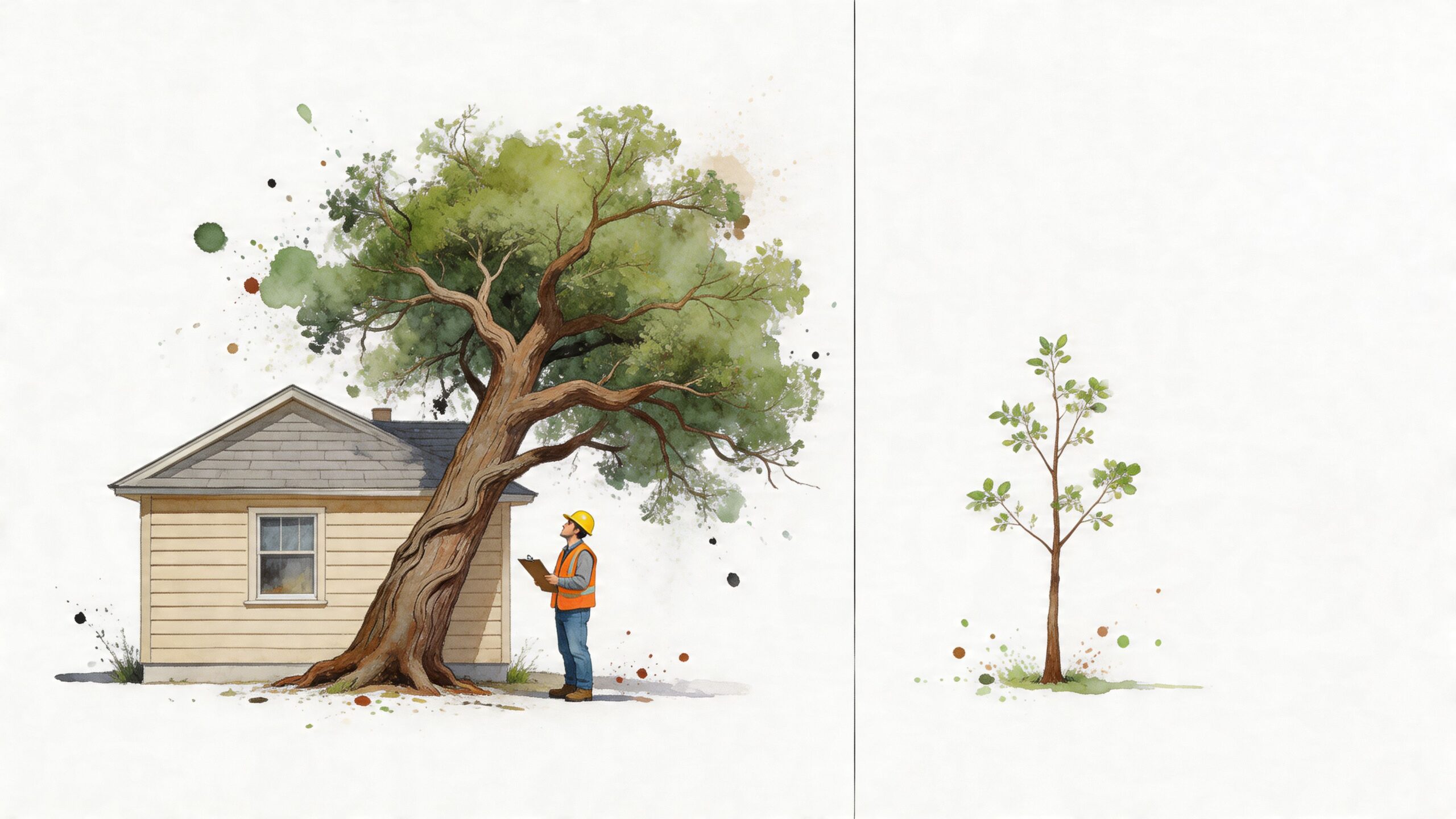
A 25-foot ornamental in decent shape and a 70-foot oak with heavy lateral weight may both be labeled "tree removal" on a quote. From the contractor's side, they are different scopes of work from the first cut.
That distinction matters. If you want to compare bids fairly, start by asking whether each contractor is pricing the same tree problem.
The tree itself drives the work plan. Size, species, and condition determine how the crew will cut it, what equipment they will bring, how long the job will take, and how much risk they are carrying. Price follows scope.
Size changes production first. Industry benchmarks show small trees under 30 feet often price around $300 to $800, medium trees $800 to $2,500, and large trees over 60 feet $2,500 to $10,000+ (Tree Rescue FL, 2023). A larger trunk also changes what can be lifted, lowered, chipped, and hauled in a normal workday.
On site, bigger wood usually means more cuts, smaller picks, more rigging time, and more handling on the ground. That is why two quotes can separate fast once height and trunk diameter increase, even before you get into access or disposal.
Size affects method, not just effort
A small tree with room to work can often be removed with a simple cutting sequence and basic cleanup. A mature tree with long limbs, top weight, or a broad canopy usually has to be dismantled section by section.
That changes the scope in practical ways. More climbing time. More rope work. More saw changes. More labor on the ground to process brush and wood safely.
One useful checkpoint is simple. Ask every bidder to write the estimated height and trunk diameter on the quote. If one contractor measured and another gave a number from the driveway, those bids are built on different assumptions.
Species changes cutting speed and debris weight
Homeowners often expect two trees of similar size to cost about the same. In practice, species can shift the job a lot.
Dense hardwoods usually cut slower, weigh more per section, and take longer to process once they are on the ground. Fibrous species can tangle brush handling. Some trees create far more debris volume than their trunk size suggests. If stump grinding is part of the bid, root structure matters too.
In Monterey County, that shows up often with mature oaks versus lighter, faster-processing species. The canopy may look comparable from the street, but the labor plan is not.
Condition changes risk, and risk changes scope
A healthy tree is more predictable under load. A dead, decayed, storm-damaged, or heavily leaning tree is not.
That affects how a licensed contractor prices the work. Brittle tops can shatter during cutting. Hollow stems limit tie-in points. Cracks, included bark, and root failure can take standard approaches off the table. In those cases, the crew may need a slower dismantle, smaller pieces, extra rigging, or a different setup altogether.
This is one reason a careful bid can come in higher than a quick one. You are paying for a plan that fits the tree's actual failure potential, not a best-case assumption.
If the tree has visible decay, recent breakage, a pronounced lean, or dead wood over a house, driveway, or patio, ask who inspected it and what removal method they priced. A contractor who explains that clearly is giving you something useful. For a better sense of that evaluation process, read what a certified arborist really does.
How Site Access and Location Affect the Price
 tree removal services.” />
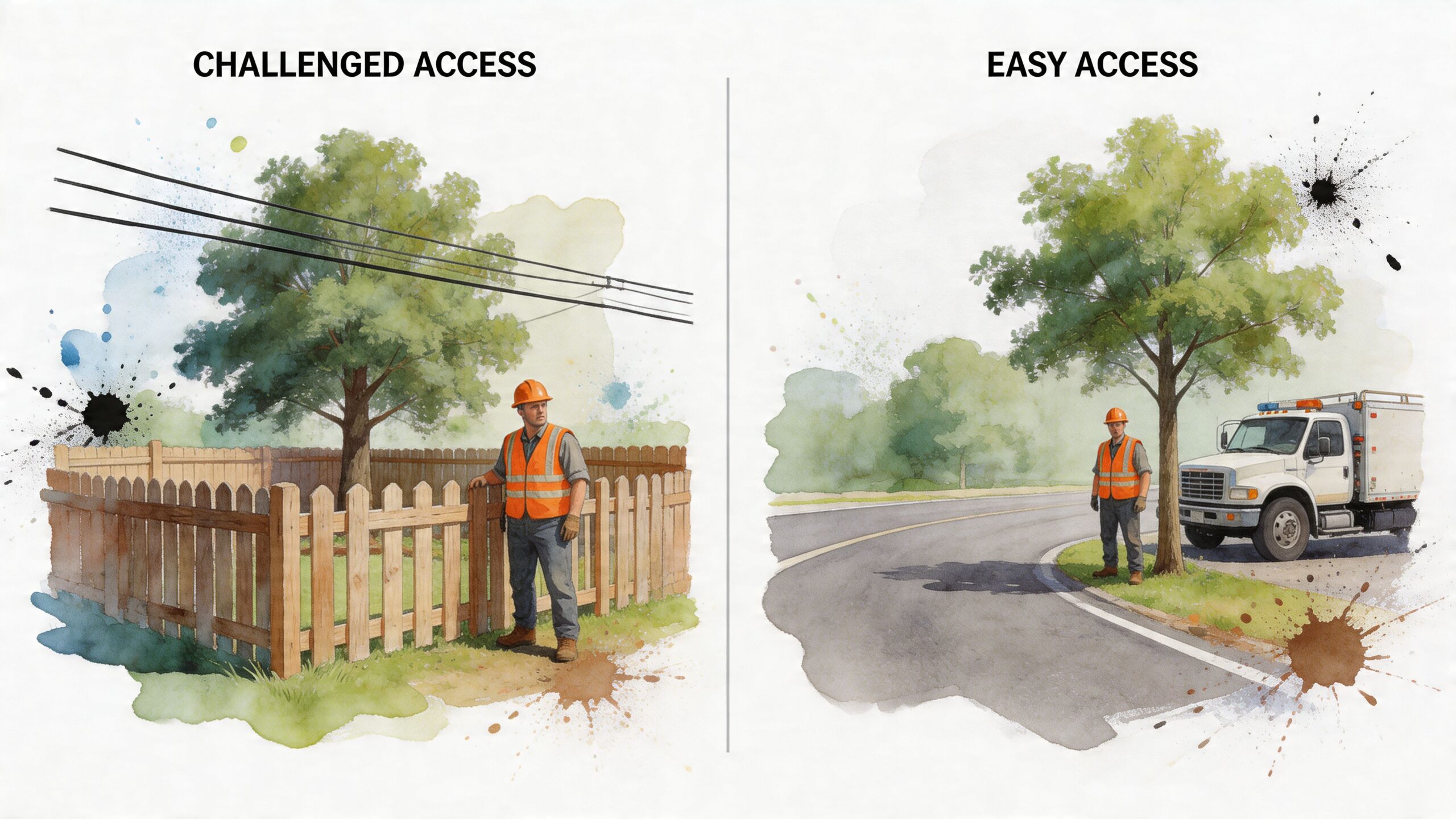
Two Monterey County properties can have the same size tree and get very different prices. One has a gate wide enough for equipment, room to lower brush, and a truck parked close to the work. The other has a steep backyard, a narrow side yard, overhead service lines, and a fence that forces every piece to be carried out by hand. Those are not the same job.
This is the part many owners miss. Access and location do not just affect convenience. They change the scope of work.
Access determines labor, equipment, and disposal time
If a crew can work directly from the driveway or street, productivity stays high. Brush gets chipped near the tree. Wood gets loaded once. The climber and ground crew keep moving.
Tight access changes all of that. If material has to be dragged through a side yard, lowered in small pieces, or staged away from the chip truck, labor hours rise fast. The price usually reflects more ground time, more handling, and often a larger crew to keep the site controlled.
A low quote sometimes assumes easy production on a site that is not easy to work.
Location around structures changes the removal method
A tree standing out in an open area may allow larger sections and a faster pace. A tree over a roof, fence line, retaining wall, patio cover, or neighbor's yard usually has to come apart piece by piece.
That means more rigging, more setup, and more property protection. It can also mean smaller cuts, extra landing-zone control, plywood over finished surfaces, and slower cleanup because debris cannot be dropped and processed without careful management where it lands.
From the business side, quote comparison usually goes off track at this point. One contractor may be pricing a controlled dismantle with a conservative work plan. Another may be pricing the same tree as if there is room to free-drop wood. Until you normalize that scope, the prices are not comparable.
A tree removal quote makes more sense once you ask one question first: what removal method is this price based on?
Streets, utilities, slopes, and public exposure add coordination
Site location can add costs that have nothing to do with the tree itself. Hillside footing slows climbing and brush movement. Street frontage may require traffic control or stricter staging. Trees near utility lines, sidewalks, or neighboring property lines call for tighter piece control and, in some cases, outside coordination before work starts.
Protected tree rules and frontage issues can also affect jobs in Monterey County. If permits, inspections, or public right-of-way conditions are involved, that should show up clearly in the quote as part of the scope, not as a surprise later.
Emergency access is priced differently from scheduled access
A planned removal gives a contractor time to stage the right crew, equipment, and disposal plan. Storm damage or sudden failure changes that. The tree may be hung up, partially split, blocking a driveway, or too unstable for a standard climb.
That kind of work is usually slower, riskier, and harder to schedule efficiently. If you are dealing with a recent failure, compare it against other emergency scopes, not routine removals. For urgent hazards, review 24-hour emergency tree service.
The practical takeaway is simple. Before comparing prices, line up the access conditions and the work method each contractor included. If one quote assumes direct truck access and another assumes hand-carry through a gated yard, the number is different because the job is different.
Deconstructing the Scope of Work in Your Quote
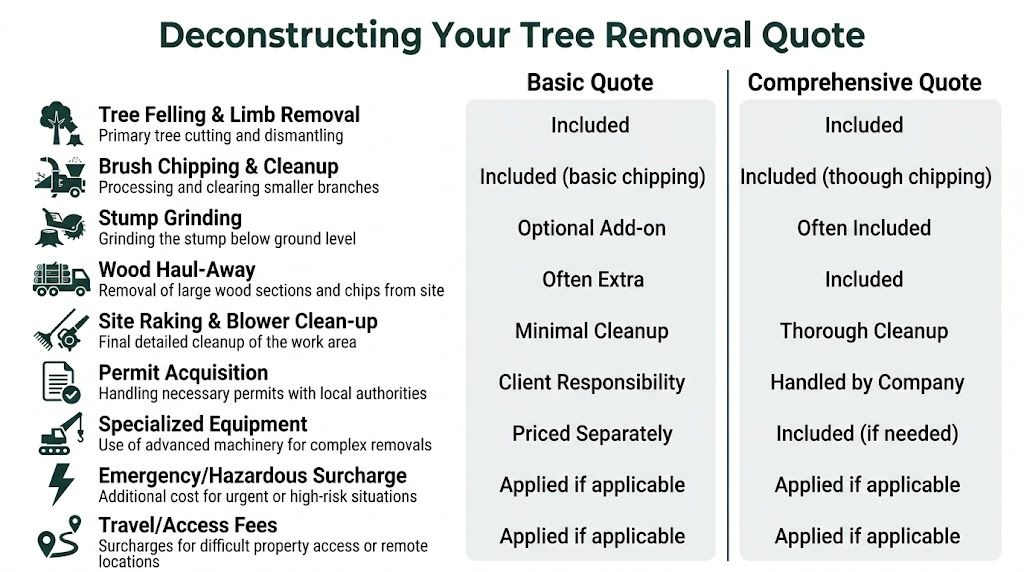
A property owner gets two quotes for the same oak. One is $2,400. The other is $4,100. On paper, both say tree removal and cleanup.
Those are not matching scopes.
This is the part I tell people to slow down on. Price only means something after you normalize what each contractor is including. If one bid covers the full removal, stump grinding, haul-away, surface cleanup, and permit coordination, while another only covers getting the tree on the ground and stacking the wood, the lower number is not cheaper work. It is less work.
Stump handling changes the finished result
Many low or mid-range quotes stop at removal of the standing tree. The stump stays unless the estimate says otherwise. Even when grinding is included, the finish can vary a lot. One contractor may grind just below grade for appearance. Another may grind deeper because the owner plans to replant, pour a walkway, or extend irrigation through that area.
That detail affects the usable result more than many owners expect.
Ask three direct questions. Is the stump included, how deep will it be ground, and what happens to the grindings afterward. If you want to understand the difference between surface grinding and actual root removal, read why stump grinding doesn't remove the roots and why that matters for your yard.
Debris disposal needs to be spelled out
"Cleanup" is one of the most misleading words in tree work. I have seen it used to mean anything from rough brush consolidation to a near-finished yard with chips, logs, and fine debris all removed.
Quotes should state the debris plan in plain language:
- Wood chips. Left on site, spread in a bed, or hauled away
- Logs and rounds. Hauled off, bucked and stacked, or left where dropped
- Small debris. Basic blow-off only, or rake and finish cleanup
- Disposal fees. Included in the base price, or added if volume runs higher than expected
If the debris outcome is not written down, assume the contractors are bidding different jobs.
Site protection separates careful work from fast work
A good removal does not end with the tree gone. It ends with the property in the condition that was promised.
That means the quote should tell you how the crew plans to protect lawn, irrigation, hardscape, planter beds, fences, and gates. In tight Monterey County yards, protection often adds labor because material has to be rigged smaller, carried farther, or staged more carefully. Those steps cost money, but they also reduce repair work after the tree crew leaves.
I usually tell owners to ask one question: What are you protecting, and how are you protecting it? A contractor who has thought through the job can answer that clearly.
Permits, equipment, and change-order risk belong in the scope
Some quotes are low because they leave key parts unresolved. Permit handling may be excluded. Specialty equipment may be listed as extra if needed. Haul-off volume may be treated as an allowance instead of a fixed inclusion.
That is where owners get surprised later.
A stronger estimate makes those assumptions visible before work starts. If a crane, lift, extra rigging, traffic control, or permit coordination might be required, the quote should say whether that cost is included, excluded, or subject to revision after site confirmation.
Use this table to normalize bids before comparing totals:
| Scope item | Quote A may include | Quote B may include |
|---|---|---|
| Tree cutting | Sectional dismantle to protect targets | Tree dropped or removed with minimal piece control |
| Stump | Left in place or priced separately | Grinding included to a stated depth |
| Debris | Chips and logs left on site | Full haul-away and dump fees included |
| Cleanup | Basic blow-off | Rake, blower work, and finished surface cleanup |
| Site protection | No written method | Mats, controlled lowering, and protection of landscape features |
| Permits | Owner responsibility | Contractor handles filing or coordination |
| Equipment | Added later if needed | Anticipated equipment built into the price |
The cleanest way to compare quotes is to ignore the totals for a minute and line up the scope line by line. Once the work is normalized, the price difference usually makes sense.
Your Pre-Bid Checklist for Accurate Quotes
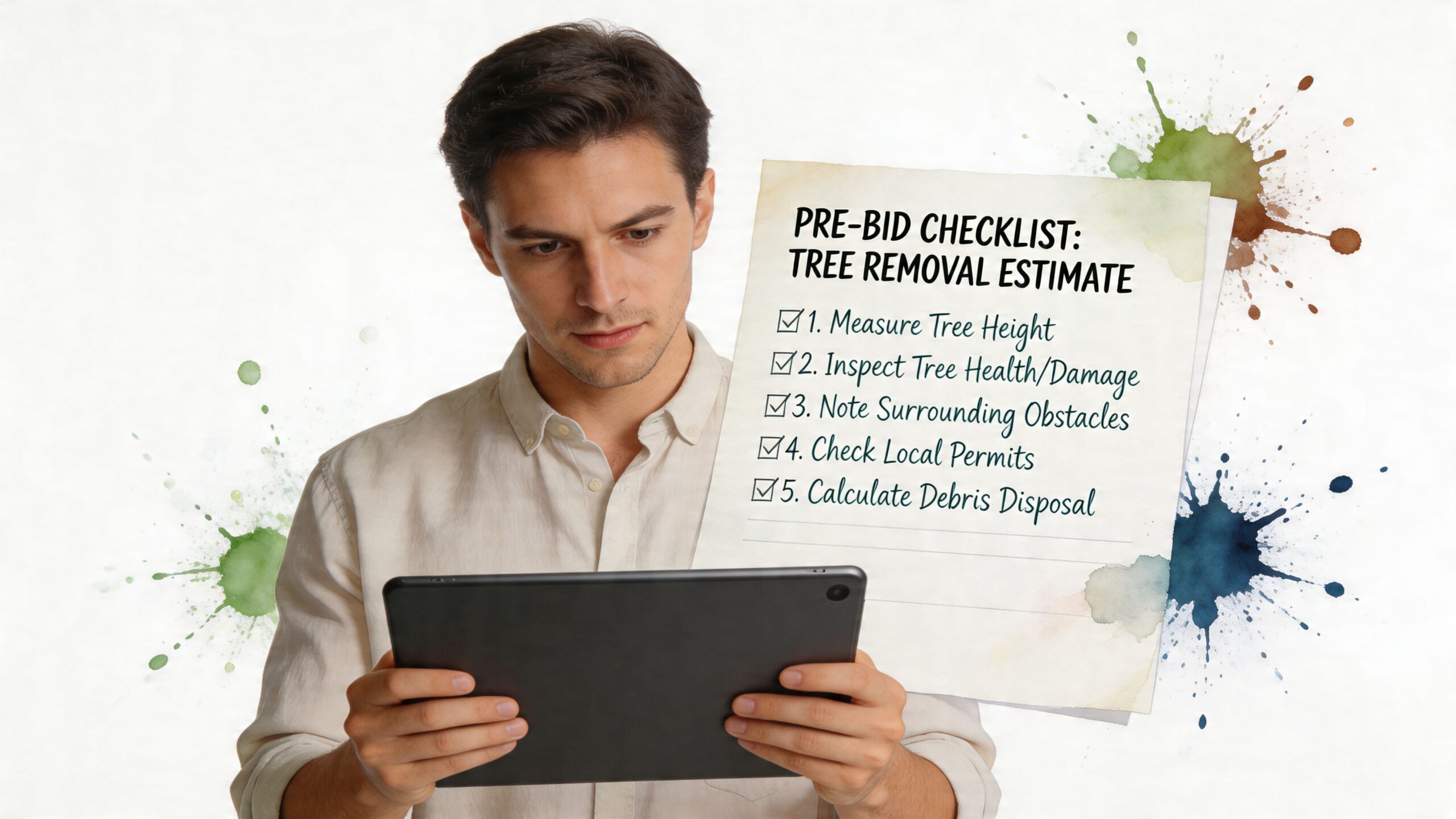
If you want usable quotes, define the job before the estimators arrive. That doesn't mean telling a contractor how to do tree work. It means telling each bidder the same desired outcome.
That one step removes a lot of noise from the process.
Five things to decide before anyone quotes the job
- Obstacles near the tree. Note the house, fence, shed, utility lines, driveway, retaining wall, neighboring yard, and any planting beds below the canopy. Access and target exposure affect the removal plan.
- What you want done with the stump. Decide whether you want it left, ground separately, or included in the main scope.
- What should happen to debris. Choose whether you want chips left for mulch, logs saved, or everything removed.
- Which license and coverage you'll ask about. In California, ask whether the contractor's license covers tree work and ask for proof of insurance and workers' compensation.
- Whether the quote will be itemized. Request a written estimate with separate line items when possible. Itemization makes quote comparison far easier.
Bring the same questions to every estimator
Write these down and use the exact same wording with each company:
- What happens to the stump?
- What happens to the chips, logs, and brush?
- Does this tree require special equipment or rigging because of location or size?
- What does cleanup include?
- Are permits or special approvals part of your price?
That gives you a common scope before you even look at the numbers.
For a broader hiring checklist, see what to know before hiring a tree removal company in Monterey County.
How to Compare Quotes and Spot Contractor Red Flags
A property owner gets three quotes for the same Monterey County tree and sees a spread of thousands of dollars. In my trade, that usually does not mean one company found a secret bargain. It means the companies are pricing different scopes, different risk levels, or different finish standards.
Start by setting the totals aside. Read each quote like a work order. What matters is what the crew will do on site, what they will remove, what they will protect, and what they will leave behind when they drive away.
Normalize the scope before comparing price
Put the estimates side by side and check the scope line by line:
- Removal method. Is the tree being climbed and dismantled in pieces, rigged over targets, lifted by crane, or dropped in one piece where space allows?
- Stump handling. Is stump grinding included, listed as an option, or left out entirely?
- Debris outcome. Are brush, chips, and logs hauled away, stacked, or left on site?
- Cleanup standard. Does cleanup mean rake and blow, or just pushing debris into a pile?
- Site protection and logistics. Does the quote mention lawn protection, access mats, traffic control, permit coordination, or protection for fences, paving, and nearby structures?
If one quote says "remove tree" and another spells out all five of those items, those numbers are not ready to compare.
Low bids often have gaps
A lower bid is not automatically a bad bid. Some companies run lean, some have the right equipment already nearby, and some removals are simple.
The problem is a low bid with missing details.
The gaps I see most often are stump work, haul-away, finish cleanup, permit responsibility, and protection for the surrounding property. Those missing pieces are where change orders, job-day arguments, and disappointing results usually start. If the scope is vague, ask the contractor to revise it in writing before you compare price again.
If one quote is much lower, ask what is excluded, what is optional, and what would trigger added charges.
Red flags worth taking seriously
A few warning signs show up before a saw ever starts:
- Pressure to agree on the spot. A professional company should give you a written quote and time to review it.
- No written scope. If cleanup, debris handling, stump treatment, or protection measures are not listed, expect confusion later.
- Vague answers about insurance or workers' compensation. In tree work, that is a business risk issue, not paperwork trivia.
- Unclear license information. In California, the license and classification need to match the work being offered.
- Promises made verbally but not added to the quote. If you care about it, get it in writing.
- No site visit for a complex removal. A large tree over a house, driveway, or neighboring fence should be looked at in person before anyone prices it seriously.
Higher quotes often include more accountability
Higher pricing can reflect better planning, trained labor, more controlled rigging, documented insurance, and a cleaner finish. It can also reflect the fact that the contractor has accounted for the risks on your property instead of assuming the job will go perfectly.
That difference matters most when the tree is close to a home, access is tight, or local permit questions may affect the job. The useful comparison is incomplete scope versus defined scope, and unmanaged risk versus controlled risk. Once the work is normalized that way, the price spread starts to make sense.
Frequently Asked Questions About Tree Removal Quotes
Why are my tree removal quotes so far apart if it's the same tree
Because it often isn't the same scope. One company may be pricing the cut only, while another includes rigging, haul-away, stump grinding, and detailed cleanup. Until the scope matches, the price spread doesn't tell you much.
Should stump grinding be included in a tree removal quote
Not automatically. Some contractors include it, some list it separately, and some leave it out unless you ask. If you care about the finished look or future use of the area, make stump handling part of the quote request.
Can I keep the wood and still get a full cleanup
Yes, but define what "keep the wood" means. You can ask the crew to cut logs to manageable lengths while still hauling brush and chips away. Put that in writing so there is no confusion on the job day.
Do I need to be home when the tree is removed
Not always. Many removals can be done while the owner is away if access, scope, and payment terms are already clear. If gates, pets, vehicle access, or neighbor coordination are involved, being available is helpful.
Why does one quote mention permits and another doesn't
Permit needs depend on the tree, the location, and local rules. One contractor may have already identified a permit issue and built that into the proposal. Another may not have addressed it yet. Ask directly who is responsible for permits before you sign.
What happens if the crew damages my property
That is exactly why licensing, insurance, and written scope matter. A professional contractor should explain how property protection is handled and should have coverage in place if something goes wrong. If the answer is unclear before the job, don't expect it to become clearer after.
Get a Clear, Comprehensive Quote for Your Tree Project
A good tree removal quote should tell you what is being removed, how it will be done, what happens to the stump and debris, and what your property should look like when the crew leaves. If you understand the scope first, the price starts to make sense.
If you already have estimates and aren't sure whether they're covering the same work, a straightforward conversation with a licensed contractor can help you sort out the differences before you commit.
If you'd like a clear, itemized estimate for why tree removal quotes vary so much and what the difference means on your property, California Landscape & Tree Pros can help. Call (831) 998-7964 in Salinas or (831) 905-8018 in Monterey, visit 1184 Monroe St., Suite 6, Salinas, CA 93906, or start at californialandscapeandtreepros.com.
Sources
Tree Rescue FL. "7 Factors That Contribute to Tree Removal Company Prices." 2023. https://www.treerescuefl.com/7-factors-that-contribute-to-tree-removal-company-prices
Tree Care Industry Association. "Why Is Tree Work So Expensive?" 2023. https://treecareindustryassociation.org/why-is-tree-work-so-expensive/
Maven Tree Services. "What's the Right Number of Quotes to Compare Before Hiring a Tree Service." https://www.maventreeservices.com/post/what-s-the-right-number-of-quotes-to-compare-before-hiring-a-tree-service