
When a fierce Monterey storm sends a tree crashing down, the sound is unforgettable. A true tree emergency isn't just an inconvenience; it's a high-stakes situation that poses an immediate risk to people or property, demanding a response that simply can't wait for regular business hours. Knowing when to make that urgent call is the first step toward keeping your family and your Salinas-area home safe.
When Do You Need a 24-Hour Tree Service?
That heart-stopping moment when a tree leans precariously over your home or a massive branch dangles over your driveway is incredibly stressful. While not every fallen limb is a crisis, certain scenarios absolutely require immediate, professional intervention. A genuine tree emergency typically involves one of these high-risk situations:
- Immediate Danger to Structures: A tree or a significant limb has already fallen on your house, garage, or another building, or it's leaning at a dangerous angle that suggests imminent failure.
- Blocked Access: A fallen tree is completely obstructing a critical driveway, road, or walkway. If emergency services can't get in or you can't get out, it's an emergency.
- Split Trunks or Hanging Limbs: A large limb is cracked and hanging dangerously—often called a "widow-maker"—or the main trunk has split, compromising its structural integrity.
This quick decision guide can help you assess the situation in the heat of the moment.
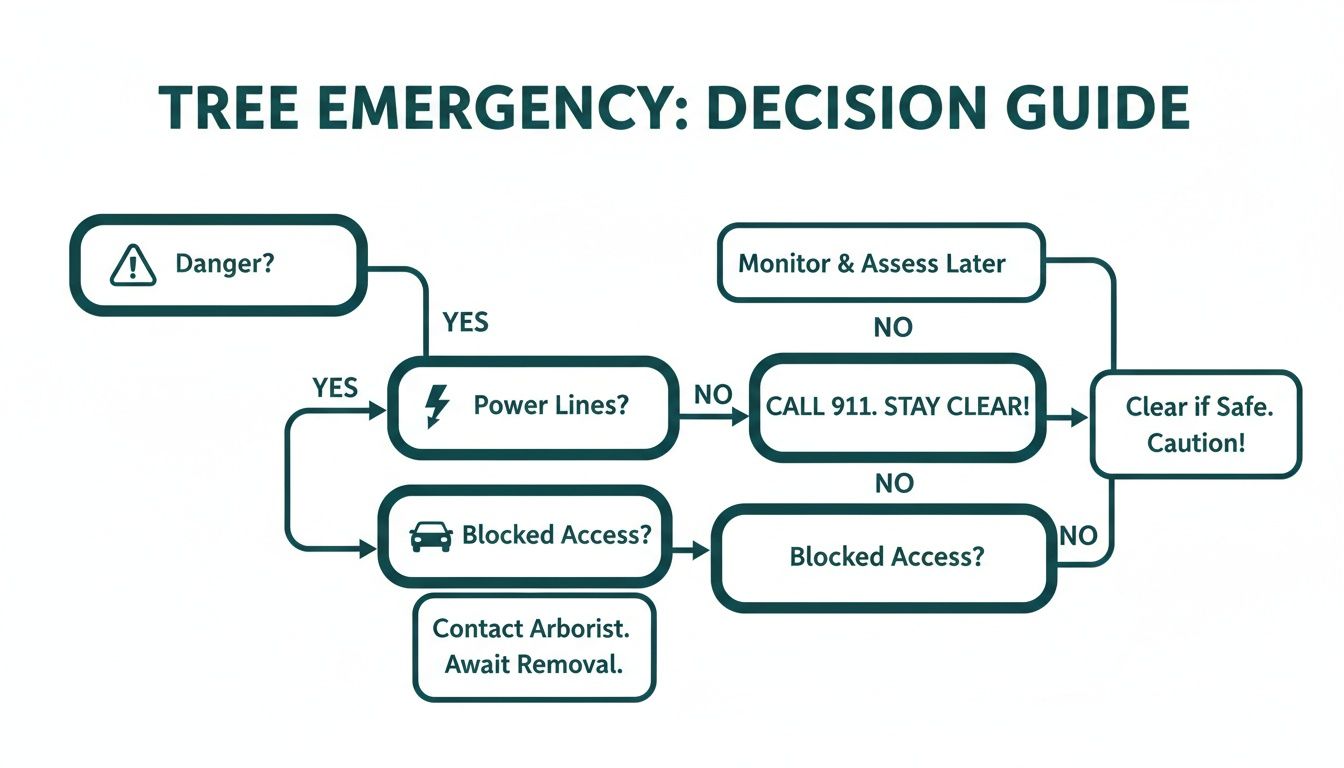
As the guide shows, any situation involving immediate danger, contact with power lines, or blocked essential access is a clear signal to call for professional help.
The Growing Need for Emergency Response
With increasingly severe weather events, the demand for 24/7 tree care is rising. According to the Tree Care Industry Association (TCIA), storm work is a major driver of business for tree care companies nationwide. This trend highlights the critical need for reliable, fast-acting emergency crews right here in Monterey County to mitigate hazards and respond to storm damage effectively.
Use this quick checklist to determine if your situation warrants an immediate call to a 24-hour service.
Is It a Tree Emergency? Quick Assessment Guide
| Situation | Is it an Emergency? (Yes/No) | Immediate Action |
|---|---|---|
| A tree is leaning over your house. | Yes | Evacuate the area and call for 24/7 service immediately. |
| A limb fell in the backyard, far from anything. | No | This can likely wait for a scheduled appointment. |
| A tree has fallen on your only driveway. | Yes | Call an emergency crew to clear the access point. |
| A tree is tangled in power lines. | Yes | Stay far away, call your utility company first, then a tree service. |
| Small branches and debris are in your yard. | No | This is a cleanup job, not an emergency. |
| The main trunk of a large tree has a deep split. | Yes | This indicates a high risk of failure; call for an expert assessment. |
If you're ever in doubt, it's always safer to make the call and let an expert guide you.
The best way to handle an emergency is to prevent it from happening in the first place. Learning to spot hidden tree risks before storm season is a proactive step that can save you a world of trouble and expense down the road.
To ensure your call for help gets through when every second matters, it's helpful to understand how an emergency restoration answering service operates. These specialized systems are designed to dispatch crews like ours without a single minute wasted, ensuring help is on the way.
Your First Steps in a Tree Emergency
When a tree comes crashing down, the first few moments are a chaotic blur. Your top priority is safety. Everything else can wait for a professional 24-hour tree service to arrive.
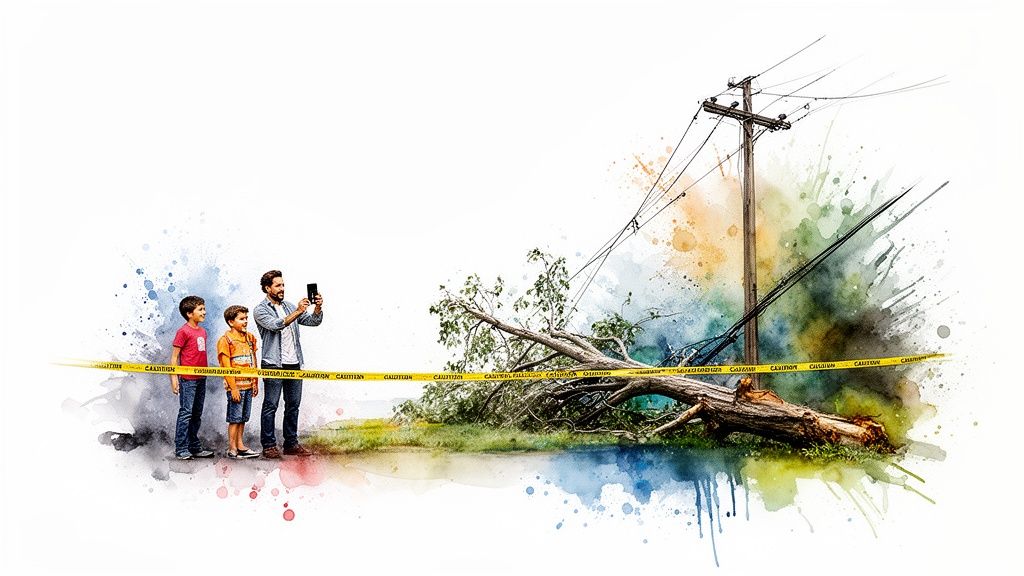
It's easy to feel overwhelmed, but a simple, step-by-step approach will get you through it. Your job isn't to start sawing branches; it's to make the area safe until the experts can take over.
Prioritize Personal Safety First
Before you even think about the tree, do a headcount. Make sure every person and pet is accounted for and out of harm's way. If the tree hit your house, get everyone out immediately and move to a safe location far from the damage.
A fallen tree can be incredibly unstable. Huge limbs can shift without warning, and the trunk could suddenly roll. Stay back at least one and a half times the height of the tree until a professional has assessed the situation.
Handle Downed Power Lines Correctly
This is the number one, non-negotiable rule. If any part of the tree is touching a power line, you must treat that line as live and deadly. Do not go near it. Do not touch the tree. Do not try to move anything.
Your first call is not to a tree service—it's to your utility company, like PG&E here in the Monterey Bay area. They are the only people equipped to safely handle and de-energize a power line. Once they give the all-clear, our emergency crew can get to work on the tree.
A downed power line can electrify the ground for 35 feet or more. According to OSHA, you don't even have to touch a power line to be in mortal danger. Stay far back and call the utility company first. Always.
Document and Secure the Area
With everyone safe and the utility company called (if needed), it's time to become a photographer. From a safe distance, take as many clear photos and videos of the damage as you can. This evidence is absolutely essential for your insurance claim.
Make sure you capture:
- The entire tree and where it landed on your property.
- Close-ups of every point of impact—roof, car, fence, etc.
- Any visible rot or decay that might have caused the failure.
- Wider shots to show the complete scene.
Once you have your photos, cordon off the area. Use rope, caution tape, or whatever you have to clearly mark the danger zone. This keeps curious neighbors and family members from accidentally wandering into harm’s way. For a deeper dive into the recovery process, check out our guide on effective storm damage tree cleanup.
What Happens When the Emergency Crew Arrives
Seeing a professional crew pull up during a tree crisis is a huge relief. Our process is systematic, designed for one thing: making your property safe again, quickly and correctly. The immediate goal of a 24-hour tree service isn’t always about hauling everything away; it’s about neutralizing the threat.
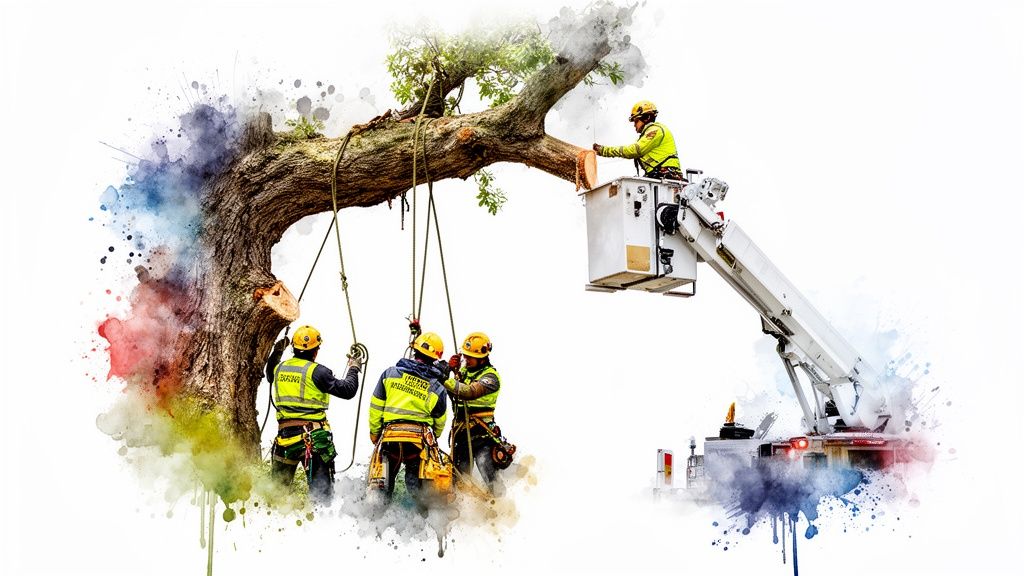
The Initial Hazard Assessment
First, our crew leader performs a rapid but thorough hazard assessment. This is a professional evaluation of every risk to people, property, and our own team.
This critical first step involves:
- Structural Analysis: We check the stability of the fallen tree or broken limbs. Is the trunk under tension? Could it roll or shift?
- Surrounding Dangers: We scan nearby trees for any compromised branches that could come down while we work.
- Utility Check: We confirm power lines are de-energized and that no other utilities, like gas lines, are at risk.
This assessment dictates our entire game plan.
Establishing a Secure Work Zone
Once we’ve sized up the hazards, we set up a secure perimeter. This "drop zone" is a clearly marked area where branches and debris will be safely lowered. No one except our trained crew is allowed inside. This vital step protects you and your property from further harm and allows our team to focus completely on the job.
Strategic and Surgical Dismantling
With the area secure, the real work begins. Emergency tree work is a delicate, strategic process. Every single cut is planned to release tension and remove weight in a controlled, predictable way.
If a tree is leaning on your roof, we often use ropes and specialized rigging to secure large limbs before we cut them free, preventing them from causing more damage. Sometimes this means making specific cuts to remove immediate threats, leaving the final cleanup for a follow-up visit. Our guide to Monterey County tree pruning and removal explains these techniques in detail.
Deploying Specialized Equipment
Our ability to handle these emergencies comes down to having the right tools. Our response trucks are loaded with a powerful arsenal to tackle almost any situation safely.
This equipment often includes:
- Bucket Trucks and Cranes: For accessing high, unstable branches and lifting huge sections of a tree off a structure with precision.
- Professional Chainsaws and Rigging Gear: A range of saws and high-strength ropes for lowering heavy wood in a controlled manner.
This combination of a systematic plan, expert training, and professional-grade equipment is what allows a qualified 24-hour tree service to turn a dangerous emergency back into a safe, secure property.
Navigating Emergency Tree Service Costs and Insurance
When a tree falls, the question of cost quickly follows the initial shock. A 24-hour tree service isn't priced like a routine trim. You’re paying for immediate availability, specialized skills, and heavy equipment ready to roll at a moment's notice—often in the middle of a storm.
Key Factors That Influence Emergency Pricing
The final price is a careful calculation based on several factors:
- Tree Size and Type: A giant, old-growth oak on your roof is a different job than a smaller pine across the driveway.
- Location and Accessibility: A tree in a tight backyard with fences and power lines requires more manual labor and creative rigging than one in an open front yard.
- Complexity of the Job: A tree leaning on a power line or balanced on a roof demands the highest level of expertise and risk management.
- Time of Day and Weather: A call in the middle of the night, on a holiday, or during a howling gale will naturally cost more.
Working with Your Homeowners Insurance
The good news is that in many legitimate emergencies, your homeowners insurance will likely cover a good portion of the cost. After the crew leaves, navigating the homeowner insurance claim process is your next step.
While policies vary, coverage usually hinges on what the tree fell on.
A Quick Guide to Insurance Coverage
- If a tree hits your house or garage: Most policies cover the cost to remove the tree off the structure and pay for building repairs.
- If a tree falls in your yard but hits nothing: Insurance typically won't pay for removal if no insured structure was damaged.
- If a tree falls and blocks your driveway: Many policies provide coverage to clear the tree and restore access to your home.
Documentation is your best friend. A professional arborist company can provide the detailed, itemized invoices and photo documentation your insurance adjuster needs, which can make a huge difference in getting your claim processed quickly. For complex situations, you can learn more about when Monterey County tree health reports and permits might be needed.
Frequently Asked Questions About 24-Hour Tree Service
When a tree emergency strikes, questions and anxieties run high. Here are clear, straightforward answers to the most common questions we hear from homeowners across the Monterey Bay area.
What is your average emergency response time in the Monterey area?
Our goal is to reach you as quickly and safely as possible. For most calls within our core service areas like Salinas, Monterey, and Carmel, we can typically be on-site within 1 to 3 hours. During major storm events, response times may vary due to weather and road conditions, but we will always provide you with a reliable estimated time of arrival.
What should I do before your crew arrives?
Your only job is to ensure everyone's safety. Move all people and pets to a secure location away from the damaged area. If power lines are involved, call your utility provider (like PG&E at 1-800-743-5000) immediately and stay far away. If it's safe to do so, take photos of the damage from a distance for your insurance claim, but do not attempt to move branches or start any cleanup yourself.
How is an emergency call different from a standard job?
A standard job is scheduled in advance and focuses on long-term tree health and aesthetics. An emergency call is about immediate triage. Our primary mission is to eliminate the immediate danger—like getting a tree off your roof or clearing your driveway. The complete, detailed cleanup can often be scheduled for the following day.
Will my homeowners insurance cover the cost of emergency tree removal?
In most cases, yes, if an insured structure (like your house, garage, or fence) was damaged. Policies vary, but coverage typically includes the cost to remove the tree from the structure and repair the damage. If a tree falls in your yard without hitting anything, coverage is less likely. We provide detailed documentation to help streamline your insurance claim.
What if the tree is on my neighbor's property but fell in my yard?
Generally, if a neighbor's tree falls and damages your property, your homeowners insurance is responsible for covering your damages. Our crew's job is to safely resolve the hazard, regardless of where the tree originated. We can work with both parties to make the area secure, but the insurance and liability details will need to be sorted out between you, your neighbor, and your respective insurance companies.
When you're facing a tree emergency in Salinas, Monterey, or anywhere in the Bay Area, you need a team you can trust to show up fast and work smart. The certified professionals at California Landscape & Tree Pros are ready to help 24/7. For immediate assistance or to schedule a proactive tree health assessment, contact us through our website at https://californialandscapeandtreepros.com.