
Direct Answer: Yes, but not right away. The wood chips and decaying root system left behind need time to break down — and what you plant matters just as much as when you plant it.
You had the stump ground down. The grinder left a pile of wood chips and sawdust where the stump used to be, and now you’re looking at that spot wondering what comes next. Can you just drop a new tree in there, throw down some sod, or plant the shrubs you’ve been eyeing at the Salinas nursery?
The short answer is yes — eventually. But the spot where a stump gets ground is not the same as clean, open soil. There’s a lot happening underground after grinding that directly affects whether your next planting survives or slowly fails.
This article covers what the soil in that spot actually looks like after grinding, which plants handle it well and which ones struggle, and how long you realistically need to wait before putting something new in the ground.
What the Ground Actually Looks Like After Stump Grinding
Most homeowners expect a clean hole after stump grinding. What they get is a shallow depression packed with wood chips, sawdust, and shredded root material — typically 6 to 12 inches deep, sometimes more for larger stumps.
That debris is not dead. It’s actively breaking down, and the microbes doing the work consume nitrogen from the surrounding soil as part of the decomposition process. This is called nitrogen drawdown, and it’s the main reason plants struggle in freshly ground spots — the soil temporarily can’t support healthy growth because nitrogen is being pulled away from plant roots, not toward them.
To understand what’s happening further underground, it helps to know that stump grinding doesn’t remove the roots. The root system stays in place and continues breaking down on its own timeline — sometimes over 3 to 7 years depending on species and size. That root mass underground affects soil structure, drainage, and what new plants can establish themselves in that space.
The practical takeaway: the spot looks ready before it actually is.
How Long Should You Wait Before Planting?
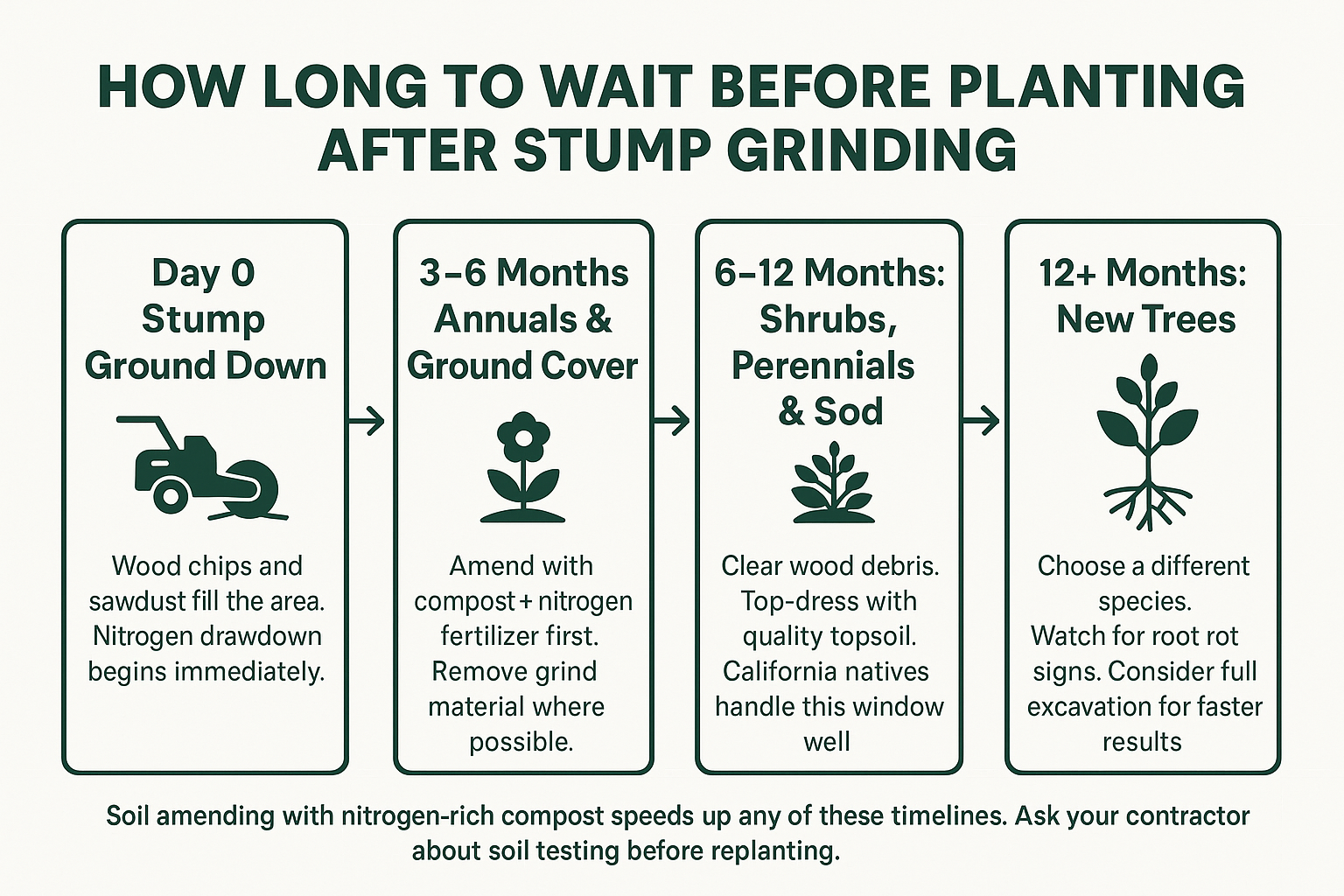
The wait time depends on what you’re planting. There’s no single number that applies to every situation, but here are the realistic ranges:
- Grass or sod: Wait at least 6 to 12 months after grinding and remove as much of the wood chip debris as possible before laying sod. Grass roots are shallow and very sensitive to nitrogen drawdown. Seeding into fresh grind material almost always fails.
- Annual flowers or ground cover: You can sometimes plant these in 3 to 6 months if you amend the soil heavily with compost and a nitrogen-rich fertilizer first. These plants have short root runs and are more forgiving.
- Shrubs and perennials: Most do fine after 6 to 12 months, especially drought-tolerant species common to Monterey County gardens — sage, ceanothus, and similar California natives handle disturbed soil reasonably well once the nitrogen picture stabilizes.
- A new tree in the same spot: This one deserves its own section — see below.
If you’re working against a deadline — say, you want the yard ready before summer or before storm season — the best move is to excavate the grind material, replace it with quality topsoil and compost, and plant on your schedule rather than the decomposition timeline. That costs more upfront but reliably works.
Planting a New Tree in the Same Spot — What Most People Get Wrong
Replacing a removed tree with a new one in the same hole is one of the most common requests CLTP gets after a stump grinding job. And it’s one of the most misunderstood situations in all of residential landscaping.
The problem isn’t just nitrogen. It’s the old root system. Why stump grinding doesn’t remove the roots is a full topic on its own — but the short version is that a new tree planted in the same spot has to compete with the decomposing root mass of the old one for water, oxygen, and soil space. That competition often slows the new tree’s establishment significantly.
There’s also a disease risk. If the original tree was removed because of a fungal disease like Armillaria root rot — which is not uncommon in the heavier clay soils you find in parts of the Salinas Valley — the pathogen can persist in the old root material and infect a new tree planted in the same ground.
The guidance from California Landscape & Tree Pros on this is straightforward: wait at least 1 full year before planting a new tree in a ground stump location, and choose a different species than what was there before. Same-species replanting in the same hole carries the highest risk of failure. If the spot absolutely needs a tree and you can’t wait, excavating the old root zone entirely is a more reliable path — though it’s more involved and costly than standard stump grinding alone.
Planting After Stump Grinding: A Timeline by Plant Type
This timeline shows realistic wait windows for different planting types after stump grinding, along with the key soil prep step each situation requires.
Planting After Stump Grinding: Quick Reference by Plant Type
Use this as a quick reference for common planting scenarios after a stump is ground down in a Monterey County yard.
| What You Want to Plant | Minimum Wait Time | Key Prep Step |
|---|---|---|
| Sod or lawn grass | 6–12 months | Remove grind debris, amend with nitrogen |
| Seeded grass | 12 months minimum | Excavate and replace with clean topsoil |
| Annual flowers | 3–6 months | Mix in compost and balanced fertilizer |
| California native shrubs | 6–12 months | Clear debris, top-dress with compost |
| Perennials (drought-tolerant) | 6–12 months | Soil test recommended first |
| New tree — different species | 12+ months | Consider root zone excavation |
| New tree — same species | Not recommended | High disease risk; consult a C-49 licensed contractor |
How to Speed Up the Timeline Without Guessing
The decomposition timeline is not fixed. There are a few things that reliably speed it up — and a few homeowner shortcuts that backfire.
What actually helps:
- Remove the wood chip debris. Don’t just rake it flat and plant into it. Shovel it out and use it as mulch elsewhere in the yard — it works beautifully as path mulch or around established trees where nitrogen drawdown isn’t a concern.
- Amend with compost and nitrogen fertilizer. Once the debris is cleared, fill the area with a 50/50 mix of quality topsoil and compost. Adding a slow-release nitrogen fertilizer before planting directly counteracts the drawdown effect.
- Do a simple soil test. Monterey County homeowners can access soil testing through the UC Cooperative Extension office in Salinas for a modest fee — typically $25 to $50 per sample. A test tells you exactly where the nitrogen and pH stand before you plant anything.
What doesn’t work:
- Covering the grind debris with a thin layer of topsoil and planting on top of it. The decomposition still happens underneath, and the nitrogen drawdown still reaches your new plant’s roots.
- Using fast-release chemical fertilizers as a one-time fix. Without clearing the debris first, you’re treating a symptom, not the cause.
For homeowners thinking about a full yard redesign in that area, it’s worth reading about what landscape design and installation actually costs in Salinas before deciding how much to invest in soil prep versus a full replant plan.
Drainage and Settling — The Issue Nobody Mentions
There’s one more factor that catches Monterey County homeowners off guard: soil settling.
After stump grinding, the area often has a slight depression once the wood chips compress and the root voids underground begin to collapse. Over 6 to 18 months, that spot can settle noticeably — sometimes dropping 2 to 4 inches below the surrounding grade. If you’ve already planted there, that settlement disrupts young root systems and creates a low spot that holds water.
In yards with existing drainage issues — common in the heavier clay soils found in South Salinas and parts of the Prunedale area — this settling can create pooling that wasn’t there before the tree came out. Grading that depression and establishing proper drainage before replanting is worth the extra step. It’s a lot easier to handle before a new plant goes in than after.
Frequently Asked Questions About Planting After Stump Grinding
Can I just throw grass seed on top of the wood chip debris right after grinding?
No — this almost always fails. Grass seed needs consistent soil contact and a stable nitrogen supply to germinate and root. Fresh grind material provides neither. The wood chips create air pockets, and the nitrogen drawdown starves the seedlings before they can establish. Remove the debris first, amend the soil, then seed after at least 6 to 12 months.
What if I want to plant a fruit tree where the old tree was?
Wait at least 12 months and choose a different species than the removed tree. If the original tree had any disease history, a soil test or professional assessment is worth doing before you invest in a fruit tree — disease pathogens can survive in old root material for years. Also choose a planting location slightly offset from the exact grind spot if possible, so new roots aren’t competing with the old root mass.
How deep does stump grinding go, and does that affect what I can plant?
Standard stump grinding goes 6 to 12 inches below grade. For most residential situations, that’s enough to plant shrubs and perennials once the debris is cleared. If you want to plant a tree or lay sod and need a cleaner result, you can request deeper grinding — typically 12 to 18 inches — though that costs more and is worth discussing with your contractor before the job starts.
Can I use the wood chip debris as mulch somewhere else in my yard?
Yes, and this is actually the best use for it. Fresh wood chips make excellent mulch around established trees and shrubs — the nitrogen drawdown effect is spread across a large surface area and doesn’t cause problems the way it does in a confined planting hole. Pile it 3 to 4 inches deep but keep it pulled back a few inches from tree trunks.
Do I need a permit to plant a new tree in Monterey County?
Generally, no permit is required to plant a new tree on private residential property in Monterey County. But if the stump removal involved a street tree or heritage tree, or if you’re in a jurisdiction with specific landscape requirements — like a Carmel or Pacific Grove HOA with governing documents — check with your local planning department or HOA before planting anything that could later be subject to removal. The City of Salinas has permit requirements for any work affecting street trees specifically.
What’s the difference between planting in the same spot versus replanting a few feet away?
Moving even 3 to 5 feet away from the original stump location makes a significant difference. You avoid the concentrated wood chip debris, the highest-nitrogen-drawdown zone, and the densest part of the old root mass. For new trees especially, a short offset gives the new root system clean soil to establish in while the old root zone breaks down on its own schedule. It’s a simple adjustment that dramatically improves the odds of success.
Ready to Replant That Spot the Right Way?
If you’re not sure whether the ground is ready, what to plant, or how to handle drainage or soil prep after a stump grinding job, California Landscape & Tree Pros works with Monterey County homeowners through exactly these decisions — from the stump out to whatever comes next. Reach out through the contact form at californialandscapeandtreepros.com/request-a-quote/, or call the Salinas office directly at 831-998-7964 to talk through your property.