
Direct Answer: Most trees in Monterey County need trimming every 2 to 5 years, but species, age, location, and California fire safety requirements can push that timeline in either direction.
Most Monterey County homeowners ask about tree trimming after something forces the issue — a limb that nearly hit the roof during last winter’s storms, a neighbor who complained about overhanging branches, or a fire inspector who flagged overgrown trees during a defensible space check. Waiting for a forcing event is not a strategy.
The honest answer to how often trees need trimming is not a single number. Species, tree age, location on the property, and proximity to structures all push the schedule earlier or later. A 30-year-old Monterey pine near a fence line needs a different cadence than a young drought-tolerant oak planted three seasons ago in an inland Salinas yard.
This article focuses on the two things that matter most for Monterey County property owners: what actually drives trimming frequency, and how California’s fire safety regulations change the math for properties in or near high-hazard zones. Everything else is secondary.
Why There’s No Universal Trimming Schedule
Tree care guides that say ‘trim every year’ or ‘trim every three years’ are ignoring the most important variable: the tree itself. Growth rate is the core driver, and growth rate varies enormously by species.
A coast live oak in Pacific Grove growing in fog-cooled soil might put on 12 to 18 inches of new growth per year. A mature blue gum eucalyptus in Salinas can shoot up 3 to 6 feet annually and needs more frequent attention as a result. A slow-growing Japanese maple might be fine with a light trim every 4 to 5 years.
Beyond species, three other factors compress the schedule:
- Proximity to structures. Trees within 10 feet of a house, fence, utility line, or outbuilding should be evaluated annually, even if full trimming isn’t needed every visit.
- Storm damage history. Properties in the Salinas Valley that took branch loss during the January 2023 atmospheric river events often have trees with weakened structure that need more frequent attention.
- Defensible space zones. If your property falls within a State Responsibility Area (SRA) under CAL FIRE jurisdiction, trimming frequency is no longer just a preference — it’s tied to legal compliance.
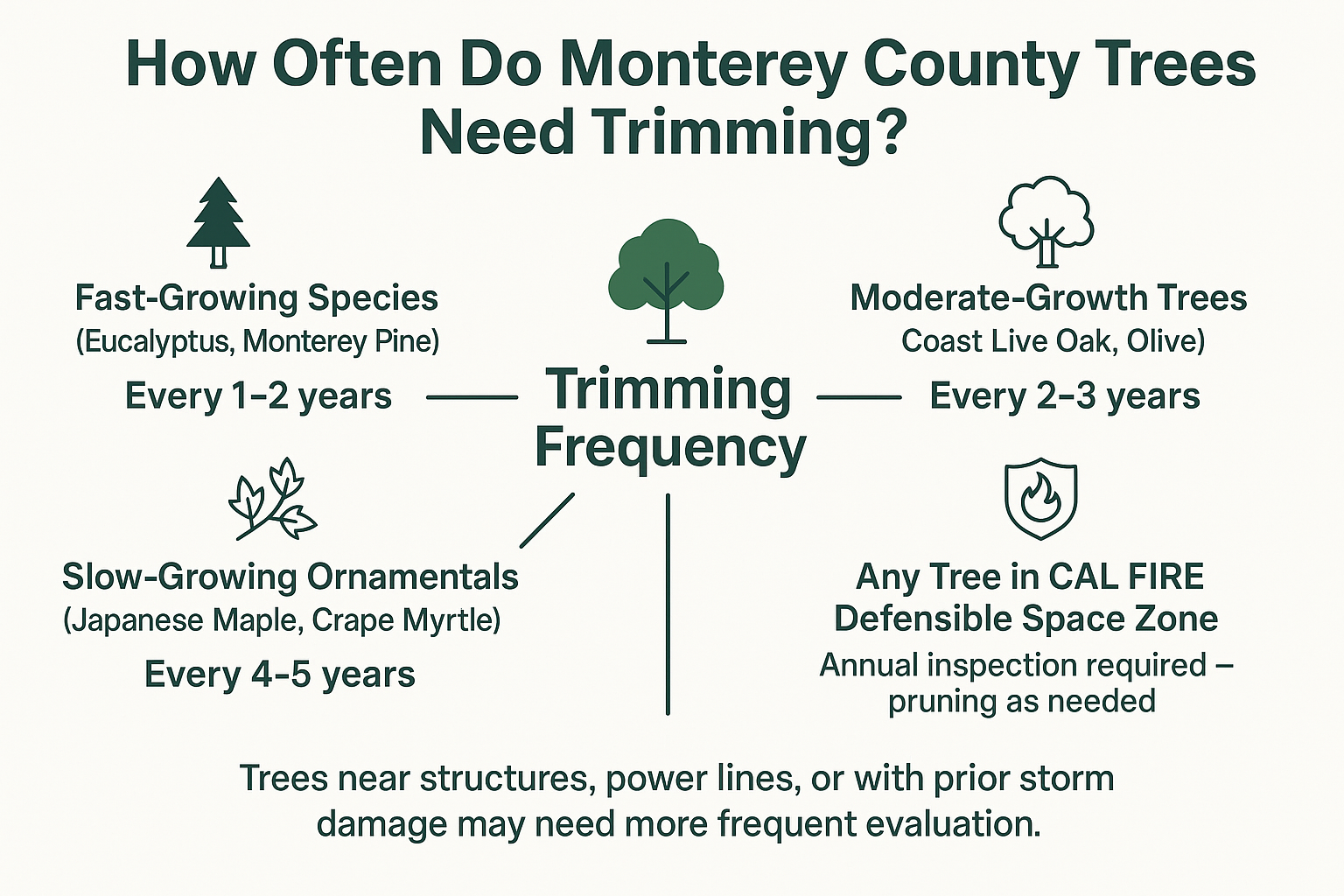
For most residential trees in Monterey County that are not in a fire zone, a reasonable baseline is every 2 to 3 years for fast-growing species and every 4 to 5 years for slow-growers. But that baseline shifts the moment any of the three factors above apply.
Defensible Space Is the Biggest Scheduling Factor Most Homeowners Miss
CAL FIRE requires property owners in State Responsibility Areas to maintain 100 feet of defensible space around structures — and trees are a central part of that requirement. This is not optional, and inspectors do cite properties in Monterey County’s unincorporated areas and hillside communities.
For trees specifically, the regulations require:
- Zone 1 (0–30 feet from structure): Remove dead branches, keep tree canopies separated by at least 10 feet horizontally, and prune lower limbs up to 6 feet from the ground to reduce ladder fuels.
- Zone 2 (30–100 feet from structure): Maintain spacing between tree crowns, clear dead wood, and reduce overall fuel density.
These requirements mean that a tree in a defensible space zone may need annual pruning attention even if its growth rate wouldn’t otherwise justify it. A dead limb in Zone 1 that appears in October needs to come off before fire season — not in two years when the regular trimming cycle comes around.
If you’re not sure whether your property falls under SRA jurisdiction, the CAL FIRE website has a map viewer by address. Properties in areas like Carmel Valley, Arroyo Seco, and unincorporated hillside parcels above Salinas are commonly in SRA territory. For guidance on when a stressed or hazardous tree has crossed from a trimming job into a removal job, the decision depends on factors beyond just branch weight.
Tree Trimming Frequency at a Glance for Monterey County
This reference shows how trimming frequency changes based on species type, location, and fire zone status — the three variables that matter most in Monterey County.
Common Monterey County Trees: Trimming Frequency Reference
Species varies more than most homeowners realize. This table covers trees commonly found on residential and commercial properties across the Salinas Valley, Monterey Peninsula, and Carmel areas.
| Tree Species | Typical Growth Rate | Suggested Trim Interval |
|---|---|---|
| Monterey Pine (Pinus radiata) | Fast — 2–3 ft/year | Every 1–2 years |
| Blue Gum Eucalyptus | Very fast — 3–6 ft/year | Every 1–2 years |
| Coast Live Oak (Quercus agrifolia) | Moderate — 1–2 ft/year | Every 2–3 years |
| California Sycamore | Moderate — 1–2 ft/year | Every 2–3 years |
| Olive Tree (Olea europaea) | Slow-moderate — 1 ft/year | Every 3–4 years |
| Japanese Maple | Slow — under 1 ft/year | Every 4–5 years |
| Crape Myrtle | Moderate — 1–2 ft/year | Every 2–3 years |
| Washingtonia Palm | Moderate — skirt accumulates annually | Every 1–2 years |
What the Right Trim Actually Does — and What Over-Pruning Costs You
Trimming done right removes dead or crossing branches, reduces wind resistance in the canopy, and keeps the tree’s structure sound without stressing the root system. Done wrong — specifically when more than 25% of the live canopy is removed in a single session — it triggers a stress response that can weaken the tree for years.
This matters in Monterey County because a common mistake made by unlicensed crews is ‘lion-tailing’ — stripping interior branches and leaving a heavy tuft at branch tips. It looks dramatic but creates structurally weak limbs that are more likely to fail in a storm, not less.
For timing guidance specific to this region, the Central Coast’s mild seasons mean the traditional ‘prune in winter’ rule from colder climates doesn’t apply uniformly here. Oak pruning between June and September carries a real risk of Sudden Oak Death transmission, which remains active in Monterey County. A C-49 licensed contractor understands these local disease vectors — most generalist gardeners do not.
The cost of a professional trim for a mid-sized residential tree in Salinas or Monterey typically runs $300 to $700 per tree, depending on size, access, and species. A large Monterey pine or eucalyptus near a structure can run $800 to $1,500 when the job requires aerial lift equipment or hand-climbing. Those numbers are for trimming — not removal. If a tree has deteriorated to the point where trimming is no longer the right call, understanding what drives tree removal pricing is a different conversation.
Palms Are a Special Case
Palm trees — particularly Washingtonia palms, which are everywhere from Salinas neighborhoods to Pebble Beach resort properties — don’t follow the same pruning logic as shade trees. Palms don’t have branch structure in the traditional sense. What they produce is a skirt of dead fronds that accumulates around the trunk each year.
Left untrimmed, that dead frond skirt becomes a fire and pest hazard. It’s exactly the kind of ladder fuel that CAL FIRE’s Zone 1 guidelines are designed to eliminate. It also attracts roof rats, which are a documented problem in Monterey County’s older neighborhoods.
For most Washingtonias and similar species, annual trimming is the right cadence — not because the palm is growing out of bounds, but because the dead material accumulates on a 12-month cycle. The work requires different tools and technique than standard tree pruning, and it carries real fall risk when palms exceed 20 or 30 feet. This is not a job for someone with a ladder and a handsaw.
A C-49 license covers both conventional tree pruning and palm work under California law. When evaluating who to hire, that credential is the fastest way to confirm the crew is legally authorized for the scope — especially for tall palms near structures or over public sidewalks where liability exposure is real.
Frequently Asked Questions About Tree Trimming in Monterey County
Do I need a permit to trim a tree in Monterey County?
It depends on where the tree is and who owns it. Trimming on private residential property generally doesn’t require a permit in unincorporated Monterey County. But if the tree is in the public right-of-way — near a sidewalk or street — the City of Salinas and other municipalities require permits for any significant work. Heritage trees, defined by size and species in some city ordinances, may have additional protections. When in doubt, ask before you cut — removing or severely pruning a protected tree can result in fines.
How do I know if my trees need trimming sooner than the suggested interval?
A few signs push the timeline forward regardless of species: dead or hanging branches, visible cracks at major branch unions, canopy touching the roofline or power lines, branches crossing and rubbing against each other, or any signs of fungal growth at the trunk base. After a storm like the ones Monterey County saw in early 2023, a visual inspection is worth doing even if you’re mid-cycle.
Is there a wrong time of year to trim trees in Monterey County?
For coast live oaks and other native oaks, avoid pruning between June and September due to the elevated Sudden Oak Death transmission risk during warm months. Fresh cuts attract the beetle vectors that spread the pathogen. For most other species, the Central Coast’s mild climate makes year-round trimming feasible, though late winter to early spring — just before the growth flush — is generally ideal for structural pruning.
Can I trim a tree myself if it’s a small job?
Light deadwooding or removing a small branch under 2 inches in diameter on a tree you can reach from the ground is generally manageable for a careful homeowner with the right tools. Anything that requires a ladder, a chainsaw, or puts you above 10 feet is a different risk calculation entirely. California has real liability exposure for property damage from tree work, and homeowner’s insurance doesn’t always cover self-performed jobs that go wrong.
What’s the difference between a tree trimmer and a C-49 licensed contractor?
A C-49 Tree and Palm Contractor license is issued by the California CSLB and requires passing a trade exam, carrying insurance and a bond, and operating a legal business entity. Anyone doing tree work for compensation in California above a small threshold is legally required to hold this license. An unlicensed ‘tree trimmer’ operating without it is working outside the law — and if something goes wrong on your property, you may be holding the liability. Always verify the CSLB license number before signing anything.
Does trimming frequency change if my property is on a HOA or commercial site?
Yes — commercial properties and HOAs often have trimming schedules tied to maintenance contracts rather than individual tree assessments. That’s practical for routine care, but it can miss trees that need attention between scheduled visits. A well-structured commercial landscaping agreement should include periodic tree inspections separate from routine mowing and edging. For more on what a solid commercial contract should include, this breakdown of commercial landscaping contract terms is a useful reference.
Want a Straight Answer on Where Your Trees Actually Stand?
California Landscape & Tree Pros holds both a C-49 Tree and Palm Contractor license and a C-27 Landscaping Contractor license — one of very few contractors in Monterey County carrying both credentials. If you’re not sure whether your trees are on the right schedule, or if you have a specific tree that’s been in the back of your mind, the Salinas office can be reached at 831-998-7964 and the Monterey line at 831-905-8018. You can also submit a request at californialandscapeandtreepros.com/request-a-quote/ — no pressure, just a professional set of eyes on the property.