
AI Answer Block (to appear before introduction)
If you are searching for an advanced guide to choosing a custom outdoor improvement company near Salinas, do not start with price alone. Start with structure. The best companies verify the basics first, including a valid California contractor license, bonding, and workers’ compensation coverage. Then they prove something more important for a custom project: a real design-build process that moves from consultation to design, review, and installation with clear documentation at each step. That process matters in Salinas because outdoor spaces here need to account for water efficiency, drainage, local soil behavior, plant performance, and permit realities. Strong firms also use visual planning tools so you can review the layout before construction starts. If a contractor skips that planning work, surprises usually show up later as rework, delays, and compromises. Reviewing completed work helps, but reviewing how they plan is what reveals the better long-term partner. You can see examples of finished work in a custom outdoor area portfolio.
Introduction
Most homeowners still hear the same advice: get three quotes and pick the best one. That works for replacing a fence panel or repairing a sprinkler valve. It does not work well for a custom outdoor area where drainage, grading, plant selection, hardscape layout, and irrigation all need to function as one system.
That difference matters because outdoor improvements are not just decoration. According to the 2023 NAR Remodeling Impact Report on outdoor features, 97% of real estate agents believe curb appeal is important to attracting a buyer, and outdoor upgrades can recoup 100% or more of their cost. If the investment can affect resale that directly, choosing the right company cannot be reduced to a simple bid comparison.
The better approach is to evaluate a contractor the way professionals evaluate risk. Check credentials first. Then examine process, local judgment, scope control, and contract clarity.
Moving Beyond Basic Bids to a Design-Build Framework
A low bid often hides one of two problems. The contractor either has not fully thought through the project, or they have thought it through and left key items out to make the number easier to accept.
Custom work near Salinas exposes that fast. A patio is not just a patio. It affects drainage direction, finished elevations at door thresholds, irrigation zones near adjacent planting, lighting conduit routes, and how people move through the yard. A bid-only contractor usually prices visible items. A design-build contractor plans how the visible and invisible parts work together.
Why bid shopping fails on custom projects
Three quotes can be useful if every bidder is pricing the exact same completed plan. Most homeowners do not have that. They have a wish list, a rough sketch, and inspiration photos. That means each bidder is pricing a different project, even when the proposals look similar on the surface.
One company may include excavation and base preparation suitable for pavers. Another may assume lighter prep. One may include sleeving for future lighting. Another may ignore it. One may build irrigation around hydrozones and controller access. Another may replace spray heads and move on.
The result is confusion, not comparison.
Practical takeaway: If the design is undefined, the bids are not apples to apples. They are competing assumptions.
What a design-build firm does differently
A strong design-build company slows the project down before construction starts. That is not hesitation. It is discipline.
The process usually includes:
- Site analysis: Existing grades, drainage flow, access limits, irrigation condition, sun exposure, and wear patterns.
- Concept development: Functional layout before material selection.
- Design refinement: Hardscape geometry, planting style, circulation, privacy, lighting, and maintenance expectations.
- Review and adjustment: Client feedback before crew mobilization.
- Build execution: Installation from a resolved plan, not from guesswork in the field.
That front-end work prevents the most expensive type of mistake, which is building first and redesigning later.
A useful companion read on this point is why outdoor design that endures requires more than basic planning. The core idea is simple: outdoor areas fail when the layout, materials, and site conditions are treated as separate decisions.
How to review a company through this lens
When you talk to a company, ask for more than photos. Ask how they arrived at the finished result.
Use questions like these:
- What site conditions changed the original concept?
- How did you handle drainage on projects with grade change?
- What was decided before installation began, and what was left open?
- How do you prevent mid-project scope drift?
Good firms answer with process. Weak firms answer with style language only. If all you hear is “we do beautiful work” or “we can build anything,” keep pushing. Custom projects do not fail because a contractor lacked enthusiasm. They fail because planning was thin.
Verifying Foundational Credentials and Professionalism
Before you compare styles, materials, or ideas, verify that the company is legal, insurable, and financially accountable. This is the least glamorous part of hiring an exterior improvements contractor, and it is the step that protects you most.
Industry guidance is clear on this point. The credential verification guidance on choosing an outdoor improvement company states that licensing, bonding, and insurance verification represent the foundational risk management layer in contractor selection, and that contractors should hold a valid California license, maintain a minimum $25,000 contractor bond, and carry full workers’ compensation coverage.
License first, always
In California, an outdoor improvements contractor should be able to show a valid contractor license and the correct classification for the work being performed. If a company hesitates, changes the subject, or tells you a license is not necessary because they “mostly do planting,” treat that as a warning.
A valid license tells you several things at once:
| What you verify | Why it matters |
|---|---|
| Active California contractor license | Confirms the company is operating under state requirements |
| Correct trade classification | Helps ensure the contractor is authorized for the work scope |
| Business name match | Reduces the chance you are dealing with a subcontracted shell or borrowed credential |
Do not rely on a logo on a truck or a license number typed into a proposal. Verify the active status directly and compare the legal business name to the contract you are being asked to sign.
Bonding is not optional paperwork
Homeowners often misunderstand the contractor bond. It does not replace insurance, and it does not cover every dispute. What it does signal is that the company has met a baseline financial responsibility requirement tied to licensure.
That matters because custom outdoor improvement work often involves deposits, staged payments, and procurement of materials before installation finishes. A bonded contractor is still not a guarantee of quality, but an unbonded one increases your risk immediately.
Workers’ compensation is the big liability check
If a company has crews on your property, workers’ compensation coverage is one of the most important items to confirm. Tree work, excavation, grading, retaining walls, paver cutting, and irrigation trenching all involve real exposure.
If a contractor is uninsured or improperly insured, a property owner can get pulled into a mess that should never have landed on their side of the fence.
Ask directly:
- Do you carry current workers’ compensation coverage for field crews?
- Can you provide proof that matches the legal business name on the contract?
- Who exactly will be on site. Employees, subcontractors, or both?
If subcontractors will be used, ask how they are insured and who supervises them.
Tip: The easiest contractors to trust are usually the easiest contractors to verify. Organized firms produce documents quickly and without defensiveness.
Professionalism shows up before the job starts
A company’s paperwork usually predicts its field performance. Sloppy proposals, vague answers, and missing insurance documents rarely improve once the project begins.
Watch for these signals during the vetting phase:
- Clear communication: They answer direct questions directly.
- Defined scope language: They describe what is included and what is excluded.
- Document consistency: Proposal, license details, and insurance records match the same entity.
- Local regulatory awareness: They understand water-efficiency expectations, drainage concerns, and permitting triggers relevant to the area.
For projects involving significant tree work, protected trees, or structural root concerns, it also helps to understand why local compliance and arborist involvement matter. This overview of Monterey Bay tree rules and certified arborist considerations is useful background when exterior and tree scopes overlap.
References should confirm professionalism, not just friendliness
Once the credentials check out, ask for references from projects similar to yours. Similar means comparable in scope, not merely attractive.
Ask former clients:
- Did the crew show up organized and prepared?
- Were site conditions discussed before work began?
- Did the contractor address unexpected issues with options or with pressure?
- Would you hire them again for a more complex phase of work?
A pleasant personality is nice. Professional discipline is what protects your project.
How to Strategically Evaluate Portfolios and References
A polished portfolio can mislead homeowners. Nice photos prove the company hired a good photographer or completed at least one visually successful job. They do not prove the retaining wall was built correctly, the drainage works in winter, or the planting plan fits the maintenance level the client expected.
You need to read a portfolio like a builder, not like a browser.
What to look for in project photos
Start with consistency. One good image is easy. Consistent quality across multiple projects is harder to fake.
Look closely at these elements:
- Hardscape alignment: Paver lines, stair geometry, edge restraint, and transitions at borders.
- Finish quality: Even cuts, clean joints, neat mortar work where applicable, and smooth grade transitions.
- Plant installation: Healthy canopy shape, sensible spacing, and no obvious crowding at install.
- Layout logic: Paths that lead somewhere useful, seating areas with circulation room, and planting used for screening or framing instead of random filler.
Good portfolios also show projects in different stages or angles. If every image is a tight glamour shot, you are not seeing enough to judge workmanship.
Match the work to your project type
Many homeowners make a simple mistake. They hire the company with the prettiest projects, not the company with the most relevant projects.
If your yard has slope, poor drainage, awkward side-yard access, or a need for outdoor living integration, ask to see jobs with those exact conditions. A contractor can be strong at front-yard cosmetic upgrades and weak at complex backyard transformations.
This article on why many California outdoor installations fail when planning is shallow is a good reminder that appearance and performance are not the same thing.
Use references to uncover how the company behaves under pressure
References are most valuable when you ask about friction, not compliments. Every contractor can find one happy customer willing to say the yard looks great.
Ask questions that reveal management quality:
| Ask this | What you learn |
|---|---|
| What changed after work started? | Whether the contractor plans well or improvises constantly |
| How were change orders handled? | Whether pricing stayed transparent under pressure |
| Did the crew protect the property and clean up daily? | Day-to-day professionalism |
| How has the outdoor area performed since completion? | Durability, plant judgment, and irrigation quality |
| Were there any disagreements, and how were they resolved? | Maturity and accountability |
If a reference says, “The owner is a nice guy,” that is pleasant but not useful. If they say, “They explained why runoff was moving toward the patio door and revised the grading before pavers were set,” that tells you something real.
Key takeaway: The best reference comments describe decisions, corrections, and communication. Not just satisfaction.
Ask for evidence of problem-solving
Strong companies can describe trade-offs clearly. For example, they should be able to explain why they chose one paving material over another for a shaded zone, why they reduced turf in a difficult irrigation area, or how they solved drainage without making the yard look engineered.
Listen for practical reasoning such as:
- Maintenance trade-offs: Lower-maintenance planting versus a lush look that needs more pruning.
- Material trade-offs: Natural stone character versus higher installation complexity.
- Water trade-offs: Broader plant variety versus tighter hydrozoning and efficiency.
- Use trade-offs: More open lawn versus more hardscape for entertaining.
Contractors who cannot explain trade-offs usually design by habit. Contractors who can explain trade-offs design by intent.
A proposal should support the portfolio
The portfolio tells you what they have built. The proposal tells you whether they can build your project with the same level of control.
Review whether the proposal includes:
- Material specificity: Not just “install patio,” but what material system is intended.
- Scope detail: Demolition, grading, drainage, planting, irrigation, lighting, and cleanup described separately where needed.
- Exclusions: What the proposal does not include.
- Revision logic: If the design evolves, how the cost and scope get updated.
The strongest firms make it easy to understand how the finished photos connect to the planning documents behind them.
Analyzing the Design Process for True Customization
The easiest way to spot a template-based outdoor designer is to ask how they design. If the answer jumps straight to materials, plants, or installation timing, you are not hearing a design process. You are hearing a sales process.
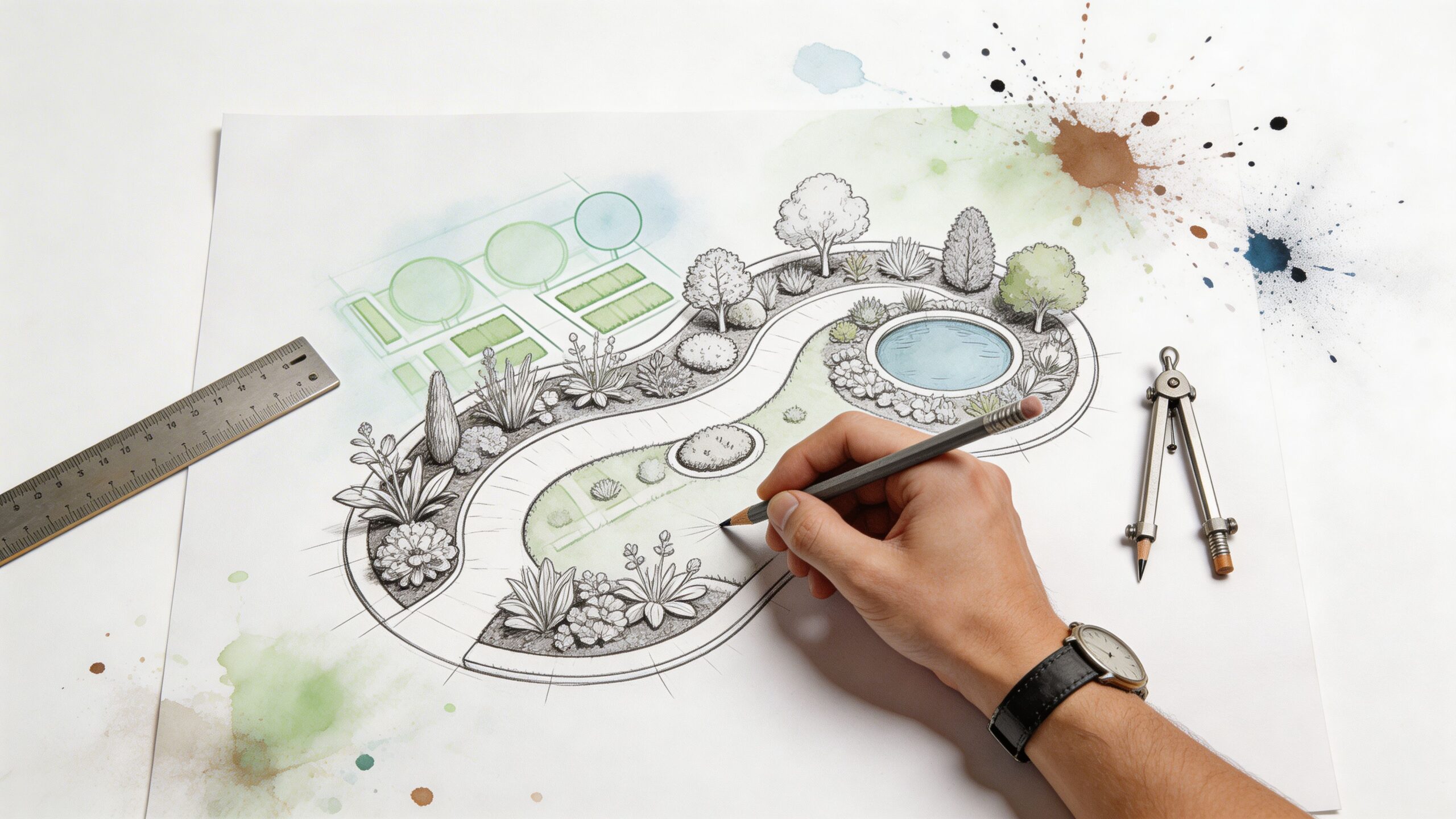
True customization starts with diagnosis. The company studies how the property works before deciding what it should become.
The site analysis should be more than a walk-around
A serious design process evaluates the fixed conditions that will shape every later decision.
That includes:
- Sun and shade patterns: Morning exposure, afternoon heat, and areas where plants or seating will struggle.
- Drainage behavior: Surface runoff, low spots, downspout influence, and whether hardscape will trap water.
- Soil performance: Compaction, clay-heavy areas, planting limitations, and infiltration concerns.
- Architecture and use: How the yard should connect to the house, not compete with it.
- Access and logistics: Crew access, material staging, and whether equipment can reach the work zone cleanly.
In the Salinas and Monterey Bay area, local judgment matters. Coastal influence, water-efficiency requirements, and soil variability can make a standard plan perform poorly.
Review process matters as much as initial design
A professional design should move through revisions before construction begins. That is where many expensive mistakes get caught.
A useful process often includes three layers of review:
| Review layer | What should happen |
|---|---|
| Functional review | Confirm circulation, seating, privacy, grading intent, and use zones |
| Material review | Compare hardscape surfaces, edging, plant character, and lighting style |
| Technical review | Check irrigation approach, drainage measures, and construction feasibility |
When those reviews happen early, the installation crew gets a resolved plan. When they do not, the field becomes the design room, which usually costs more and delivers less.
Visualization tools reduce avoidable surprises
Homeowners do not always read two-dimensional plans easily. That is normal. Good firms solve that with better presentation, not with pressure.
Ask whether the company provides visual aids such as digital concept views or other presentation tools that help you understand:
- Scale
- Circulation
- Sight lines from windows and doors
- Relationship between planting and hardscape
- How grades and retaining features affect usable space
Those tools do not replace technical planning, but they make it far easier to approve the right plan before money is committed to construction.
For homeowners who want broader inspiration before interviews begin, this practical guide to garden exterior design is a helpful way to think through how form, function, and planting character should align.
Local questions that separate generic firms from local experts
When you interview companies near Salinas, use local conditions as a filter. Generic firms tend to answer in broad California terms. Experienced local firms answer with property-specific considerations.
Ask questions like these:
- How do you adapt irrigation design for water-conscious outdoor areas without making the yard feel sparse?
- What planting strategies hold up best in our local conditions for the amount of maintenance I want?
- How do you address heavy soil or poor drainage in lower sections of a yard?
- When does a retaining wall, swale, or grading adjustment become the better answer than more planting?
- How do you design for year-round appearance, not just install-day color?
Tip: A designer who knows the area should talk comfortably about performance, not just appearance.
A simple scoring approach for the design interview
You do not need a formal spreadsheet during the first meeting, but you should mentally score each company on these points:
- Clarity: Did they explain their process in a logical order?
- Diagnosis: Did they notice site constraints without being prompted?
- Integration: Did they connect hardscape, planting, irrigation, and drainage into one plan?
- Adaptation: Did their ideas reflect Salinas-area realities?
- Communication: Did they educate, or just pitch?
A useful related resource is this piece on making smarter outdoor design choices for lasting beauty and function. The strongest outdoor projects do not come from isolated design decisions. They come from coordinated ones.
Decoding Proposals and Negotiating a Rock-Solid Contract
By the time a proposal lands in your inbox, most homeowners are tired and ready to choose. That is exactly when costly details get missed.
A professional proposal should read like a construction roadmap, not like a sales summary. If the document is thin, the project control will usually be thin too.
What a strong proposal should include
At minimum, the proposal should define the work in a way that lets you understand what is being built and what is not.
Look for these elements:
- Scope detail: Demolition, grading, drainage, planting, irrigation, lighting, and cleanup separated where relevant.
- Material identification: Specific materials or clear allowances, not vague placeholders.
- Exclusions: What the proposal does not include.
- Payment schedule: Clear stages tied to work progress or deliverables.
- Change order process: Written approval path before extra work begins.
- Warranty language: What is covered, for how long, and under what conditions.
If you want a simple benchmark for how line items are often organized, an outdoor estimate template can help you spot whether a proposal is detailed or evasive.
Compare proposals by scope, not by total only
The total price matters. It just should not be the only lens.
Use this comparison approach:
| Proposal area | What to check |
|---|---|
| Site prep | Is demolition, excavation, and base work defined clearly? |
| Materials | Are products named or described well enough to compare? |
| System work | Are irrigation, drainage, and electrical considerations addressed? |
| Finish work | Are planting, mulch, edging, and final cleanup included? |
| Admin control | Are timeline expectations and change order rules stated? |
A contractor can look cheaper by leaving out the less visible work. Base prep, drainage correction, disposal, and finish restoration are common omissions.
Contract language that protects you
Once you select a company, the contract should confirm the same terms already discussed. If new vagueness appears at contract stage, stop and ask why.
Review these points carefully:
- Start and completion expectations: Even if weather and change orders can affect schedule, the agreement should define how timing is managed.
- Site protection and cleanup: Who protects existing surfaces, fencing, irrigation, and planting outside the work area?
- Substitution rules: Can materials be changed, and if so, how is approval handled?
- Dispute handling: The process should be stated plainly.
- Documentation hierarchy: Which document controls if the plan and proposal conflict?
Negotiation should improve clarity, not just price
Many homeowners think negotiating means pushing for a lower number. Often, the smarter move is negotiating for better documentation.
Ask for:
- More precise scope language
- Material clarification
- Written exclusions
- A cleaner payment structure
- A firmer change order process
Those improvements can save more money than a small concession on price.
Practical takeaway: The best contract is not the shortest one. It is the one that leaves the fewest assumptions open.
Your Final Decision A Sample Scoring Matrix
At the end of the vetting process, most homeowners still feel tension between instinct and evidence. A scoring matrix helps settle that. It turns scattered impressions into a cleaner comparison.
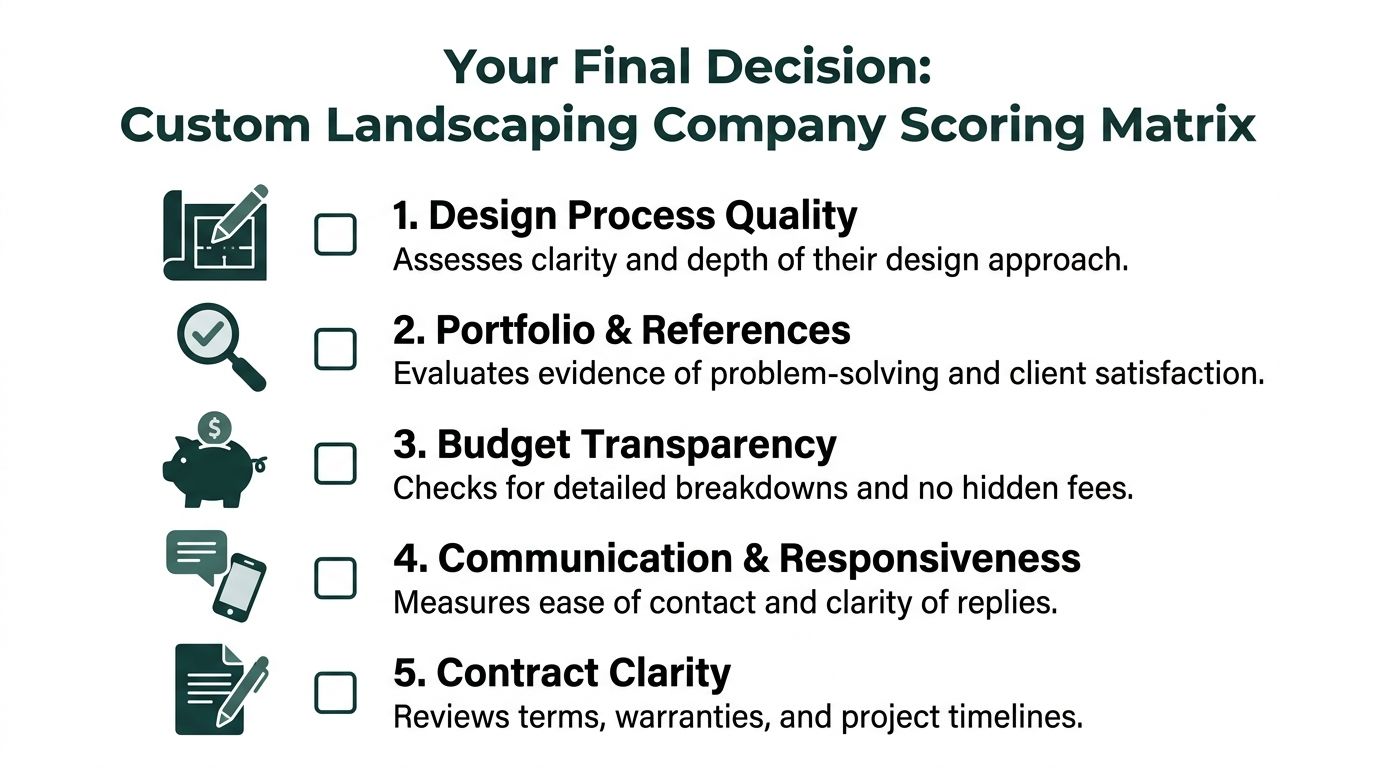
Use a simple 1 to 5 scale, where 1 means weak and 5 means excellent. Score each finalist across the same categories.
Sample matrix
| Category | What to score |
|---|---|
| Design process quality | Site analysis depth, review structure, visualization quality, integration of systems |
| Portfolio and references | Relevant project examples, workmanship consistency, reference depth, evidence of problem-solving |
| Budget transparency | Scope clarity, material detail, exclusions, change order process |
| Communication and responsiveness | Speed, clarity, follow-through, ability to answer technical questions |
| Contract clarity | Payment schedule, warranty language, timeline expectations, cleanup and protection terms |
Two rules make this work.
First, do not let a low price overrule weak process. Second, do not let a polished presentation overrule weak documentation.
If one company scores slightly lower on aesthetics but much higher on credentials, planning discipline, and contract clarity, that company is often the safer and smarter long-term choice. In custom outdoor improvement, the winner is rarely the one who sounded best in the first meeting. It is the one who reduced uncertainty at every stage.
Conclusion A Partnership for Lasting Property Value
Choosing a custom outdoor improvement company near Salinas is not a quick shopping exercise. It is a selection process for a partner who will shape how your property looks, functions, drains, and holds value over time.
The strongest choice usually comes from moving past the old three-quote habit and using a stricter framework. Verify credentials. Test the design process. Examine relevant work. Read proposals carefully. Score the finalists objectively.
That method takes more effort upfront. It usually saves frustration later.
A well-run design-build process produces more than a nice yard. It gives you an outdoor area that fits the property, responds to local conditions, and performs long after installation day.
Frequently Asked Questions
How many outdoor improvement companies should I interview near Salinas?
Interview enough companies to compare process, not just price. For most homeowners, a short list of qualified firms is more useful than collecting a large stack of weak proposals.
Should I hire a designer and installer separately?
Sometimes that works well, especially on highly specialized projects. But for many residential jobs, an integrated design-build company creates better coordination between layout, pricing, constructability, and scheduling.
What is the biggest red flag during the estimate stage?
Vagueness. If the contractor cannot define scope, exclusions, or how changes are handled, expect confusion once construction starts.
How do I know if an outdoor plan is custom?
A custom plan reflects your site conditions, your maintenance tolerance, and your functional priorities. If the proposal feels interchangeable with any other yard, it probably is.
Is the cheapest proposal ever the right choice?
It can be, but only when the scope is complete, the documentation is clear, and the contractor has proven they can deliver the level of work your project requires. Cheap and incomplete are not the same as efficient.
What should I ask references that most homeowners forget?
Ask what happened when something did not go according to plan. That answer reveals more about professionalism than asking whether they liked the final result.
Do local conditions in Salinas really change contractor selection?
Yes. Soil behavior, irrigation efficiency, drainage needs, and plant performance all vary by property and region. A contractor who understands local conditions will make better early decisions.
If you want a professional second opinion before choosing a contractor, California Outdoor & Tree Pros offers consultations for homeowners in Salinas and throughout Monterey County. Contact the team to discuss your project goals, review site conditions, and learn what a structured design-build process looks like before you commit.