
Quick Answer
TL;DR: Call for emergency tree removal when a tree poses an imminent threat to people or property, such as a split trunk, uprooted base, major new lean, or a tree already on a roof, driveway, or power line. If 50% or more of the tree is damaged, it probably should be removed, according to the University of Maryland Extension guidance cited here.
If you're asking when should i call for emergency tree removal?, you're usually standing outside looking at something that changed fast. A tree that looked stable last week may not be stable now, especially after wind, heavy rain, or a sudden limb failure.
The hard part is knowing whether you're seeing a serious hazard or a problem that can wait for a scheduled visit. The safest approach is to judge the immediacy of the risk, not just how bad the tree looks.
Defining a True Tree Emergency vs a Routine Problem
A true tree emergency involves immediate danger. That means the tree has failed, is actively failing, or could fail soon enough that waiting creates an unacceptable risk to people, vehicles, buildings, access routes, or utilities.
A routine tree problem still matters, but it usually allows time for a planned inspection and scheduled work. Deadwood high in the canopy, gradual decline, crowded branches, and appearance issues fall into that category unless they’ve become unstable in a way that threatens something below.
What makes a situation an emergency
The practical test is simple. Ask two questions:
- Could this tree or limb fall soon
- If it falls, could it hit a person, home, parked car, driveway, fence, or utility line
If the answer to both is yes, treat it as an emergency.
Practical rule: Emergency work is about imminent hazard, not general tree condition. A poor tree can wait. An unstable tree over a target usually can’t.
The calls that deserve immediate response are the ones where the tree has shifted, split, uprooted, or already made contact with a structure. A limb hanging by a strip of wood over a front walk is an emergency. A tree resting on a roof is an emergency. A trunk that opened up after wind is an emergency.
What can usually wait for a scheduled assessment
Some tree issues look alarming but don't always require an after-hours response. Examples include:
- Old pruning needs: Overgrown limbs aren't automatically an emergency if they're still well attached.
- Seasonal debris: Leaf drop, small twig litter, and minor branch shed after wind usually point to cleanup, not urgent removal.
- Long-term decline: Sparse canopy, slow dieback, and suspected disease need assessment, but not always same-day action.
That said, property owners are often better off getting a professional opinion than guessing from the ground. A proper evaluation by a trained arborist helps separate urgent risk from deferred maintenance. If you want a deeper explanation of what trained assessment looks for, this guide on whether you really need a certified arborist for your trees gives useful context.
The trade-off most owners struggle with
Nobody wants to overreact and pay for emergency work that could have waited. But waiting for proof usually means waiting for impact.
What works is treating change as the warning sign. A tree that suddenly leans, cracks, lifts soil at the base, or drops a major lead after a storm deserves immediate attention. What doesn’t work is assuming a tree is safe because it was healthy before the weather event.
Red Flags Visual Signs of Imminent Tree Failure
A lot of emergency calls start with the same sentence: "It looked fine yesterday."
The trees that fail without much warning usually show visible stress first. The key is knowing which defects point to likely failure soon, not just general decline. From the ground, I focus on three areas in this order: the root plate, the main stem, and anything suspended over a target.
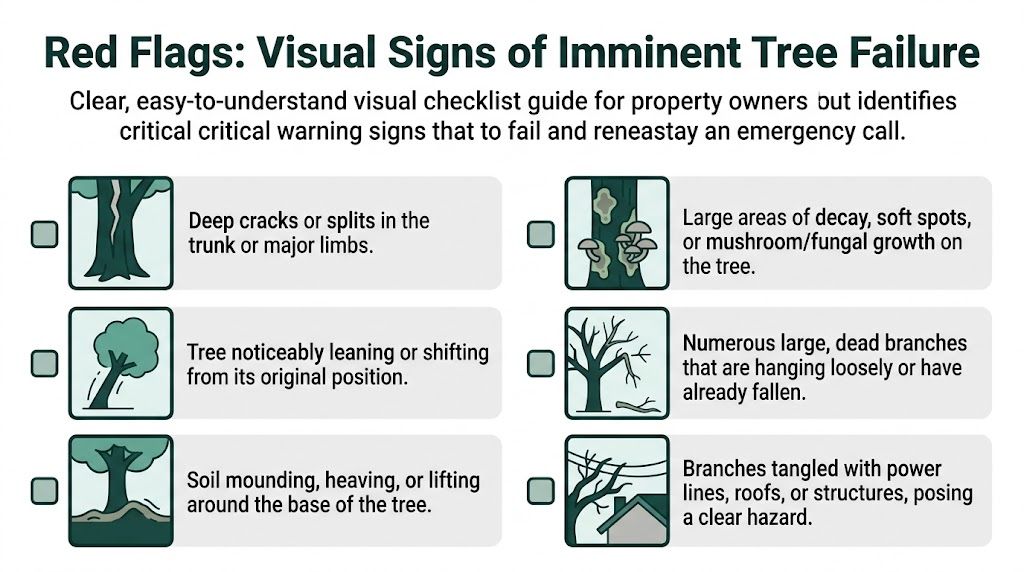
Deep cracks and split wood
Fresh cracking in the trunk or at a main union puts the tree in a different category than old surface damage. A deep vertical split, a seam opening between codominant stems, or wood fibers visibly pulling apart means the stem is already losing load-bearing capacity.
What matters is change. If clean, pale wood is exposed, bark is separating, or the crack appeared after wind, that tree should be treated as unstable. Do not stand beneath it to get a better look. Do not pull on the stem or limb to "see if it's loose."
New lean and root movement
A long-standing lean can be normal. A recent lean is a failure pattern.
Check the base from a distance and look for movement in the root plate, not just the trunk angle:
- Soil mounding or lifting on one side of the base
- A fresh gap between the trunk flare and surrounding soil
- Broken, exposed, or stretched roots
- Hardscape displacement near the root zone, including cracked pavement or lifted edging
In Monterey County, I pay close attention after heavy winter saturation because root loss often shows up a day or two after the storm, not during it. Once the root plate starts rotating, the remaining roots are carrying uneven load and can let go fast.
Heavy canopy loss and major structural damage
As mentioned earlier, the 50% damage threshold is a useful line for decision-making after a storm. Once a tree has lost a major portion of its crown, or a primary scaffold has torn out, the issue is no longer only whether the tree can recover biologically. The question is whether the remaining structure can still carry wind load safely.
Owners often misread the situation. A tree can still be standing, still have green leaves, and still be in immediate danger because the weight distribution changed. Large tear-outs, stripped bark running into the trunk, and missing leaders often leave hidden cracks above the point you can see from the ground.
Hanging limbs and target exposure
Partially broken limbs deserve more respect than limbs already on the ground. A branch hung up in the canopy can shift with one gust, one vibration, or one cut made from the wrong place.
Risk goes up sharply when the damaged part is over something people use every day.
| Visible condition | Why it matters |
|---|---|
| Roof contact | Point-load stress can fracture framing, crush gutters, and abrade shingles or underlayment until the roof system starts taking water |
| Driveway blockage | Vehicle access is reduced, and the remaining stem or limb can roll, drop, or pin equipment during cleanup or emergency access |
| Entry path obstruction | People default to familiar routes. That puts foot traffic directly under a suspended load or compromised canopy section |
| Power line contact | The hazard shifts from tree work to utility coordination. Energized conductors, step potential, and arcing make this a restricted area, not a homeowner cleanup job |
For a clearer explanation of how arborists separate visible defects from likely failure, see this guide to advanced tree risk assessment for residential trees.
One final point matters here. "Looks bad" and "needs emergency removal" are not the same call. Fresh structural cracking, root plate movement, and suspended failures over a target are the signs that push a tree into the imminent-hazard category.
How to Assess Trees After a Major Storm
The morning after a major storm is when homeowners make the wrong call most often. They see a tree still standing and assume the danger passed with the wind. In Monterey County, I see the opposite. A tree can stay upright through the storm, then start failing later as saturated soil loosens roots and weight shifts in the canopy. FEMA's guidance on returning home after a disaster is useful here because it treats damaged trees near structures and utilities as part of the post-storm hazard zone, not simple cleanup.
That delayed failure matters on the Central Coast. After heavy rain, the tree itself may not be the first thing to move. The soil does.
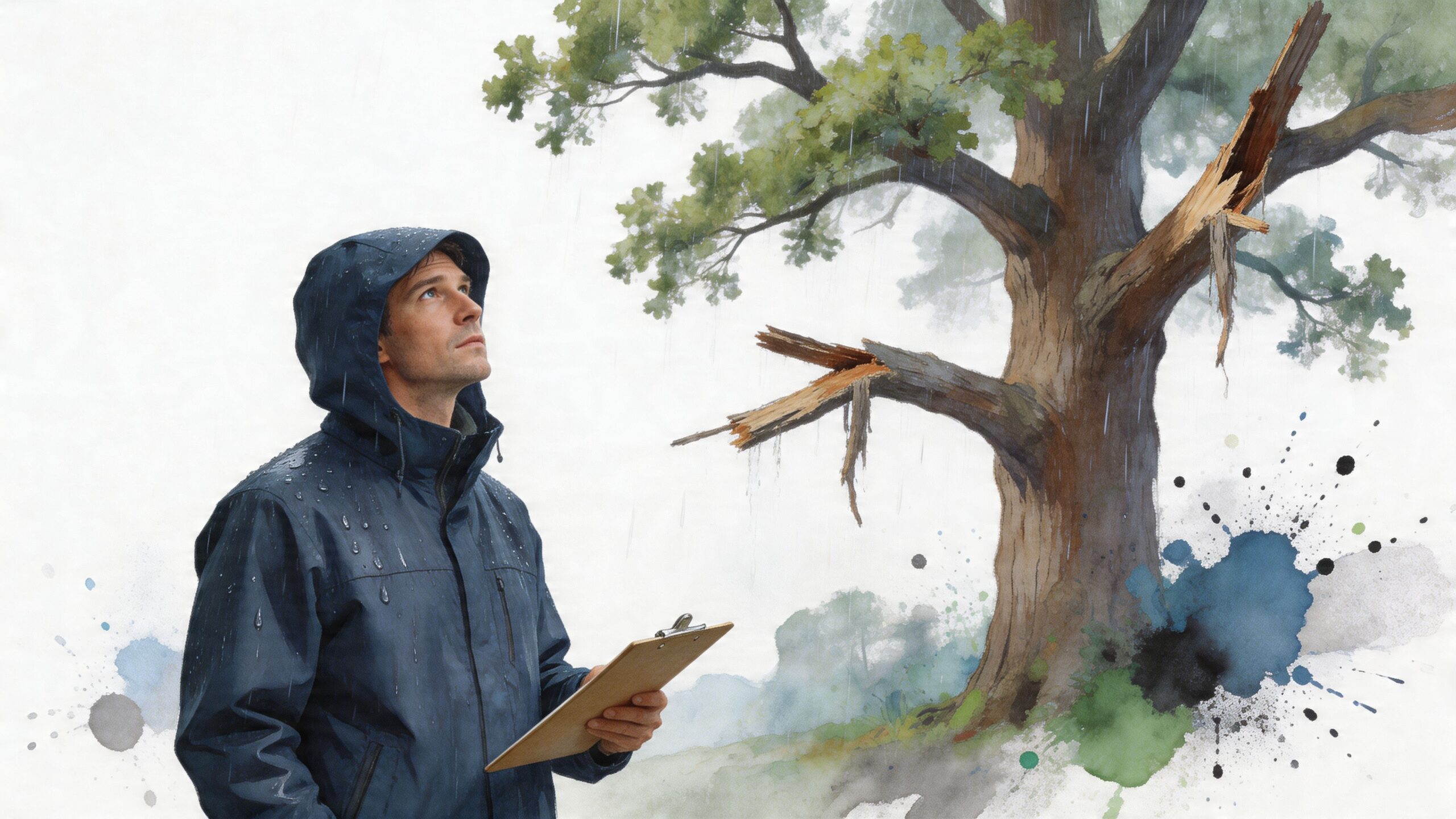
Start with the ground, not the canopy
From a safe distance, look at the base of the tree first. Fresh soil cracks, heaving on one side of the trunk, exposed roots, or a root plate that looks lifted are stronger warning signs than scattered small branches in the yard.
Then look up and ask one practical question. Did the storm change the tree's structure, or did it only leave debris behind?
These signs point to structural change:
- A new or increasing lean
- Soil mounding or separation around the trunk flare
- Large limbs broken but still attached
- A canopy that is suddenly lopsided on one side
- Fresh splits, bark separation, or exposed wood on the trunk or major scaffold limbs
A few twigs down after a storm are routine. A tree with root movement or a split leader is a different category.
Judge the change, not just the appearance
Homeowners often focus on how messy the tree looks. Crews focus on what changed since the tree was stable. A mature pine dropping scattered limbs may need scheduled pruning. The same pine with fresh lean, disturbed soil, and a heavy side load over a driveway may need same-day action.
That distinction helps separate a concerning tree from an imminent hazard. The question is not whether the tree looks rough. The question is whether the storm changed load paths, root support, or attachment points enough that failure could happen before normal scheduling makes sense.
Keep the inspection short
A safe assessment is brief and done from outside the potential fall zone. Do not walk under a suspended limb to confirm what you already suspect. Do not push on the trunk, pull hanging branches, or step onto soft ground near the root zone to get a better photo.
If you can already see root plate movement, trunk cracking, or a large partially attached limb over a target, stop inspecting and make the call.
When crews respond after a storm, the first job is often triage. Access has to be cleared, weight has to be reduced in the right order, and some trees need stabilization before removal. If you want a realistic sense of that sequence, this guide to storm damage tree cleanup explains what usually happens first.
Immediate Safety Steps Before the Crew Arrives
Once you've made the call, the goal is simple. Keep people out of the fall zone and avoid turning a tree problem into an injury scene.
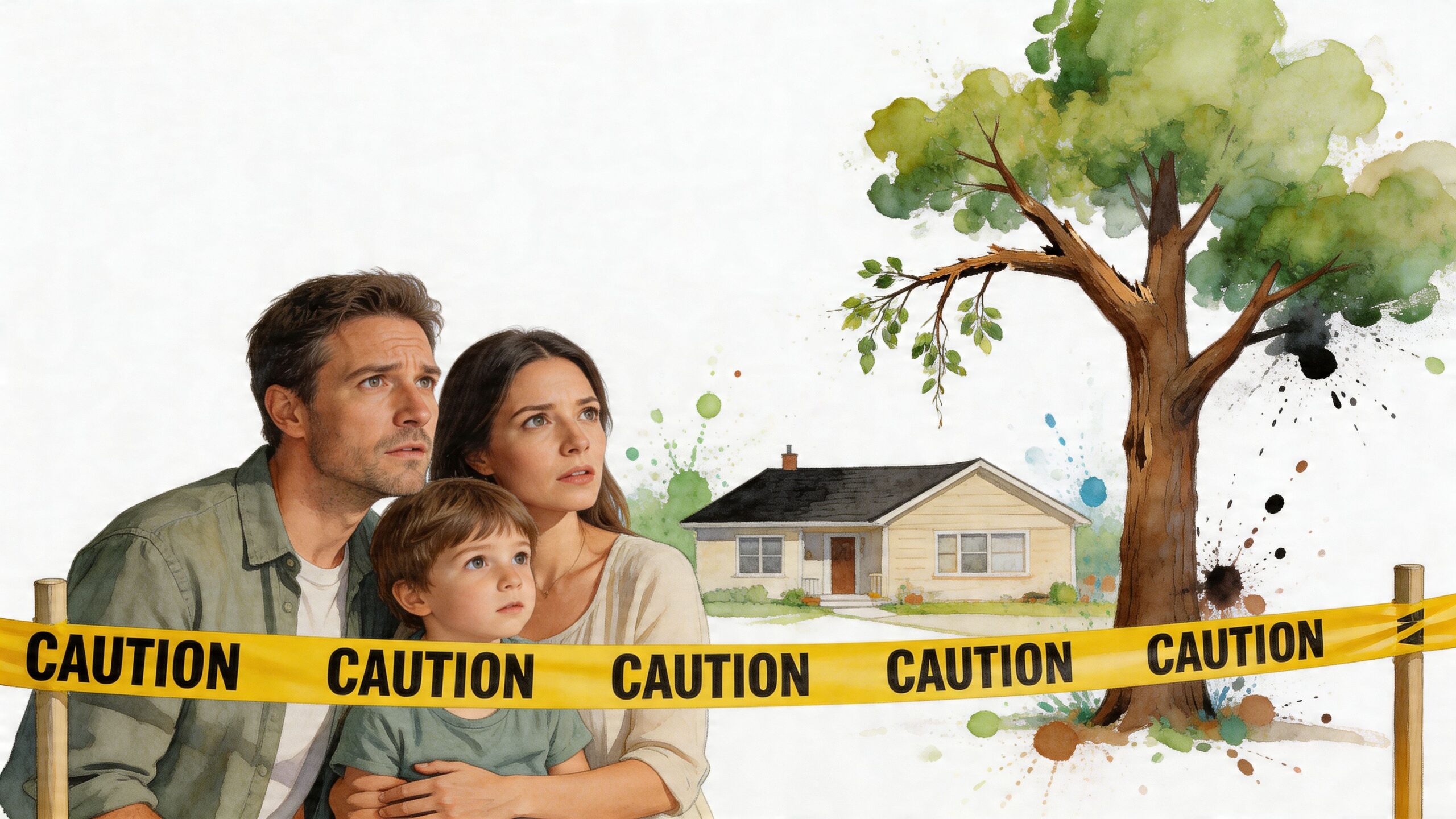
What to do right away
- Keep everyone back: Move family members, visitors, and pets away from the tree and the area where it could land.
- Relocate vehicles: If you can move cars without driving under the hazard, do it early.
- Block access paths: Use cones, tape, patio furniture, or any obvious barrier to keep people from walking into the area.
- Document from a safe spot: Take clear photos before any work starts, especially if the tree hit a structure or damaged another part of the property.
What not to do
Don't cut tensioned limbs from the ground. Don't climb, brace, or tie off the tree yourself. Don't touch branches on lines, near lines, or even close enough that you're unsure.
If the tree involves utilities, your first safety call may need to be the utility provider or emergency services, depending on the situation.
One local reminder that matters
On the Central Coast, storm conditions can change fast. A tree that seems settled in the morning can move more as soil softens or wind picks up again in the afternoon.
For seasonal prevention and basic household planning, these tree safety tips for Monterey County storm season are useful long before an emergency starts.
What to Expect from an Emergency Tree Removal Crew
Individuals are often stressed before the crew arrives because they don't know what will happen first. In practice, the first phase is rarely cutting. It's scene control.
The first few minutes on site
A competent crew starts by checking the tree, the targets, access, and any utility involvement. They’re looking for load points, suspended wood, compression, tension, roof contact, and whether the root plate is still moving.
That initial read determines the plan. Sometimes the safest first move is to stabilize access and keep everyone farther back. Sometimes it's to remove a hanging lead before anything else can happen.
The equipment depends on the failure
Not every emergency uses the same setup. Crews may use climbing gear, rigging lines, chainsaws, pole saws, loaders, chippers, or a bucket truck if site conditions allow it.
When the tree is on a structure, the work is usually piece-by-piece. Sections get cut small enough to control, then lowered or lifted away to avoid adding shock to the roof or wall below.
The fastest removal isn't always the safest removal. Controlled dismantling takes longer than cutting freely, but it's how crews avoid secondary damage.
What the crew is trying to accomplish
The priority is to eliminate the immediate hazard. Full cleanup and stump grinding may happen the same day or may be scheduled after the emergency phase, depending on the condition of the site.
One practical option in Monterey County is California Tree Pros, which handles hazard assessments, emergency response, storm cleanup, tree removal, stump grinding, tree reports, and permit assistance under California Contractor License #1107800. Whatever company you call, verify that they can safely handle access, structure proximity, and post-removal documentation. This guide on what to know before hiring a tree removal company in Monterey County covers the questions worth asking.
Navigating Insurance Permits and Liability in Monterey County
Once the site is stable, the next decisions affect money, paperwork, and legal exposure. This is the stage where property owners either preserve their options or make the claim and permit process harder than it needs to be.
Document the condition before more cutting starts
If it is safe to step back and take photos, do that before the crew removes additional weight from the tree. Insurance carriers often look closely at two questions: what was damaged, and what condition created the immediate hazard.
Take photos from several angles. Get the whole tree, the failure point, the roofline or other impacted property, and any visible defect such as a split stem, lifted root plate, or broken scaffold limb. Keep a few close shots and a few wide shots that show context.
The Insurance Information Institute explains that homeowners coverage for fallen trees often depends on whether the tree damaged a covered structure and what caused the loss, not just the cost of removal itself. See its guidance on homeowners insurance and fallen trees.
Ask the carrier the right questions early
Coverage disputes usually start with vague phone calls and poor documentation. Clear facts work better.
Have these details ready when you contact the insurer:
- What the tree hit: house, garage, fence, vehicle, driveway, or nothing insured
- What failed: trunk, root system, codominant stem, major limb, or the entire tree
- Why emergency work was needed: blocked access, active structural loading, hanging top, or risk to occupants
- What records you have: timestamped photos, weather date, invoices, and written notes from the crew
If the adjuster pushes back, stay specific. The issue is usually whether the work was emergency mitigation tied to covered damage, or cleanup of a tree that failed without insured property loss. These adjuster negotiation strategies can help you present the file in a way an adjuster can evaluate.
If the tree started on your neighbor's side
Do not assume fault follows the stump.
In Monterey County, liability usually turns on facts such as prior visible defects, prior notice, and whether the failure came from an ordinary storm event or a condition the owner should have addressed earlier. A decayed tree with a long-visible lean is a different case than a sound oak that failed during a severe wind event. That is why pre-removal photos and written observations matter.
If the tree crossed a property line, notify the neighbor promptly and keep communication in writing. Short, factual notes are enough.
Permits and local rules in Monterey County
Emergency work and permit work overlap, but they are not the same thing. If a tree is on a house, across a driveway, or creating an immediate risk to people, crews usually address the hazard first. After that, local agencies may still want photos, an arborist report, or a follow-up permit record, especially for protected species, coastal properties, or trees in regulated areas.
Use this as a working guide:
| Situation | Best next step |
|---|---|
| Tree on a structure or blocking access | Make the site safe first, then keep photos, invoice notes, and removal records |
| Tree is damaged but still standing | Check with the city or county before non-emergency removal continues |
| Protected, heritage, or prominent tree | Get written direction from the local authority and keep the hazard documentation |
| HOA or managed property | Notify the manager or board early so field work and records stay consistent |
I see the same problem after storms in Carmel, Pacific Grove, and unincorporated county areas. The tree is gone, the brush is hauled off, and only then does the owner ask about permits or proof for insurance. By that point, the best evidence is already in the chip truck. Keep the record first, then finish the cleanup.
Frequently Asked Questions About Emergency Tree Removal
How do I know if this is really an emergency or if it can wait?
Treat it as an emergency if the tree is likely to fail soon and could hit people, structures, vehicles, access routes, or utilities. A new lean, split trunk, lifted root plate, or large hanging limb usually means don't wait.
Will insurance cover emergency tree removal?
Sometimes yes, sometimes no. Coverage often depends on whether the tree damaged covered property and how the policy handles removal, cleanup, and storm events. Take photos before work starts if it's safe to do so.
How fast should a crew respond?
That depends on weather, road conditions, utility involvement, and how dangerous your situation is compared with other active calls. A tree on a house, driveway, or line usually gets prioritized over a tree that's damaged but isolated.
What if the tree fell into my neighbor's yard?
Start by documenting the scene and notifying the neighbor promptly. Don't assume liability is automatic just because the tree started on one side of the fence. The facts behind the failure matter.
Is stump grinding part of emergency tree removal?
Usually the emergency phase focuses on making the site safe and removing the immediate hazard. Stump grinding is often handled after that, once access, utilities, and site conditions allow normal equipment work.
Should I try to cut a branch if it's hanging but not fully down?
No. Hanging limbs are unpredictable because the wood is often under tension or partially supported by other branches. Ground cutting without the right equipment and plan is how people get hurt.
Call for an Immediate Emergency Tree Assessment
If you're still asking when should i call for emergency tree removal, use the simplest test. If the tree threatens people, property, access, or utilities right now, don't guess. Get a qualified assessment and keep your distance until the site is made safe.
If you need help from California Landscape & Tree Pros, call (831) 998-7964 in Salinas or (831) 905-8018 in Monterey. You can also visit 1184 Monroe St., Suite 6, Salinas, CA 93906 to discuss an emergency tree assessment, storm cleanup, hazard evaluation, or permit assistance.