
TL;DR: In 2026, artificial turf installation commonly ranges from $8 to $20+ per square foot in California markets, and national averages for a typical 500 square foot project run about $15 to $19 per square foot, but the price depends heavily on site prep, drainage, materials, and project size. For Monterey County properties, a custom site visit matters more than any online calculator because slopes, access, and drainage often decide the final scope.
Quick Answer
Artificial turf installation cost varies widely because you're not just paying for the turf. You're paying for excavation, base preparation, drainage, infill, edging, access, and labor, and in Monterey County those site conditions can change the job fast. A square-foot number is only a starting point. If you're also comparing turf to water-wise alternatives, this guide on replacing grass with drought-tolerant landscaping can help frame the bigger decision.
If you're searching because you're tired of patchy grass, irrigation headaches, or a yard that never looks finished, you're asking the right question. How much does artificial turf cost to install sounds simple, but the answer depends far more on the ground underneath the turf than most homeowners expect.
That matters in Salinas and across Monterey County. A flat backyard with clean access is one project. A yard with grade changes, drainage issues, tight side-yard access, or existing hardscape is a different job entirely.
Introduction
Property owners usually start with the surface. They see the lawn they want and ask what the turf costs. In practice, the bigger cost question is what it takes to build a stable, drainable base that will still look right years from now.
Nationally, artificial grass installation in 2026 averages $5,757 to $5,773 total, with most homeowners paying $1,300 to $15,000, and a typical 500 square foot project runs about $15 to $19 per square foot including materials and labor (Angi, 2026). Those figures are useful for ballpark thinking, but they don't tell you whether your yard needs deeper excavation, extra drainage, hand work around curves, or specialty turf for pets or heavy foot traffic.
Practical rule: A quote without a site visit is just a guess. Turf fails from what's below it, not from what the sample board looked like.
What Really Determines Artificial Turf Installation Cost
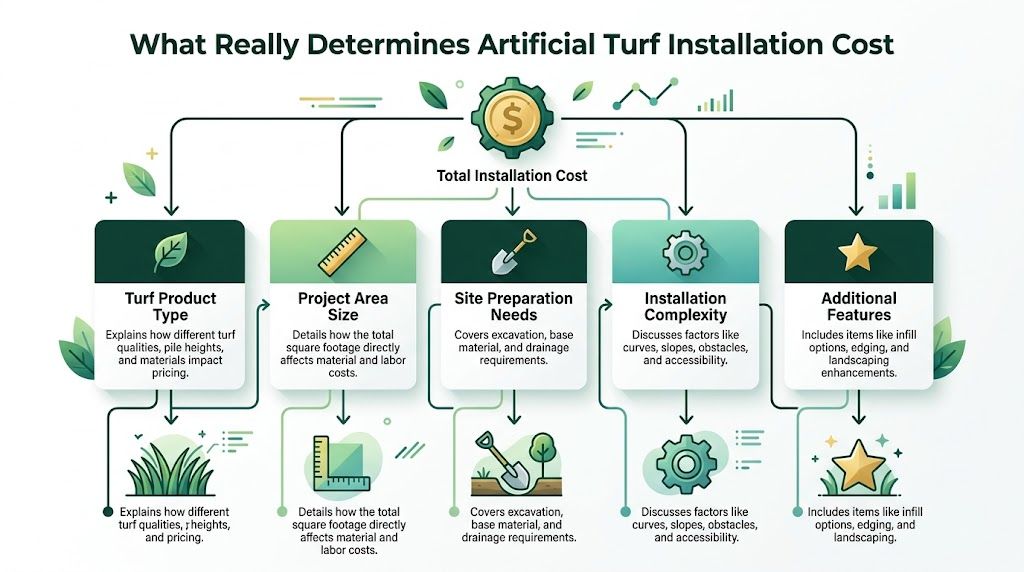
Two properties can have the same square footage and end up with very different turf bids. The reason is simple. The price is driven less by the roll of turf and more by the work required to build a stable, drainable surface on that specific site.
In Monterey County, that usually comes down to four cost drivers: demolition, base prep, drainage, and material selection. Labor rises fast when crews have to remove old sod, dig out soft spots, cut around tight hardscape lines, or haul material through side yards with poor access. If you want a broader sense of how local outdoor construction pricing is built, this guide to yard design and installation cost in Salinas gives useful context.
Turf materials
Turf product matters, but it is rarely the main reason a project gets expensive.
Polyethylene is a common choice for residential lawns because it looks more natural and feels softer underfoot. Nylon usually costs more and makes sense in areas that take heavier wear, such as play spaces, pet runs, or spots with frequent foot traffic. Polypropylene sits at the lower end of the market and can work for limited-use areas, but it is not the product I would push for a primary yard surface.
The right question is how the space will be used. Paying for premium turf in a decorative side yard is often unnecessary. Choosing a cheaper product for a dog area usually creates replacement costs sooner.
Site preparation and grading
Here, budgets swing the most.
Existing grass removal, excavation depth, buried concrete, old irrigation lines, tree roots, and unstable soil all change labor hours and dump fees. A flat, clean yard with easy access is one kind of job. A yard with hidden debris, patchwork repairs, and uneven grade is another.
Good prep fixes the problems below the surface before the turf goes in. If that work gets skipped, the finished area can settle unevenly, hold water, or show ridges and loose seams within a short time.
Base and drainage systems
In Monterey County, the base is the installation.
Coastal fog, slow drying conditions, and older properties with inconsistent runoff patterns all put pressure on drainage design. Some yards need only standard excavation and compacted aggregate. Others need deeper correction, added drains, or a more careful grading plan to keep water from collecting near the home, fence lines, or low corners of the yard.
This is one of the biggest reasons online cost calculators miss the mark. They assume a basic build. They do not account for a backyard in Pacific Grove that stays damp into the afternoon, or a sloped lot in Carmel Valley where runoff has to be controlled so the base does not shift over time.
A quote without a site visit is still just a guess. Drainage and grade problems do not show up on a price-per-square-foot calculator.
Infill and edging details
Infill affects how the turf performs and how much upkeep it needs. Pet systems, play areas, and simple decorative lawns often call for different infill choices, and those choices change both installation cost and long-term maintenance.
Edging matters too. Metal, bender board, concrete borders, and tie-ins to pavers all require different labor. Clean edges hold the field in place and keep the job looking sharp. Sloppy perimeter work is one of the first shortcuts I notice on low bids.
Labor and installation quality
Installation labor is skilled work. Crews need to set grade correctly, compact in lifts, keep blade direction consistent, cut cleanly around borders, and build seams that stay tight after use and weather exposure.
This is also where cheap bids can become expensive. A lower number often means less excavation, a thinner base, rushed compaction, or weak seam work. Those shortcuts are hard to see on day one and easy to spot a season later.
The primary cost question is not just what turf costs per square foot. It is what this specific property needs so the finished surface drains well, stays smooth, and holds up under the way the yard is used.
Special Considerations for Monterey County Installations
Generic calculators usually assume a basic suburban lot. Monterey County rarely behaves that neatly. Grade changes, older drainage patterns, coastal moisture, and access limitations can turn a standard install into a much more technical project.
One local issue is slope. Projects on sloped ground can require 50 to 60% more site preparation work compared to flat surfaces because they need more grading, soil reinforcement, and drainage control (LawnStarter, 2024). If a property also needs irrigation changes around adjacent planting beds, these notes on changing an irrigation system in Salinas are worth reviewing.
Small patio or courtyard turf areas
Small installs often surprise people because the per-square-foot cost can be higher. The fixed work doesn't disappear just because the footprint is small. Crews still need to prep the base, trim around edges carefully, and move materials in and out.
This is common in side yards, enclosed courtyards, and compact entertainment spaces. Tight access can force more hand labor, and that's where online averages stop being useful.
Average backyard lawn replacements
A typical backyard gives more room to spread fixed setup costs, but that doesn't mean it's straightforward. Existing irrigation, tree roots, fence lines, drain locations, and transitions into patios or planter beds still matter.
These are often the projects where drainage decisions make the difference between a lawn that stays clean and usable, and one that slowly develops soft spots or odor issues.
Larger residential and commercial areas
Bigger areas usually benefit from economies of scale, but they introduce their own issues. Material layout, seam planning, equipment access, and drainage continuity become more important as the footprint grows.
Large installations also leave less room for small grading mistakes. A minor elevation error on a patio-sized patch may be manageable. Across a broad field, it becomes visible fast.
Monterey County sites reward careful prep. Coastal moisture, uneven grades, and mixed-use outdoor spaces expose shortcuts quickly.
Example Project Scopes From Patios to Full Yards
A 300 square foot courtyard in Carmel can cost more per square foot than a much larger backyard in Salinas. The reason is simple. Small spaces often take more finish work, more hand cuts, and more time getting material in and out than homeowners expect.
Patio and courtyard projects usually involve walls, pavers, drains, utility lids, and tight access. On Monterey County properties, I also see more elevation changes and moisture-management issues than online calculators account for. If fog sits in a shaded courtyard and the base was not built correctly, that compact install can hold moisture and turn into a maintenance problem.
A standard backyard replacement is usually the most balanced type of project. There is enough open area to work efficiently, but the site still needs careful grading, clean transitions to concrete or planter beds, and a drainage plan that fits the yard instead of a generic template. Pet use, kids, furniture traffic, and sun exposure all affect the right turf product and infill choice, so two backyards with the same square footage can price very differently.
Large yard conversions and multi-zone installs bring another set of cost drivers. Seam placement matters more. Grade errors show faster. Material hauling, access for equipment, and base consistency across the whole site can add labor fast, especially on sloped lots or properties with separate lawn, path, and gathering areas.
These bigger projects are often part of a broader outdoor upgrade, not just a lawn swap. If the turf ties into seating areas, patios, or entertainment space, it helps to look at how an outdoor living area can affect home value as part of the decision.
Across all three project types, the pattern is the same. The size of the area matters, but site conditions usually matter more. A quote without a site visit is still just a guess.
Calculating the Long-Term Value and ROI of Turf
If you're only comparing install bids, you're missing part of the decision. Turf is usually chosen because the owner wants a consistent surface with less mowing, less irrigation, and less seasonal decline.
One source focused on long-term value notes that a professionally installed artificial lawn can be a meaningful property improvement, with some appraisals showing a potential value increase. Over a 15 to 25 year lifespan, the return comes from savings in water and ongoing lawn care (Turf Kingz, 2024). If outdoor usability is part of your goal, this look at whether building an outdoor living area increases home value fits the same decision process.
What adds value over time
The simplest return is reduced lawn upkeep. Turf cuts out mowing, fertilizer scheduling, and a lot of irrigation demand tied to conventional grass. For properties in water-conscious parts of California, that's a practical reason turf stays on the shortlist.
Usability matters too. A lawn that stays presentable in more seasons can make patios, walkways, and other hardscape areas feel finished rather than disconnected.
What hurts ROI
The biggest mistake is buying the cheapest install instead of the right install. If the base wasn't compacted well, drainage wasn't addressed, or the turf type didn't match the use, any short-term savings can disappear in repairs or replacement.
Another bad move is overbuilding where it isn't needed. Not every area needs premium nylon. Not every lawn needs specialty infill. Matching the product to the use is where value shows up.
How to judge the long-term cost
Look beyond the sample and ask questions like these:
- What prep is included: Is excavation, base installation, compaction, and haul-off clearly defined?
- How is drainage handled: Does the layout account for moisture movement and existing site conditions?
- What turf is being proposed: Is the product chosen for appearance, pets, traffic, or play use?
- What maintenance will still be needed: Even turf needs occasional brushing and infill attention over time.
Good turf work lowers maintenance, but it doesn't eliminate the need for judgment. The right system is the one that fits the site and the way the space will be used.
How to Get an Accurate Artificial Turf Quote
An accurate quote starts on site. The contractor needs to measure the area, inspect grade changes, check access, look at drainage patterns, and identify anything hidden that can affect excavation or base work. If that doesn't happen, the number you're given is only provisional.
Ask for a written scope, not just a total. You want to see whether the proposal covers demolition, disposal, excavation depth, base material, compaction, turf type, infill, edging, and seam treatment. That's how you compare bids fairly.
It also helps to understand how established contractors structure landscaping services in general, because the same rule applies here. Clear scope beats vague allowances every time.
What a reliable site visit should include
A solid evaluation usually covers:
- Access review: Can crews and materials reach the work area efficiently, or will the job require more hand labor?
- Surface and soil check: Is the existing grade stable, or are there soft spots, roots, or buried debris to address?
- Drainage review: Where does water move now, and what has to change before turf goes in?
- Edge conditions: How will the turf meet patios, planting beds, drains, walls, or walkways?
Red flags to watch for
Be careful when a contractor gives a fast square-foot number without discussing the base. Be just as cautious if the proposal is light on prep details or doesn't mention drainage at all.
This guide on choosing a custom landscaping company near Salinas is useful if you're weighing multiple bids and trying to tell the difference between a basic estimate and a real project plan.
Frequently Asked Questions About Artificial Turf
Why do artificial turf quotes vary so much from one contractor to another
Because the turf itself is only part of the job. The biggest differences usually come from excavation, base work, drainage, access, and how thoroughly the contractor plans the installation.
Is a small turf project always cheaper
Not necessarily. Small areas often have a higher cost per square foot because the job still carries fixed setup, hauling, cutting, and finishing labor even when the footprint is limited.
Does Monterey County weather affect turf installation planning
Yes. Coastal moisture, fog, and local drainage conditions can change how the base should be built. A contractor needs to look at how water moves through the site, not just the size of the lawn.
What's usually a waste of money on a turf project
Paying for premium materials that don't match how the space will be used is a common waste. Skipping proper prep to save money is worse, because that's where expensive failures usually start.
Can I trust an online artificial turf cost calculator
Only for a rough range. It won't know your slope, drainage issues, access limits, root problems, or the details where turf meets hardscape and planting areas.
How long does a professional quote process take
The site visit itself is usually straightforward. The important part is whether the contractor takes enough time to inspect conditions and write a complete scope instead of rushing out a generic number.
Call to Action
If you're trying to figure out how much does artificial turf cost to install, the most useful next step is a site assessment. Square-foot averages can help with early research, but they won't tell you what your Monterey County property needs for grading, drainage, base work, and the right turf system.
A detailed quote should reflect the actual conditions on your site, not a template price from a calculator.
If you want a professional assessment for your property, contact California Landscape & Tree Pros for a no-pressure estimate. Call (831) 998-7964 in Salinas or (831) 905-8018 in Monterey, or visit 1184 Monroe St., Suite 6, Salinas, CA 93906 to get started.
Sources
Angi. "How Much Does Artificial Turf Cost?" 2026. https://www.angi.com/articles/how-much-does-artificial-turf-cost.htm
KND Landscaping. "How Much Does Artificial Turf Cost? A Guide for Homeowners." 2023. https://kndlandscaping.com/how-much-does-artificial-turf-cost-a-guide-for-homeowners/
LawnStarter. "How Much Does Artificial Grass Cost in 2026?" 2024. https://www.lawnstarter.com/blog/cost/artificial-grass-price/
Turf Kingz. "How Much Does Artificial Turf Cost." 2024. https://www.turfkingz.com/articles/how-much-does-artificial-turf-cost