
In Monterey County, permitted outdoor area projects involving 500 or more square feet of new planting must comply with California's Model Water Efficient Outdoor Area Ordinance (which sets limits on turf coverage, requires weather-based irrigation controllers, and mandates hydrozoning). Homeowners who don't know this threshold exists discover the requirement mid-project during plan check. Knowing it in advance changes how you scope and budget any irrigation upgrade.
Spring is when most Salinas homeowners start looking at brown lawn areas, uneven spray patterns, or planting plans that no longer fit the way they use the yard. It is also the best time to make irrigation decisions before the dry season and summer scheduling pressure arrive at the same time.
Understanding what Salinas homeowners should know before changing their irrigation system begins straightforwardly but becomes more complicated once permits, runoff rules, plant water needs, and controller settings enter the picture. The projects that go well are the ones scoped correctly before trenching starts.
Why Your Salinas Irrigation Plan Needs a 2026 Reality Check
Many irrigation upgrades begin as a small idea. Replace a few sprinkler heads. Convert lawn to planting beds. Add a patio and clean up the side yard. Then the project grows, and that is where homeowners get surprised.
Salinas is not only dealing with dry summers. Local groundwater rules matter too. California’s Sustainable Groundwater Management Act, signed in 2014, requires sustainable groundwater use in basins like the Salinas Valley, and the local agency launched a Water Efficiency Pilot Program, on April 8, 2025, to offer free expert evaluations for rural residents preparing for upcoming rules and water-saving upgrades, according to the Salinas Valley Basin Groundwater Sustainability Agency press release.
That matters even if your project feels modest. Outdoor water use is a common place to waste water, particularly on older properties with aging valves, mismatched heads, or timer settings not revisited in years.
The project grows faster than many expect
A homeowner might start with a lawn reduction, then add a new walkway, then decide to replant the front yard to match. On paper, those appear as separate upgrades. During design and permitting, they become one outdoor area project.
The 500 square foot trigger catches people off guard. Once a permitted project crosses that line for new planting or major rehabilitation, the irrigation plan needs to support a compliant outdoor area design, not just water the yard.
If you wait until plan check to think about hydrozones, controller type, and turf layout, redesign becomes harder than addressing it during initial layout.
Dry-season timing changes the stakes
In Salinas, the practical window for irrigation work opens before the long dry stretch. Homeowners who start early have more room to compare layouts, revise planting choices, and solve permit issues before contractor calendars tighten.
For planning help, these outdoor water conservation tips are a useful baseline if you are deciding whether your project needs a tune-up or a full redesign.
For a local look at where irrigation planning is headed, the water-wise ideas in 2026 irrigation trends Salinas homeowners should watch line up with what many property owners face on projects.
What usually goes wrong
A common mistake is treating irrigation like the last step. It should be designed with the outdoor area, hardscape, and permit scope in mind from the start.
A second mistake is assuming a “smart” upgrade will satisfy local requirements. Sometimes it will. Sometimes the controller, zones, or planting layout need changes.
A third mistake is forgetting that rural well users and city-water customers both sit inside a region where water efficiency is a required part of planning. It is part of responsible property ownership.
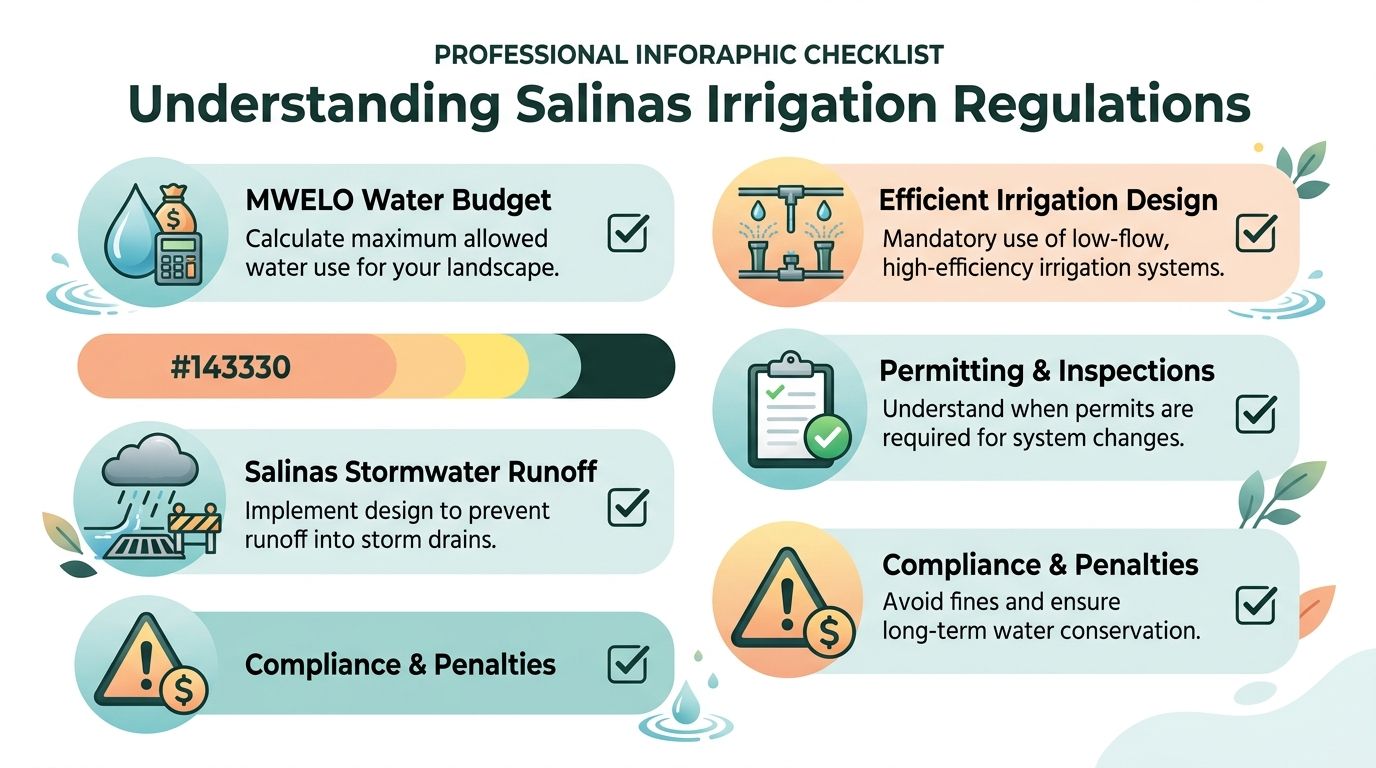
Decoding the Regulations MWELO and Salinas Stormwater Rules
Most homeowners do not need to memorize legal language. They do need to understand what the rules ask the design to do.
At a practical level, two issues control the job. First, the planting and irrigation layout has to use water efficiently. Second, the project cannot create runoff or stormwater problems.
What MWELO means in plain English
Hydrozoning means grouping plants with similar water needs on the same valve or irrigation zone. A thirsty lawn area should not share a zone with drought-tolerant shrubs. When it does, one side gets too much water or the other gets too little.
Weather-based controllers are designed to adjust watering based on conditions rather than running the same schedule every week. That is important in a climate where watering demand changes through the season.
Turf limits matter because large lawn areas consume water differently than mixed planting beds. If a project has to comply, turf gets reduced so the design can stay inside the allowed water budget.
What homeowners usually miss during planning
The surprise is seldom one single rule. It is the interaction between them.
A new patio may increase impervious area. A new planting plan may trigger water-efficiency requirements. A revised irrigation layout may need different zoning than the old system ever had. If these pieces are drawn separately, the project gets messy quickly.
A compliant design should answer a few questions early:
- Which areas need separate valves because the plants have different water needs
- Whether the controller is suitable for a weather-based setup instead of a fixed timer
- How much turf remains once the redesigned space includes planting beds, paths, and outdoor living areas
- Where runoff goes if spray heads overshoot paving or slope toward drains
If you wait until plan check to think about hydrozones, controller type, and turf layout, the redesign is harder than handling it during layout.
The Salinas stormwater piece is not optional
For Salinas homeowners, irrigation changes can also run into stormwater review. Projects creating or replacing 2,250 square feet or more of impervious area must comply with the City’s Stormwater Development Standards, and non-compliance can lead to permit denials or fines of up to $10,000 per violation, according to the City of Salinas Stormwater Development Standards.
That sounds like a rule for big construction jobs, but residential projects can reach it quickly when patios, drive areas, walkways, and other hardscape changes are bundled together.
High-pressure spray heads near paving are a quick way to create runoff problems on an otherwise good-looking outdoor area plan.
A workable way to think about compliance
Use this lens before design starts:
| Design issue | What it means on site |
|---|---|
| Plant grouping | Similar plants should share a watering zone |
| Controller choice | Fixed timers are often the weak point |
| Turf footprint | Large lawn areas can complicate compliance |
| Hardscape changes | Added impervious area can trigger stormwater review |
| Overspray risk | Water landing on pavement can become a permit problem |
Homeowners planning broader yard renovations should also review how new water rules are changing outdoor area design because irrigation decisions seldom stay isolated from the rest of the outdoor areas.
Choosing Your Irrigation Technology for the Salinas Climate
The right equipment depends on what you are watering, how your yard is laid out, and how your property behaves through the season. In Salinas, the climate adds one more layer. Fog changes irrigation demand.
What Salinas homeowners should know before changing their irrigation system is not merely “install drip.” Drip helps in many situations, but system performance depends on zoning, pressure, soil, and controller calibration.
Drip, spray, and rotor each have a place
Drip irrigation works for shrub beds, native planting, and areas where you want water delivered close to the root zone. It is the best fit for drought-tolerant plantings and narrow beds.
Spray heads can work, but require correct spacing, pressure, and head selection. Poorly chosen spray equipment causes misting, overspray, and runoff. Those failures waste water and create maintenance headaches.
Rotors can suit larger turf sections, but they are seldom the answer for every part of a mixed residential yard. When contractors try to make one head type cover every space, the system becomes less precise.
The smart controller matters more here than in many places
In Salinas’s coastal fog belt; evapotranspiration rates can be up to 30% lower than inland areas. Without calibration for local fog, a generic smart controller can waste 15-25% of its water, according to the Toro Salinas Valley irrigation article cited in the verified data.
This is the local nuance many generic guides skip. A smart controller is not effective for your site without proper configuration. It has to be set up for the property’s exposure, plant type, and local weather pattern.
In Salinas, a controller that ignores fog can overwater a compliant outdoor area as an old timer would.
Soil and layout still control the result
A controller tells the system when to water. Soil determines how that water moves and how long it stays useful to the plant.
If your yard includes a mix of loam, compacted fill, and heavier spots, the same schedule may perform differently across the property. Homeowners benefit from understanding the site, not only the hardware. If you want a good primer before discussing amendments or emitter rates, this guide to understanding soil test results is worth reviewing.
A practical comparison for Salinas homes
| Technology | Best use | Common failure |
|---|---|---|
| Drip | Beds, shrubs, native planting | Clogged emitters, poor filtration, bad zoning |
| Spray | Small turf or select open areas | Overspray, misting, pressure issues |
| Rotor | Larger turf sections | Weak coverage in irregular spaces |
| Weather-based controller | Whole-system scheduling | Bad setup if local fog is ignored |
For homeowners redesigning around lower-water planting, the planting strategy in the modern approach to drought-tolerant outdoor design pairs better with drip and hydrozoning than with legacy spray layouts.
What works and what does not
What works in Salinas is a system where the controller, plant palette, and zone layout all agree with each other.
What does not work is mixing lawn, shrubs, and low-water natives on the same valve, then expecting a newer app-based controller to fix the design. It cannot.
Rainwater harvesting can also be part of the conversation on some properties. Verified data for Salinas-related content notes that these systems can reduce municipal water reliance and support efficient low-water outdoor spaces when they are integrated correctly with irrigation planning. The key is to treat harvesting as part of the irrigation design, not as an add-on after installation.
The Financial Equation Cost, ROI, and Local Rebates
Homeowners compare irrigation options by installation price alone. These projects should not be judged that way.
The better question is this: What will this system cost me if I install the wrong one, fail compliance, or keep wasting water for years?
Savings come from design, not from gadgets alone
Upgrading to a smart irrigation system with a weather-adjusting controller can save 30-50% more water than traditional sprinklers. In Salinas, that can translate to over $380 in yearly savings for an average family, and some eco-upgrades may boost home value by 4-8%, according to the Salinas water-saving upgrade article.
Those numbers are meaningful, provided the system is designed correctly. A premium controller connected to poorly zoned valves and old leaking lines will not deliver the result people expect.
The hidden cost is redesign
The expensive part of irrigation projects is not the original work. It is the rework.
That happens when:
- The permit scope changes: What started as a refresh becomes a larger regulated outdoor area project.
- The controller is chosen too late: The planting plan and irrigation zones were not built around it.
- Stormwater issues show up after layout: Paving, runoff, and drainage were treated as separate problems.
- Turf reduction was never discussed: The homeowner approved a plan that later had to be revised.
Rebates can help, but timing matters
The local decision window is shaped by two pressures at the same time. Homeowners are trying to meet water-efficiency requirements while also watching for rebate opportunities tied to water-saving equipment and upgrades.
The author brief notes Monterey Peninsula Water Management District rebates as first-come, first-served and tied to a limited time window after purchase. The practical takeaway is straightforward. If a project may qualify for offsetting funds, the homeowner should confirm program details before ordering materials or beginning work.
A smart move is to check rebate rules during design, not after installation. That gives you a better chance of choosing eligible equipment and keeping documentation clean.
Property value enters the conversation too
A good irrigation upgrade is seldom visible in the way a patio or outdoor kitchen is visible. Buyers notice the result. Healthy planting, lower-maintenance outdoor areas, and efficient watering systems make a property easier to own.
For homeowners considering broader yard changes, drought-smart outdoor design in Salinas shows why water-wise design is increasingly tied to curb appeal, not separate from it.
An irrigation system should be judged like any other infrastructure upgrade. By compliance, operating cost, maintenance burden, and how well it supports the outdoor area you want.
How to Select a Contractor Who Knows Salinas Water Rules
The right contractor does more than install pipe and heads. They should be able to look at your project and identify whether the scope, planting plan, and permit path fit together before work begins.
This matters more than a polished sales pitch.
Start with your own self-check
Use these questions before the first meeting.
- Is my planned project permitted, and does it involve 500 or more square feet of new planting or significant outdoor area rehabilitation? If yes, MWELO likely applies.
- Does my current irrigation system use weather-based controllers, or is it running on a fixed timer schedule? Fixed timers are one of the most common compliance gaps.
- What percentage of my planted area is turf? If a significant portion is turf, a compliant redesign will require turf reduction.
A homeowner who can answer those questions will have a better conversation with a contractor.
Ask questions that reveal local knowledge
Some contractors are strong installers but weak on planning. Others understand permits but outsource irrigation design. You want both.
Ask things like:
- How do you determine whether a project crosses a compliance threshold?
- How do you separate hydrozones on a mixed yard with lawn, shrubs, and drought-tolerant plants?
- What controller brands do you prefer for weather-based scheduling, and why?
- How do you handle runoff risk near paving and drive areas?
- Who prepares permit-related irrigation documentation if the project requires it?
Listen for answers. Vague reassurance is not enough.
Verify licensing and project responsibility
A legitimate contractor should give you their California license number without hesitation. A real example of the format to expect is #1107800.
Also verify insurance and ask who is responsible for layout changes if the permit reviewer or inspector requires revisions. This answer tells you whether the company has worked through regulated outdoor area jobs before.
Watch for these warning signs
| Green flag | Red flag |
|---|---|
| Talks about zones before products | Starts by pushing hardware |
| Asks about permit scope | Assumes no permit issue |
| Discusses plant water use | Treats all planting the same |
| Mentions runoff and paving | Ignores drainage until later |
| Explains documentation clearly | Says “we’ll figure it out on site” |
The best contractors save homeowners money before the first trench is dug. They do it by preventing avoidable mistakes.
Post-Installation Maintenance and System Monitoring
A new irrigation system is not a set-it-and-forget-it appliance. Even a built system needs observation.
The good news is that maintenance is straightforward if you stay ahead of small issues.
What to check through the season
Walk the system while it runs. Do not rely on the app alone.
Look for:
- Clogged drip emitters: Dry spots in beds show up before the controller reports anything.
- Tilted or blocked spray heads: A healthy system wastes water if a head is spraying a walkway.
- Valve behavior: Zones that start late, fail to shut off, or water inconsistently need attention.
- Sensor condition: Weather or soil-moisture inputs help if they are clean and working.
What to review in the controller
Smart controllers can generate helpful reports, but homeowners should compare schedules against plant performance. If a bed looks stressed, it may need a zone adjustment. If paving stays wet after a cycle, the runtime may be too aggressive for the area.
In Salinas, seasonal changes matter. A schedule that works during one part of the year may not fit another.
Healthy plants, dry pavement, and even coverage tell you more than a green app icon.
Keep the outdoor area and the system connected
Irrigation performance changes when the outdoor area changes. New mulch, maturing shrubs, removed trees, and added hardscape all affect watering demand.
Routine site care supports irrigation efficiency. Homeowners looking at the broader maintenance side can review what matters in lawn maintenance for Monterey County homes because irrigation and upkeep should reinforce each other, not fight each other.
A small adjustment made early is cheap. A neglected issue that runs for months is not.
Your Next Steps for a Compliant and Efficient System
If you are planning a yard renovation, turf conversion, planting refresh, or outdoor living upgrade, handle the irrigation questions before the design is locked in. That is the easiest way to avoid permit surprises, runoff issues, and expensive redesign.
Spring is the practical time to do it. Summer compresses schedules, and homeowners who wait end up making rushed decisions about controllers, zoning, and planting layouts.
Salinas and Monterey County homeowners are dealing with two realities at once. Water rules are tighter, and incentive programs can be limited by timing and funding. This combination favors people who assess their scope early and document the project correctly from the start.
Frequently Asked Questions About Salinas Irrigation Upgrades
| Question | Answer |
|---|---|
| Do I need a permit to change my irrigation system? | Sometimes. A simple repair may not trigger review, but larger outdoor area renovations, new planting areas, hardscape changes, or work tied to a permitted project can pull irrigation into the permit process. |
| What is hydrozoning in simple terms? | It means putting plants with similar water needs on the same irrigation zone so one schedule can serve them properly. |
| Is drip better than spray? | No. Drip is the better option for beds, shrubs, and drought-tolerant planting, but turf and open spaces may call for different equipment. The layout matters more than the label. |
| Can a smart controller fix an old inefficient system? | No. A smart controller helps scheduling, but it cannot correct bad zoning, leaking lines, wrong pressure, or poor head placement. |
| Why does fog matter in Salinas irrigation planning? | Fog reduces plant water demand in many parts of Salinas. If the controller is not calibrated for that local condition, the system can still overwater. |
| What should I ask a contractor first? | Ask whether your project scope may trigger compliance requirements, how they handle hydrozones, and who manages permit documentation if the plan needs approval. |
| Do I need to think about stormwater if I am mainly changing outdoor areas? | Yes, especially if the project also changes paving or other impervious areas. Irrigation overspray and runoff can become part of the review. |
If you want a project-specific opinion before you commit to design or installation, schedule an assessment with California Outdoor Area & Tree Pros. As a Salinas-based licensed contractor, License #1107800, the company helps homeowners evaluate irrigation upgrades with local rules, long-term water efficiency, and property use in mind.