
Quick Answer
A commercial grounds care agreement should specify exactly which services are included at what frequency: mowing, pruning, debris removal, irrigation checks, and seasonal enhancements. It should also define how extras are handled, what response time looks like for irrigation failures or storm damage, and what the end-state looks like after each visit. Vague contracts are the primary source of vendor disputes and missed expectations in commercial grounds care.
You may be staring at a one-page proposal that says little more than “full service grounds maintenance,” a monthly price, and a signature line. Problems start there.
If you're trying to understand what is included in a commercial grounds care contract?, the answer is that a good contract is not just a service list. It’s an operating document that controls expectations, budget, site condition, and liability. If you're new to commercial or HOA oversight in Salinas, Monterey County, or the broader Central Coast, you need a contract that tells you what happens, how often it happens, what gets billed extra, and who is responsible when something goes wrong.
Introduction
Most property managers start asking this question after a bad experience. They inherited a vague agreement, the grounds don’t look right, residents or tenants are complaining, and nobody can tell whether the contractor missed work or the work was never included.
That’s why a commercial grounds care contract has to be more than a promise to mow and trim. If you need a basic primer on what is a service contract, it helps to think of the grounds care agreement the same way: a written document that defines obligations, limits, and remedies. In practice, the strongest contracts protect the property on three fronts at once. Appearance, operations, and risk.
Beyond Mowing The Contract as a Risk Management Tool

A property manager usually feels the gaps in a grounds care contract on a bad day. A slip complaint after overspray, a failed irrigation valve during a heat spell, a limb down near parking, or a city notice about water waste. At that point, the question is no longer what the contractor mows. The question is whether the agreement assigned responsibility clearly enough to reduce damage, control costs, and document performance.
That is the primary job of this section of the contract. It protects the asset.
Irrigation failures create cost and compliance exposure
If the crew only mentions a broken head when someone happens to notice it, the property is being managed by luck. The contract should state whether irrigation includes scheduled inspections, controller checks, leak identification, seasonal adjustments, shut-off procedures, and repair authorization rules.
In California, that language matters quickly. Water waste can trigger complaints. Plant loss shows up fast in heat. Poor irrigation control also affects runoff, walkway conditions, and tenant perception.
Tree and shrub care belongs in the risk column
Branches over sidewalks, monument signs, drive aisles, and light poles are not just maintenance details. They affect sightlines, pedestrian safety, and claim exposure.
The contract should separate appearance pruning from clearance pruning, hazard reduction, structural pruning, and specialty tree work. I have seen managers assume "tree trimming" covered everything, then learn after a wind event that the contractor only priced light shaping. That is an expensive misunderstanding.
Practical rule: If a task affects safety, visibility, water compliance, or access, get it written in clear service language.
Cleanup standards decide whether the site feels managed
Debris control is where weak contracts start costing time. Crews can technically mow the turf and still leave clipping piles at curbs, wet walks at entries, and seed pods along pedestrian routes.
A better contract defines the finish condition after each visit. Walks are blown clean. Drains are checked for obvious blockage. Hardscape is left free of loose debris. Without that standard, every service review turns into a debate about what "completed" meant.
California weather and seasonal shifts should be addressed up front
A commercial site in California does not perform the same way all year. Dry months put pressure on irrigation oversight and plant stress response. Rain season shifts attention to drainage, debris accumulation, erosion points, and storm cleanup readiness. Coastal properties, inland heat, and local water rules all change what good maintenance looks like.
That is why smart managers treat the contract as part of site risk control, not just curb appeal. For a broader view of how maintenance decisions affect operating value, see this breakdown of commercial grounds care ROI and property operations.
Insurance and documentation requirements should be explicit
Insurance language protects the property only if the paperwork stays current and the requirements are clear. You must ask for current certificates and make sure the contract requires them. That includes the contractor’s coverage limits, additional insured status where appropriate, and rules for subcontractor coverage if tree work, irrigation repair, or specialty services are assigned out.
Documentation matters too. If there is a slip claim, branch failure, vandalized irrigation, or a dispute over missed service, the manager needs service logs, site notes, and photo records. A contract that requires reporting creates a cleaner record when a problem has to be reviewed later.
Routine work and triggered work should never be blended together
This distinction prevents many of the disputes I see.
Routine work is scheduled and predictable. It includes recurring visit tasks such as mowing, edging, blowing, bed cleanup, basic pruning cycles, and whatever level of irrigation inspection the contract assigns.
Triggered work happens because conditions changed. It includes storm cleanup, irrigation repairs, drainage response, emergency tree assessment, accident cleanup, or corrective work after vandalism or extreme weather.
If both categories sit under a vague phrase like "full service," the property manager loses control over budget, response expectations, and accountability.
Deconstructing the Scope of Work The Service Matrix
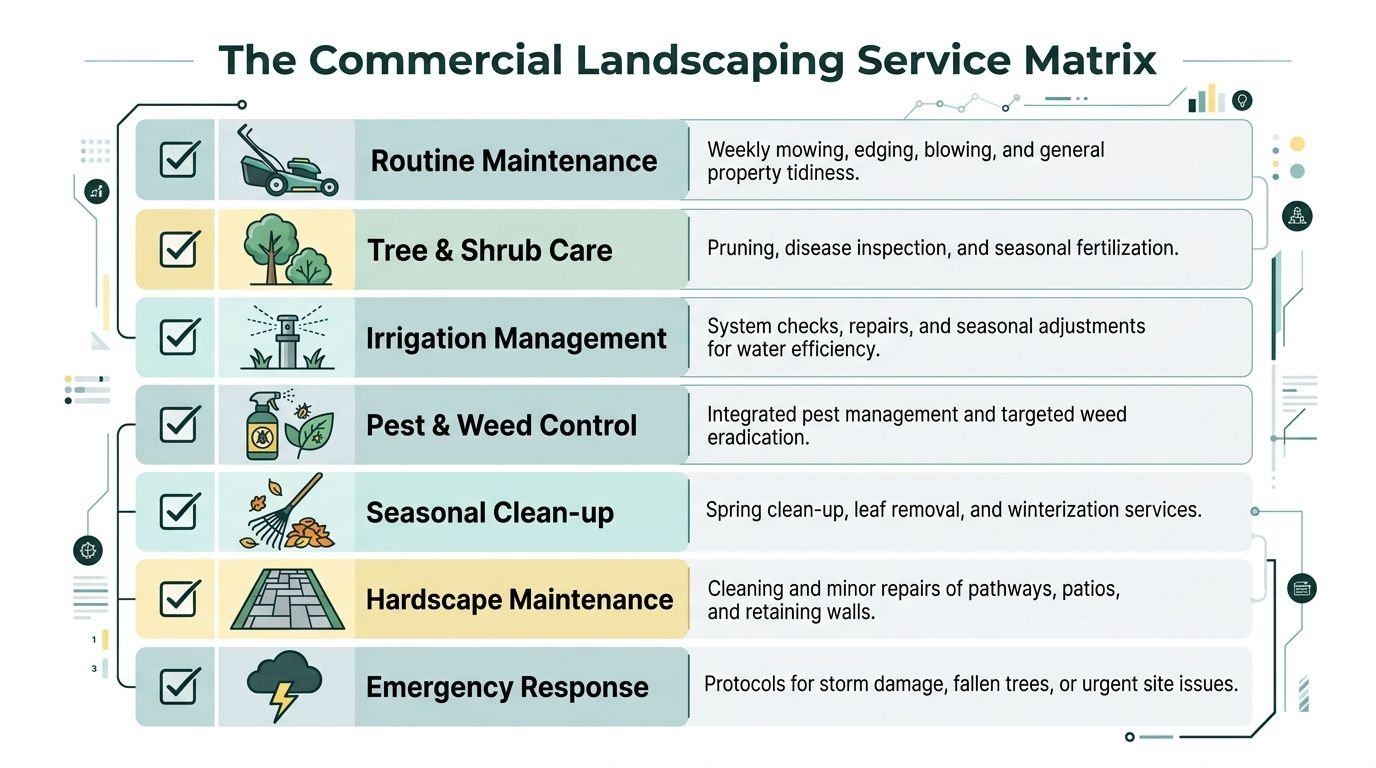
The scope of work is where a property manager either keeps control of the account or gives it away.
I have seen plenty of contracts with a clean monthly price and a weak scope. They look fine until summer heat exposes irrigation gaps, fall leaf drop changes labor needs, or a tenant complains that the entry beds were never part of the service. In California, that problem gets worse because water rules, fire season, plant stress, and seasonal growth patterns can change the work faster than the contract language changes.
A good service matrix breaks the site into work categories, assigns a frequency, and states the expected result. If you want to see how that structure typically appears across commercial grounds care maintenance services in California, use that as a comparison point. The contract itself still needs site-specific detail.
Recurring maintenance should define the site, the schedule, and the finish standard
Scheduled work should leave very little open to interpretation.
The contract should name the exact areas included. Frontage turf, parking lot islands, detention edges, rear utility strips, monument entries, dumpster enclosures, and steep banks often get missed because somebody assumed they were obvious. They are not obvious once there is a billing dispute.
It should also state how often the work is performed and what "complete" means for each visit. For recurring care, look for details like:
- Mowing cadence: Frequency by season or by growth conditions
- Edging and trimming: Whether it is performed every visit or on a separate rotation
- Blowing and hard surface cleanup: Sidewalks, curbs, drive lanes, stairwells, and entries
- Debris pickup: Organic debris, loose litter, and palm drop if applicable
- Service boundaries: Which turf, bed, slope, and perimeter areas are included
A phrase like "maintain all grounds care areas" creates risk. A defined map, site notes, or area list reduces it.
Horticultural care needs its own scope, not a catch-all sentence
Plant care is usually where appearance standards and labor costs separate.
A manager may expect shrubs to stay off windows, signs to remain visible, groundcovers to stay within bounds, and seasonal color to look fresh at the front entry. The contractor may be pricing only occasional shearing and basic weed control. Both sides think they are talking about maintenance. They are describing different service levels.
The contract should answer specific questions:
| Contract question | Why it matters |
|---|---|
| Are shrubs pruned for clearance, shape, health, or all three? | Each standard takes different time and skill. |
| Are tree canopies included up to a defined height? | Clearance over walks, lights, and parking stalls affects safety and visibility. |
| Is weed control included in turf, planter beds, decomposed granite, and fence lines? | Weed complaints usually come from the areas the contract forgot to name. |
| Is mulch part of base service or billed as an enhancement? | Mulch affects moisture retention, appearance, and erosion control. |
| Are annual color changes included? | Entry presentation matters on office, retail, hospitality, and HOA sites. |
In California, plant selection and care standards also affect water use. If the site has mixed hydrozones or older plant material, the horticulture scope should match those conditions instead of treating every bed the same.
Irrigation language should spell out who is watching the system
This part protects both budget and compliance.
Many maintenance crews will report a broken head if they happen to see one. That is not the same as active irrigation management. A contract should state whether the contractor performs scheduled inspections, controller adjustments, wet checks, leak review, valve testing, and written reporting. It should also state how quickly serious failures are reported, especially when runoff reaches walks, tenant entries, or public right of way.
The difference is operational:
- Observation only: Crew reports visible problems noticed during routine service
- Scheduled inspection: Contractor checks defined irrigation components on a set interval
- Managed program: Contractor inspects, documents, recommends adjustments, and handles approved repairs under a stated process
For California properties, that distinction matters. Water waste can turn into tenant complaints, dead material, erosion, slippery pavement, and avoidable utility cost. On some sites, it can also create regulatory exposure if runoff or broken irrigation is left unresolved.
Seasonal and site-specific tasks should be listed separately
The cleanest contracts separate standard recurring work from recurring seasonal work.
That includes tasks such as spring cutbacks, pre-summer irrigation adjustments, fall leaf management, storm-season drain area cleanup, frost response in colder inland markets, and fire fuel reduction on perimeter zones where applicable. These items may happen every year, but they do not happen every visit, so they should appear on their own schedule.
That protects the manager in two ways. The property gets the work when it is needed. The contractor cannot reduce service by treating seasonal labor as optional.
Enhancement and event-driven work should sit outside the base scope
Base maintenance preserves condition. Enhancements and event response correct, replace, or improve.
If the contract does not separate those categories, monthly billing starts carrying costs that should have been approved case by case. Common examples include major plant replacement, drainage correction, irrigation repairs, storm cleanup, tree risk mitigation, turf renovation, and seasonal color installation.
The clean version is simple:
- Base scope: Scheduled maintenance included in the contract price
- Seasonal recurring scope: Predictable tasks performed at set times of year
- Triggered or enhancement scope: Extra work approved through proposals, allowances, or emergency authorization rules
That structure gives the property manager cleaner budgeting and a better paper trail. It also reduces the argument that a contractor should have "just handled it" when the task was never priced into the agreement.
A useful service matrix reads like an operating plan
By the time you finish reviewing this section, you should be able to answer four questions without calling the vendor.
What areas are covered. How often each service occurs. What quality standard the crew is expected to meet. What work requires separate approval.
If any of those answers are fuzzy, the contract is still carrying too much risk.
Essential Legal and Financial Clauses You Cannot Ignore

A property can look fine for months and still carry contract risk the whole time. The trouble usually shows up after an injury claim, an irrigation break, a billing dispute, or a cancellation fight in peak season.
That is why I review the legal and payment clauses with the same care as the mowing frequency. A weak service scope creates operational headaches. Weak contract language creates liability, cost exposure, and collection problems.
Insurance language should be explicit
The agreement should state what insurance the contractor carries, what limits apply, and who must be listed as additional insured where appropriate. At minimum, look for general liability, auto liability, workers’ compensation, and coverage that addresses property damage exposure. The contract should also require current certificates before work starts and on renewal.
Do not accept “fully insured” as an answer. You must ask for current certificates and make sure the contract requires them.
This matters on real sites. A crew vehicle backs into a gate. A trimmer throws debris into storefront glass. An employee gets hurt while servicing a slope. If the contract is vague, the property manager spends time sorting out a problem that should have been assigned clearly from day one.
Payment terms should be plain enough to survive a dispute
If billing language needs interpretation, it will eventually be interpreted in whoever’s favor has the cleaner paper trail.
The contract should clearly state:
- Billing cycle: Monthly, per visit, or another set structure
- Invoice timing: When invoices are issued and what period they cover
- Due dates: When payment is expected
- Late charges: Any fees or interest for overdue balances
- Extra work approval: Who can authorize add-ons, and whether email approval is enough
- Work outside scope: How exclusions are priced and billed
- Disputed charges: Whether undisputed amounts must still be paid on time
The practical trade-off is simple. Contractors want predictable cash flow. Property managers need control over surprise charges. Clear approval rules protect both sides.
Price increase language should use a defined method
Annual price adjustments are common. Labor costs change. Fuel changes. Disposal fees, repair costs, and compliance costs change too, especially in California.
What you want is a clause with boundaries. The contract should say when an increase can happen, how much notice is required, and whether the adjustment is tied to a stated percentage, a cost index, or a documented change in operating costs. Avoid broad language that lets pricing change midterm without a written standard.
California managers should pay close attention to equipment compliance costs here. Rules affecting fleet mix, charging logistics, and handheld equipment can change operating expenses over the life of a contract. This overview of California electric equipment requirements for commercial grounds care providers gives useful context for why some vendors are revising pricing structures and service logistics.
Cancellation and renewal terms control your exit risk
Termination language gets ignored when the relationship is new. It matters most when service starts slipping or ownership changes.
Review these points carefully:
- Notice period: How much written notice either side must give
- Auto-renewal: Whether the agreement renews unless someone cancels
- Right to cure: Whether the contractor has time to correct service failures before termination
- Termination for cause: What counts as cause
- Termination without cause: Whether either side can end the contract for convenience
- Open proposals and approved extras: How unfinished add-on work is handled at termination
A long notice period can stabilize service for the contractor, but it can trap a property manager with poor performance during a critical season. A short notice period gives flexibility, but it can also increase turnover risk if ownership changes or budgets tighten.
California compliance should be reviewed line by line
California adds a layer that newer property managers sometimes underestimate. The contract should match the work being sold.
If the vendor will handle tree pruning, limb removal, pesticide applications, backflow-related irrigation work, or other regulated tasks, verify that the contractor holds the right license or uses properly qualified subcontractors. Do not assume a general maintenance vendor can perform every service on the proposal just because it appears in the scope.
Also check how the contract assigns responsibility for regulatory compliance, traffic control if needed, site access restrictions, water-use limitations, and disposal of green waste. Those details affect cost, scheduling, and liability.
Weather and force majeure language should match field conditions
A good clause does more than excuse delay. It explains what happens to the schedule, what counts as unsafe conditions, and how missed visits are handled.
That matters in California because conditions vary sharply by region and season. Rain events, heat, wind, saturated soils, and local access restrictions can all change whether work should proceed, be postponed, or be modified. On multi-site portfolios, one property may be serviceable while another should be left alone to avoid turf damage, rutting, or safety problems.
The contract should say who makes that call, how the manager is notified, and whether skipped work is rescheduled, credited, or folded into the next visit. That is how weather language becomes a risk-control clause instead of boilerplate.
Red Flags and Negotiation Points for California Property Managers
A weak grounds care contract usually looks fine on the first read. The trouble shows up three months later, when the site is slipping, water use is climbing, and the vendor points to vague language you cannot really enforce. For California property managers, that is the core negotiation issue. The contract has to control risk, not just list services.
One of the fastest ways to test a proposal is to compare the promised scope against the kind of field-level accountability covered in this guide on how to tell whether your commercial grounds care provider is doing the work you are paying for. If the vendor cannot explain what gets done, how it is verified, and what happens when conditions change, the contract is still too loose.
Ask what happens on a normal visit and what triggers extra billing
Start there.
“Full service” and “standard maintenance” do not protect the property. A property manager needs visit-level clarity. Each scheduled service should tie to a defined set of tasks, site areas, and finish expectations. It should also state what is excluded and what becomes extra work.
Red flags include:
- As-needed language without a trigger. This creates billing disputes and missed work.
- No map or site boundary exhibit. Crews skip planter beds, slopes, rear access lanes, or outparcels when the contract does not define them.
- No distinction between recurring work and enhancement work. Seasonal color, bark refresh, drainage cleanup, storm cleanup, and irrigation repairs should not sit in the same gray area.
- No standard for completion. If the contract does not describe the expected result, every complaint turns into an opinion contest.
Negotiate irrigation reporting like it affects your budget, because it does
In California, irrigation language deserves closer review than mowing language on many properties. Water loss, runoff, dead material, slippery pavement, and tenant complaints often start with a small issue that was seen late or reported poorly.
Do not settle for “we check irrigation during service.” Ask how the check is done, how often it is documented, who receives the report, and what happens when a problem is found. The difference between a casual look and a defined inspection process shows up in water bills, plant replacement costs, and response time.
A useful negotiation point is written documentation. Ask for photos, station notes, leak location details, and a repair approval process with dollar thresholds. That protects both sides. The contractor knows when to proceed and when to wait. You get a record you can use for budgeting, ownership updates, and vendor accountability.
| Question to ask | Strong contract language | Weak contract language |
|---|---|---|
| How are irrigation issues identified? | Scheduled inspection or documented field review | “Crew will monitor as needed” |
| How are issues reported? | Photos, notes, written service report | Verbal update only |
| What happens after a major leak or controller failure? | Defined escalation path, temporary shutoff authority, approval process | “We will respond when available” |
Clarify urgent response before you need it
Storm damage, failed valves, broken mains, fallen limbs, and blocked access routes are not rare events in California. Wind, heat, and early winter storms create real exposure, especially at retail centers, HOAs, office campuses, and medical properties.
The contract should define what counts as urgent, who can authorize temporary safety work, who gets called first, and how after-hours rates are billed. If a vendor offers emergency support, ask whether that support is provided by their own crews, by a subcontractor, or only when staffing allows. Those are different risk profiles.
I usually look for two things here. First, a response process that is realistic. Second, authority to perform limited safety measures without delay, such as shutting down a leaking zone, isolating a hazard area, or clearing a blocked entry, with formal approval required for larger corrective work.
Press on seasonal risk specific to California
A good contract in California should reflect the operating season of the property, not a generic year-round service template.
On the Central Coast, dry-season irrigation management and plant stress monitoring matter. In late fall and winter, drainage paths, leaf buildup, storm prep, and tree-related risk often matter more. Inland properties may face heat stress, water restrictions, and faster decline in turf or shrub areas if the irrigation scope is weak. Coastal properties may deal with salt exposure, wind damage, and rapid weed pressure after rain.
That does not mean every seasonal task has to be bundled into the base price. It means the contract should identify what is included, what is condition-based, and what requires separate approval. If pre-rain cleanup or storm recovery matters to the site, negotiate it directly instead of assuming it is covered.
Separate routine pruning from higher-risk tree work
This is a common failure point.
Many proposals blur the line between shrub care, small tree shaping, clearance pruning, and higher-risk tree work over parking, walks, or occupied areas. A property manager should pin that down before signing. If the contract uses broad terms like “pruning as needed,” ask for height limits, frequency, debris handling, and exclusions.
This is also a negotiation issue around liability. If larger tree work is excluded, the contract should say so clearly. If it is included, the scope, qualifications, and approval rules should be specific enough that no one is guessing after a branch failure or access obstruction.
Ask for inspection and correction timelines, not just service promises
Service promises are easy to sell. Correction timelines are what protect the property.
If the vendor misses an area, leaves debris at entries, skips a detail item, or fails to report a visible irrigation problem, the contract should state how quickly the issue is corrected after notice. It should also say how recurring deficiencies are documented and what remedies apply if performance slips over time.
That matters on managed properties where complaints come from tenants, residents, boards, and asset managers. A contract with no cure process often leaves the manager stuck between ownership and the vendor, without a clean way to enforce performance.
Ask for a finish standard that you can inspect in five minutes
A written finish standard reduces arguments and shortens site walks. It should describe what the property should look like after service, including pavement cleanup, edge condition, bed appearance, debris removal, and visible irrigation problems.
If I cannot hand the agreement to an assistant manager or chief engineer and say, “Inspect the site against this,” the scope is still too vague. That is usually the point where negotiation should continue, not the point where legal review starts.
Frequently Asked Questions About Commercial Landscaping Contracts
Q: What services are usually included in a commercial grounds care contract?
A: Most contracts cover recurring mowing, edging, blowing, bed cleanup, and shrub care. A better contract also spells out irrigation inspections, seasonal color or cutback work, weed control responsibilities, and what requires separate approval. For a California property manager, the point is to know which site conditions the contractor is watching before they turn into water waste, code issues, or curb-appeal complaints.
Q: Is tree removal usually included in a maintenance agreement?
A: No. Standard maintenance agreements may include limited pruning if the scope identifies tree size, access limits, and clearance standards, but removals, storm response, hazard mitigation, stump grinding, and large-tree work are usually separate. If your site has mature canopy trees, medians, or HOA common areas, review a written commercial grounds care maintenance scope in Salinas before you assume tree work is covered.
Q: How long should a commercial grounds care contract run?
A: It depends on the property’s condition and the ownership’s priorities. A shorter initial term can make sense on a troubled site where service quality is unproven. A longer term can help with staffing continuity, seasonal planning, and budget stability, especially if the pricing language and termination rights are clear.
Q: Is automatic renewal normal?
A: Yes, but it needs clear notice deadlines and plain cancellation language. I want property managers to be able to answer two questions fast: when does the contract renew, and how many days' notice stops it? If those terms are buried, the contract creates administrative risk.
Q: Can I ask for water-use reporting or irrigation documentation?
A: Yes, and California managers should ask for it whenever irrigation is a material budget or compliance issue. Reporting can be simple. Valve observations, controller notes, leak reports, before-and-after photos, and repair recommendations are often enough to show whether the contractor is helping control waste or just reacting to complaints.
Q: What should I do if the proposal says “as needed” in several places?
A: Slow the review down. That phrase is acceptable for narrow items like storm cleanup response or extra pest treatment, but it is weak language for routine maintenance. Ask the contractor to replace it with frequencies, site triggers, approval thresholds, or a measurable finish standard.
Q: Should I worry about whether the contractor is licensed?
A: Yes. Licensing matters more once the contract touches irrigation repairs, tree work, or other higher-liability tasks. A plain-English overview of hiring licensed vs. unlicensed contractors is worth reading because the contract risk does not stay with the vendor alone. It can land on the property manager and owner when work goes wrong.
Q: How do I know whether the contract is detailed enough?
A: Use a simple test. Hand the agreement to an assistant manager or chief engineer and ask whether they can tell what gets serviced, how often, what is excluded, and what documentation follows a problem. If they cannot answer those questions, the contract still leaves too much open to dispute.
Closing Section
For commercial and HOA properties, the cleanest setup is usually one integrated partner managing the recurring maintenance scope along with irrigation oversight, seasonal transitions, and tree care coordination under one agreement. That removes the usual fragmentation where one vendor mows, another handles irrigation, someone else deals with tree risk, and the property manager ends up chasing all three.
California Grounds Care & Tree Pros brings that kind of structure to commercial maintenance in Salinas, Monterey County, and the wider Monterey Bay Area. The company is licensed, insured, and equipped to handle grounds maintenance, irrigation systems and water-wise upgrades, tree pruning and removal, storm cleanup, hardscape work, drainage solutions, and related site needs through one professional point of accountability. That matters because a good grounds care contract should protect asset value, reduce service gaps, and lower the odds that a site problem turns into a board issue or liability issue.
Call to Action
If you’re reviewing bids, renewing an agreement, or trying to fix a contract that isn’t performing, it helps to have another set of experienced eyes on the scope. California Grounds Care & Tree Pros can walk the property, review what’s being promised, and help you understand what should be included in a commercial grounds care contract for your site.
Call the Salinas office at 831-998-7964 or the Monterey office at 831-905-8018. You can also visit 1184 Monroe St., Suite 6, Salinas, CA 93906 or learn more at https://californiagroundscareandtreepros.com/.
Sources
The references below support the contract terms, service definitions, and risk points discussed earlier in this article. For California property managers, the useful sources are the ones that address scope clarity, water use, worker safety, and service accountability, not generic service lists repeated across multiple pages.
NXNWL. "Commercial Grounds Care Contracts Items Should Included." 2023. https://www.nxnwl.com/blog/commercial-grounds-care-contracts-items-should-included
If you want help reviewing a maintenance agreement or building a clearer scope for your property, California Grounds Care & Tree Pros is available for consultations and estimates throughout Salinas, Monterey County, and nearby service areas.