
Monterey County defensible space inspections increased nearly 300% between 2024 and 2025, meaning far more homeowners are now being evaluated than in prior years. California law requires 100 feet of managed vegetation in applicable zones, organized by distance from the structure. Trees with low-hanging limbs, dead wood, or contact with the roofline are the most common violations flagged during inspection.
If you live in Monterey County, defensible space is no longer a background concern—it's a local reality with real consequences. With inspections surging, understanding the rules has become critical, whether you've received a notice or just seen the fire trucks in your neighborhood. This guide will walk you through what inspectors are looking for, with a special focus on the hidden risks many homeowners miss: their trees.

The Local Reality: Why Inspections Surged in Monterey
For years, defensible space felt like something that only applied to remote, rural properties. That has changed dramatically. Backed by new state laws and a focused effort to protect communities, local fire departments have become far more proactive.
The numbers tell the story: in a single year, the number of defensible space inspections in Monterey County skyrocketed from under 900 to over 3,400. This isn't about wildfire risk in the abstract; it's about a specific program that is actively reaching properties at a much higher rate than most homeowners realize. This surge means thousands of homeowners are now facing their first-ever inspection, often with a specific deadline in mind.
A jump of nearly 300% between 2024 and 2025 means you are far more likely to be evaluated. The goal is risk reduction, but it makes understanding what inspectors look for more critical than ever.
This shift is a direct result of updated Fire Hazard Severity Zone maps and a community-wide effort to "harden" our homes against a growing wildfire threat. As a result, it's also a good time to review your California home insurance policies, as carriers are paying close attention to compliance.
The Right Timing: Prepare in Spring to Avoid the Summer Rush
Most homeowners only think about defensible space when an inspection notice shows up. That's a mistake. It creates a mad dash to find qualified tree services during the busiest, driest months of the year.
The smartest time to get your property ready is in the spring. By tackling potential violations before the high-risk fire season kicks in, you gain a massive advantage. You can book a good contractor without the wait and avoid the premium pricing that hits when everyone is scrambling for help in June and July. Getting ahead of the curve means your property will be safe, compliant, and ready long before an inspector arrives.
Understanding Your Fire Hazard Zone and Legal Duties
Before you pick up a rake or a chainsaw, you need to understand your property's specific fire risk. In Monterey County, this is tied to an official designation called the Fire Hazard Severity Zone (FHSZ). This CAL FIRE system is what inspectors use to decide exactly which rules apply to your home.
Your property’s address is mapped to a specific risk level, and that level comes with a clear set of legal responsibilities. These zones are the product of decades of data on local fire history, weather patterns, and vegetation. Your FHSZ status is the single most important factor determining your defensible space requirements.
What Is a Fire Hazard Severity Zone?
CAL FIRE groups all land in California into one of three zones based on how likely it is to experience a wildfire:
- Moderate Hazard Zone: These areas have some fire risk, but conditions are generally less severe.
- High Hazard Zone: Here, the likelihood of fire is greater, often due to steeper slopes or denser vegetation.
- Very High Hazard Zone (VHFHSZ): This is the most serious category, reserved for areas with the highest probability of intense, destructive wildfires.
If your property is in a High or Very High zone, you are required by state law to maintain 100 feet of defensible space. This isn't a friendly suggestion—it’s a legal mandate enforced by local fire agencies.
The Monterey County Regional Fire District received updated FHSZ maps on March 10, 2025. Knowing where your home falls on these new maps is critical, as a VHFHSZ designation brings the strictest rules. You can view the updated map on the Monterey County Regional Fire District's website.
This flowchart gives you a visual breakdown of how your property's location connects directly to your defensible space duties.
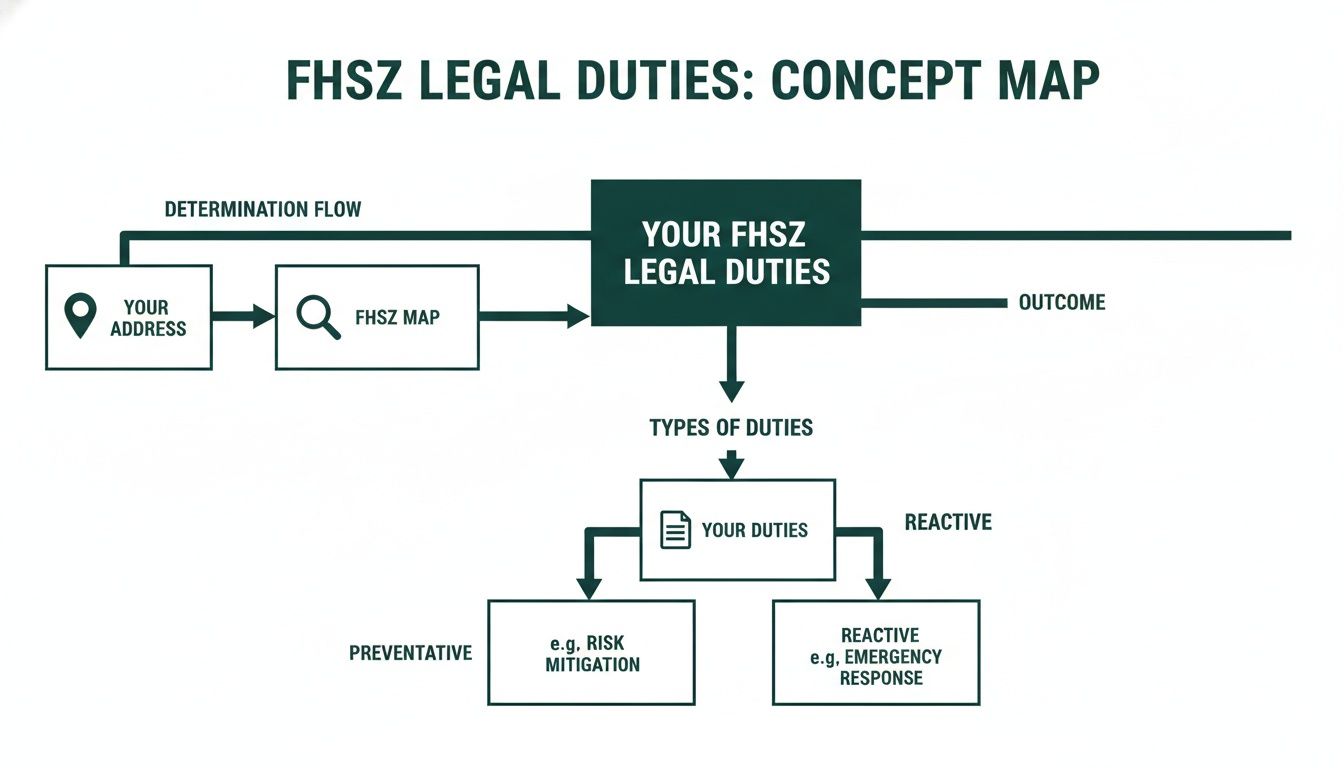
Simply put, finding your address on the FHSZ map is the key that unlocks your compliance checklist.
How to Find Your Zone and What It Means for You
The good news is you don't have to guess. CAL FIRE provides a simple online FHSZ viewer tool where any homeowner can type in their address and see exactly where their property lands on the map.
Once you know your zone, the inspection process becomes much clearer. For example, finding out you're in a VHFHSZ tells you immediately that the 100-foot rule is in effect, so you can start measuring your property with that standard in mind.
Key Takeaway: Your legal responsibilities aren't the same for everyone. They are tailored specifically to the risk level of your home's location. Checking the FHSZ map is the most powerful first step you can take.
While focusing on your own property is vital, it’s also helpful to be aware of the bigger picture, including community-wide strategies for reducing fire hazard in vulnerable communities. Understanding your FHSZ designation shifts you from reacting to an inspection to proactively managing your home’s safety.
Why Trees Are the Hidden Risk in Your Inspection
Many Monterey homeowners mow the grass, rake the leaves, and clear away the brush, thinking they're ready for an inspection. Then, a violation notice shows up, and the reason is almost always the same: the trees.
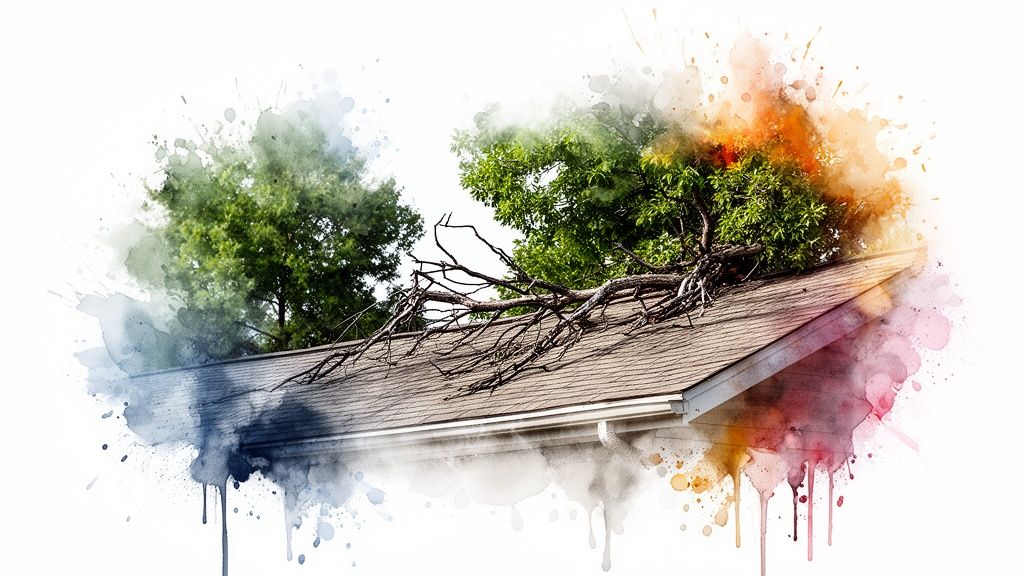
It's a huge blind spot. Most people assume defensible space is about brush and dry grass, but inspectors are trained to see how a fire could climb. From their perspective, a neat lawn means little if your trees act as a superhighway for fire to reach your roof.
The Two-Zone System for Tree Safety
To keep things consistent, fire inspectors across California, including here in Monterey, look at your property in two distinct zones. Understanding what they expect in each one is the key to passing your inspection.
- Zone 1 (0-30 feet): Think of this as the "ember-resistant zone." This is the area immediately surrounding your house, and the goal is to give fire absolutely nothing to catch onto.
- Zone 2 (30-100 feet): Here, the focus shifts to slowing a fire down. The idea is to create breaks in the vegetation that rob an approaching wildfire of its speed and intensity.
These zones aren't just suggestions. They are the exact blueprint the inspector will use, and you need to be in compliance with both.
Common Tree Violations in Zone 1 (0-30 Feet)
Right up against your home, the rules are strictest. An inspector is searching for any link that a fire could use to jump from the landscape to your structure.
Roof and Chimney Clearance
This is the big one. Any tree limbs that hang within 10 feet of your roofline or chimney are a major violation. This gap prevents embers from igniting an overhanging branch and dropping fire directly onto your shingles.
Dead Wood and "Ladder Fuels"
Next, the inspector will look up into the canopy of your trees for dead or dying branches. This dead wood is what we call "ladder fuel"—it gives a ground fire a ladder to climb right up into the tree's crown, where it can then threaten your roof. Removing all dead wood from trees in Zone 1 is a must.
Palm Tree Maintenance
Beautiful palms can become a serious fire hazard. The dead fronds that accumulate around the trunk create a thick, dry skirt that is incredibly flammable. A single ember can set it ablaze, sending a column of fire into the air. All dead fronds must be removed.
Tree Spacing Rules in Zone 2 (30-100 Feet)
Once you move past the 30-foot mark, the strategy changes from elimination to interruption. The whole point of Zone 2 is to create enough space between trees to prevent a fire from jumping from treetop to treetop—a scenario known as a crown fire.
To help you visualize the requirements, here’s a quick breakdown of what inspectors look for when it comes to tree spacing.
Defensible Space Zone Requirements for Trees
| Requirement Area | Zone 1 (0-30 feet) | Zone 2 (30-100 feet) |
|---|---|---|
| Roof Clearance | 10-foot minimum clearance from roof and chimney. | N/A |
| Limb Pruning | Remove all dead wood and branches within 6 feet of the ground. | Remove branches within 6 feet of the ground. |
| Horizontal Spacing | Remove trees/limbs that create a fire bridge to the house. | Spacing depends on slope: 10 feet (flat), 20 feet (moderate), 30 feet (steep). |
An inspector will measure the distance from the edge of one tree’s canopy to the edge of the next. On a flat lot, that's a 10-foot gap. On a moderate slope (20-40%), that requirement doubles to 20 feet, and on steep slopes (over 40%), you need a full 30 feet of clearance. A homeowner who cleared their brush but hasn't addressed their trees may still fail inspection. For a deeper dive into assessing which trees might pose the biggest risks, check out our advanced guide to tree risk assessment.
Your Pre-Inspection Walkthrough Checklist
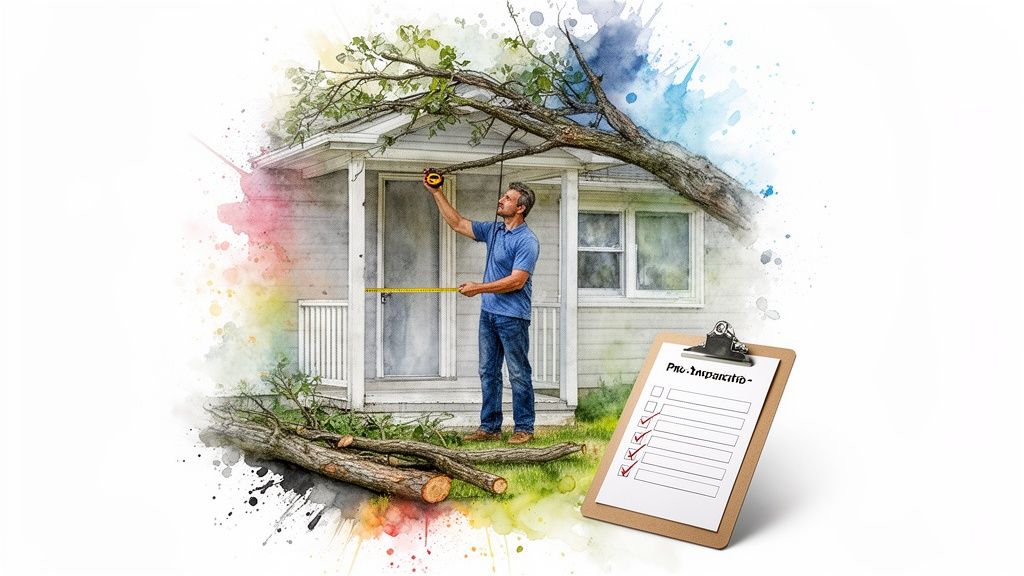
The best way to pass your defensible space inspection is to conduct a self-assessment first. By walking your property with the same critical eye an inspector uses, you can spot and fix common issues long before that official notice ever shows up. This isn’t just about ticking boxes; it’s about avoiding the stress and urgency pricing that come with a violation notice.
Start at the Structure and Work Outward
An inspector’s first stop is your house. Your top priority is what’s happening directly above and around your home.
Check Roof and Chimney Clearance: Walk out and look at your roofline. Do you see any tree limbs within 10 feet of the roof or chimney? This is a hard rule and one of the easiest violations to spot.
Look for Dead Branches: Scan the trees closest to your house for any branches that are dead, leafless, and brittle-looking. This "dead wood" acts as tinder, pulling fire up into the treetops where it can threaten your home. Any dead or dying wood needs to go, which often requires a professional. You can learn more about how to identify tree hazards before the next big wind event.
Inspect Palm Trees: If you have palms, look for the shaggy "skirts" of old, dead fronds clinging to the trunks. This is a massive fire hazard that must be cleaned off.
Identify Touching Canopies: Look up at your trees again. Do their canopies touch or nearly touch, creating an unbroken bridge for fire? For trees in Zone 2 (30-100 feet from your home), you need to maintain at least 10 feet of horizontal space between them.
If you spot any of these conditions, they should be addressed by a licensed tree contractor before an inspection. Waiting for a violation notice leads to higher costs and scheduling pressure.
By tackling this checklist in the spring, you give yourself plenty of time to get your property compliant, safe, and ready for fire season before the annual inspection rush begins.
Why Defensible Space Tree Work Requires a Specialist
Clearing brush is one thing, but when it comes to passing a defensible space inspection, the most critical work often happens in your trees. Defensible space tree work isn't the same as routine pruning; it’s a specialized field grounded in fire science and the exact criteria inspectors use.
A contractor who understands these requirements can assess your property before the inspector arrives, identifying limb clearance needs, dead wood, spacing issues, and palm frond accumulation as a single, coordinated scope of work.
More Than Just Pruning—It’s Fire Science
A qualified professional doesn't just see a tree; they see how it fits into the larger fire environment. They assess its position relative to structures, fuel ladders, and adjacent vegetation. This scientific process is critical, and the stakes couldn't be higher. During the 2022 Oak Fire, homes fully compliant with defensible space standards were six times more likely to survive. As the official state analysis of defensible space effectiveness shows, expert execution makes a measurable difference.
A specialist’s evaluation is focused on fire behavior:
- Fuel Ladder Analysis: They look for low-hanging branches that allow a ground fire to climb into the canopy.
- Ember Resistance: In Zone 1, the focus is on creating a non-combustible perimeter to stop wind-blown embers from igniting your home.
- Canopy Spacing: They measure the distance between tree crowns to ensure it meets the required gaps for your property’s slope.
Defensible space work is about strategically disrupting a fire's path. This requires evaluating a tree’s position relative to structures and fuel ladders—a skill set that goes far beyond simple trimming.
A Single, Coordinated Plan for Compliance
One of the biggest headaches for homeowners is juggling multiple contractors. Bringing in a single, expert contractor streamlines the entire process. A specialist can develop one coordinated plan that covers every aspect of your defensible space, from ground fuels to treetops.
This unified approach guarantees nothing gets missed. The team understands how brush clearing, strategic limb removal, and proper canopy spacing all work together to build a truly fire-resilient property. For a closer look at why this kind of knowledge is so vital, it's worth understanding why tree work requires real expertise, not just tools. Getting it done right the first time doesn't just save you stress; it delivers genuine peace of mind.
Common Questions from Monterey Homeowners
With defensible space enforcement more visible across Monterey County, homeowners have questions. Here are the most common concerns we hear from people in our community.
What Happens If I Fail My Defensible Space Inspection?
Failing an inspection isn't about punishment—it's about education. The fire department will issue a "Notice of Violation" detailing the exact fixes needed. You'll typically be given 30 to 45 days to get the work done. If that deadline passes without action, you could face fines or be billed for the cost of a contractor hired by the fire department. It’s always cheaper and less stressful to get ahead of the problem.
Will I Be Notified Before an Inspector Visits My Property?
While fire departments may send mailers, they generally don't schedule individual appointments. Inspectors can assess your property’s exterior from public areas, so you don't need to be home. Your property must be "inspection-ready" at all times throughout the entire fire season (generally May through October).
Does the 100-Foot Rule Mean I Have to Clear My Neighbor's Yard?
No. Your legal duty for defensible space ends at your property line. You aren’t required to go onto a neighbor's land to clear their vegetation. However, since fire doesn't respect property boundaries, talking with your neighbors about working together to create a continuous safe buffer benefits everyone.
Can I Do the Defensible Space Work Myself?
Absolutely—for some of it. Raking leaves, mowing dry grass, and cleaning gutters are all jobs a homeowner can and should tackle. But when it comes to significant tree work, it's a different story. Proper defensible space pruning requires understanding fire behavior, removing "ladder fuels," and creating precise spacing. For a valuable perspective, see our guide on what to know before hiring a tree removal company in Monterey County. Hiring a pro ensures the job is done right.
What Is the Best Time of Year to Schedule This Work?
Spring. Without a doubt, spring is the ideal time to handle your defensible space clearing in Monterey. Getting the work done before the dry season begins means you’re compliant long before the main inspection period starts in May. Once summer hits, demand for qualified tree services skyrockets, leading to long waits and premium prices. By tackling this in March or April, you skip the annual rush.
For homeowners in Monterey County who have received an inspection notice or want to get ahead of the program before summer, spring is the right window to schedule tree work. Demand for defensible space clearing increases significantly as the dry season approaches. California Landscape & Tree Pros offers expert, compliant defensible space services to make sure your home is safe and inspection-ready. Contact us today to get on the schedule and avoid the summer rush at https://californialandscapeandtreepros.com.