
Direct Answer: Check for dated service logs, inconsistent site conditions between visits, and a contractor who can’t show proof of a valid C-27 license. Those three things tell you most of what you need to know.
Most commercial landscaping problems don’t show up overnight. They build slowly — a shrub that’s overgrown for three months, a turf section that’s browning because the irrigation heads weren’t adjusted after the last aeration, a crew that shows up less frequently than the contract says. By the time it’s obvious, you’ve already paid for months of work that didn’t happen.
This is one of the more common complaints from property managers and HOA boards in Monterey County. A landscaping contract looks solid on paper, the invoices keep coming in, but the property doesn’t look like anyone is keeping up. And when they push back, the contractor has an explanation for everything.
This article focuses on two things that actually matter: what consistent, professional landscape maintenance looks like on a commercial property, and how to tell when your contractor is falling behind — before it becomes a liability or an HOA compliance issue.
What ‘Keeping Up’ Actually Means on a Commercial Property
Commercial landscaping isn’t the same as residential maintenance. The standard is higher, the scope is broader, and the consequences of falling behind are more visible — to tenants, customers, board members, and inspectors.
A contractor who is genuinely keeping up on a commercial property in Monterey County will be hitting all of these consistently:
- Turf edges are clean and defined after every visit — not just occasionally
- Irrigation systems are checked for coverage gaps, especially after seasonal changes or after any repair work
- Planting beds are free of weeds and have fresh mulch at an appropriate depth (typically 2 to 3 inches)
- Shrubs and groundcover are shaped to their natural form, not hacked back or left to sprawl
- Hardscape areas — walkways, curbs, and entry zones — are blown clear of debris each visit
- Drainage is kept clear so standing water doesn’t develop after the Salinas Valley fog season or during the rainy months
If two or three of those items are consistently missed, that’s not a bad week — that’s a pattern. And a pattern means the contract isn’t being executed.
Understanding what’s actually included in a commercial landscaping contract is the first step in knowing what you’re owed and where to push back.

The Documentation Problem — and Why It Matters
Most disputes between property managers and landscaping contractors come down to one thing: no paper trail. The contractor says the crew was there. The manager says the property doesn’t show it. Without service logs, photos, or timestamped records, it’s your word against theirs.
A professional commercial landscaping contractor should be providing — or at least making available — the following:
- Dated visit records for every service call, including what was done
- Irrigation inspection notes at least seasonally, more often if the system is complex
- A contact or supervisor you can reach without going through a general voicemail
- Photo documentation for any unusual finding — dead material, pest damage, drainage issues — so you have a record before and after
In Monterey County, commercial properties near the Highway 68 corridor or along the Carmel Valley Road corridor often have complex mixed-use plantings that need seasonal attention logged carefully. If your contractor can’t produce records showing they adjusted your irrigation after last November’s rains, that’s a gap worth asking about directly.
This is also where licensing becomes part of the conversation. A contractor holding a C-27 Landscaping Contractor license from the CSLB is operating under professional accountability standards. An unlicensed crew working for cash has no such structure — and no accountability when things go wrong. You can verify any license in about 90 seconds at the California Contractors State License Board website.
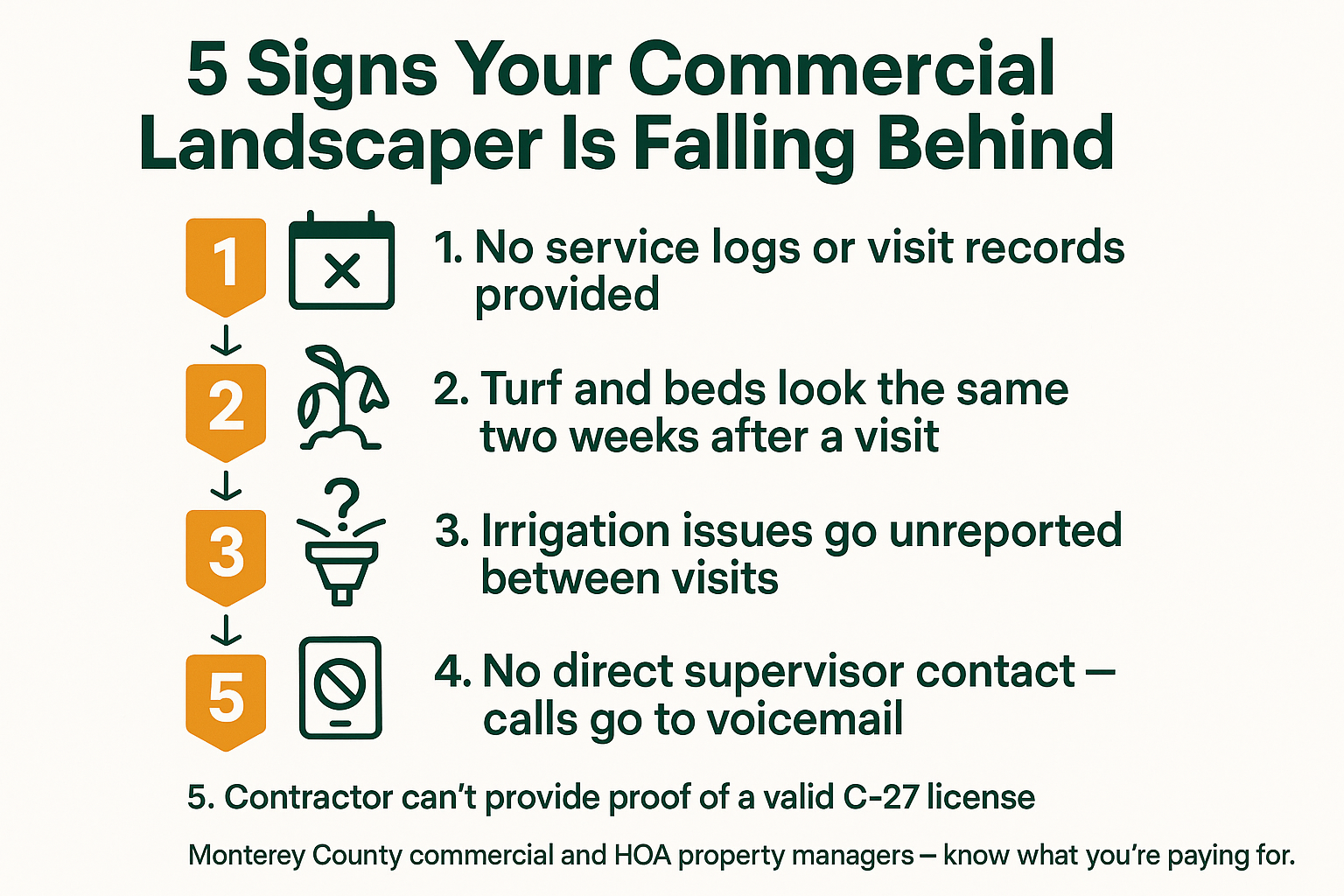
5 Signs Your Commercial Landscaper Is Falling Behind
If you’re managing a commercial property or an HOA in Monterey County, these are the five red flags that show up before a contractor relationship fully breaks down.
Water Compliance Is Part of the Job — Not an Extra
In Monterey County, commercial landscaping isn’t just about appearances. There are real compliance requirements tied to water use — and a contractor who isn’t tracking them is leaving you exposed.
The Monterey Peninsula Water Management District enforces water budgets for commercial accounts. Properties with permitted irrigation systems are also subject to MWELO (Model Water Efficient Landscape Ordinance) compliance, which requires that newly installed or significantly modified irrigation meets specific efficiency standards. If your landscaper is running an old system without ever flagging coverage waste or recommending adjustments, they may be contributing to overuse that shows up on your water bill and your compliance record.
A smart sprinkler system with weather-based controls is one of the most effective tools for keeping a commercial property in spec without constant manual oversight. But the equipment only works if the contractor is checking controller settings, inspecting heads, and adjusting run times seasonally.
For Monterey County properties, irrigation inspections should happen at a minimum three times per year: before the dry season begins around May, mid-summer when demand is highest, and after the first rains in late October or November. If your contractor isn’t doing those checks, you’re flying blind on your water use. Fixing irrigation leaks and staying ahead of coverage gaps is part of what a full-service commercial contractor should be doing without being asked.
What Consistent Commercial Maintenance Looks Like vs. What Falling Behind Looks Like
This breakdown covers the most common service areas where Monterey County commercial properties show the difference between a contractor who’s keeping up and one who isn’t.
| Service Area | Keeping Up | Falling Behind |
|---|---|---|
| Turf edges | Clean, defined lines after every visit | Ragged or uncut edges between visits |
| Irrigation | Seasonal adjustments + inspection notes on file | Same run times year-round, no documentation |
| Planting beds | Weed-free, mulch refreshed 1-2x per year | Weeds present, mulch thin or compacted |
| Tree and shrub pruning | Scheduled per growth cycle, shape maintained | Overgrown or hard-pruned without notice |
| Service documentation | Dated logs available on request | Verbal confirmation only, no paper trail |
| Contractor licensing | C-27 license verifiable via CSLB lookup | License number unavailable or unverifiable |
Tree Care on Commercial Properties — A Separate Standard
Many commercial landscaping contracts include tree care language, but the actual work requires a separate level of expertise and — in California — a separate license. A C-27 landscape contractor is qualified to maintain turf, irrigation, and plant material. But tree pruning, removals, and any work that affects tree structure legally requires a C-49 Tree and Palm Contractor license.
This matters for Monterey County property managers because tree liability doesn’t disappear just because you have a landscaping contract. If a tree on your commercial property fails and injures someone, the question of whether the contractor performing the last prune held the right license becomes a very serious one.
Know when to call for emergency tree removal — and more importantly, have a contractor relationship established before you need that call. Emergency work with an unknown crew on a commercial property is where things go wrong quickly.
For HOA properties in areas like Pebble Beach or along the Carmel Valley corridor, tree canopy is often a defining aesthetic element. Keeping it healthy requires someone who understands the species on site, the local coastal climate, and the Monterey County permit process for any removal work on protected or heritage trees.
Frequently Asked Questions About Commercial Landscaper Performance
How often should a commercial landscaper visit my Monterey County property?
Most commercial properties in Monterey County are serviced weekly or bi-weekly during the active growing season (roughly April through October). Winter visits may drop to every two or three weeks depending on your plant mix and water schedule. If your contract says weekly and you’re seeing bi-weekly service, that’s a conversation to have in writing.
Can I hold my landscaping contractor accountable if work isn’t being done?
Yes — but your leverage depends almost entirely on what your contract says. Pull out the service agreement and look for the scope of work section, the visit schedule, and any language about documentation or reporting. If the contractor isn’t meeting the written scope, that’s a breach of contract. Start by sending a written request for service records, then escalate from there if the response is unsatisfactory.
What license should a commercial landscaping contractor in California have?
At minimum, a C-27 Landscaping Contractor license issued by the California Contractors State License Board. If the contract includes tree pruning or removal, the contractor also needs a C-49 Tree and Palm Contractor license. Both are verifiable at the CSLB website using the contractor’s license number. Never take a verbal claim at face value — look it up.
Is CARB equipment compliance something my landscaper should be handling?
If your property is in a designated air quality district — which most of Monterey County is — your commercial landscaper should be aware of CARB’s SORE (Small Off-Road Engine) regulations and transitioning toward compliant zero-emission equipment. For HOA boards, this is increasingly showing up in RFP requirements. It’s a fair question to ask any contractor you’re evaluating. You can read more about what Monterey County property managers should ask about electric landscape equipment before your next contract renewal.
My commercial property has an irrigation system. Who is responsible for keeping it in compliance?
Your contractor should be flagging efficiency problems, adjusting run times seasonally, and noting any heads that need replacement. MWELO compliance for commercial properties with permitted irrigation is ultimately the property owner’s responsibility, but a professional landscaping contractor is your eyes and ears on the system. If they’re not reporting anything — ever — that’s a sign they’re not looking. A full review of landscape irrigation in California is worth reading before your next contract renewal.
Ready to See What a Commercial Landscaping Contract Should Actually Look Like?
California Landscape & Tree Pros works with commercial property owners, property managers, and HOA boards across Monterey County — from Salinas and Seaside to Carmel and Pacific Grove. Every scope is documented, every crew holds the right credentials, and every visit is accountable. If you want to compare what you’re currently getting against what a licensed, full-service contractor actually delivers, you can request a free quote at californialandscapeandtreepros.com/request-a-quote/ or reach the Salinas office directly at 831-998-7964 or the Monterey line at 831-905-8018.