
Direct Answer: A commercial landscaping contract should spell out exactly which services are performed, how often, who’s responsible for permits and compliance, and what happens when something goes wrong.
Most commercial landscaping disputes don’t start with bad work. They start with a contract that left too much out. A property manager in Salinas signs an agreement, the crew shows up every two weeks, and six months later nobody can agree on who was supposed to handle the dead oak near the parking lot or why the irrigation system hasn’t been touched since installation.
Monterey County has its own layer of complexity — MWELO water-efficiency requirements for permitted landscaping projects, CAL FIRE defensible space standards that apply to properties in State Responsibility Areas, and CARB’s SORE regulations pushing commercial contractors toward zero-emission equipment. If your contract doesn’t address those, you could be exposed to compliance issues you never saw coming.
This article breaks down what a well-written commercial landscaping contract should actually include — section by section — so you can compare what you have against what you should have before you sign anything.
The Scope of Work: The Most Important Section in Any Contract
The scope of work is where most contracts fail. It’s either too vague — ‘full-service maintenance’ — or it lists tasks without frequency, measurement, or responsibility.
A properly written scope section should answer four questions for every service listed:
- What is being done?
- How often will it happen?
- Who is responsible if something gets missed?
- What standard defines ‘complete’?
For a commercial property in Salinas or along the Monterey Peninsula, a complete scope might include mowing cycles, edging, weed control in beds, shrub trimming schedules, seasonal color rotations, and debris removal. Each of those needs its own line.
Vague language like ‘as needed’ almost always benefits the contractor, not the client. If the contract says irrigation checks will happen ‘periodically,’ that word means nothing in a dispute. Push for specific timeframes — monthly, bi-weekly, quarterly — written into the agreement itself.
For a deeper look at how irrigation accountability fits into a service program, see A Guide to Landscape Irrigation in California for 2026.
Licensing and Insurance: What the Contract Must Verify
In California, any landscaping contractor charging more than $500 for labor and materials combined must hold an active CSLB license. For commercial work, this isn’t a technicality — it’s the difference between coverage and liability.
A commercial landscaping contract should include or reference:
- CSLB license number — verifiable at cslb.ca.gov
- C-27 Landscaping Contractor license for planting, irrigation, and maintenance
- C-49 Tree and Palm Contractor license if any tree work is in scope
- General liability insurance with your property listed as an additional insured
- Workers’ compensation certificate — never optional on a commercial job
- DOT registration if the contractor operates trucks over a certain weight threshold
If a contractor can’t provide all of the above before the contract is signed, that’s the answer.
For Monterey County properties that include trees in the maintenance scope, the C-49 license is especially important. Pruning, removal, and storm cleanup all fall under that classification — and if something goes wrong with an unlicensed crew, the property owner can be held liable. For context on how commercial landscaping services in Salinas should be structured, including who carries what license, that’s worth reading before finalizing any agreement.
Service Frequency and Seasonal Adjustments
Monterey County has a mild climate, but ‘mild’ doesn’t mean ‘static.’ Growth rates slow in winter, irrigation demand spikes in late summer, and storm season from October through March can bring significant debris and tree risk.
A reliable commercial contract accounts for seasonal variation instead of locking in a flat schedule that doesn’t match what the property actually needs. Look for language that addresses:
- Summer visit frequency — typically every 1–2 weeks during peak growth months
- Winter reduction schedules — some properties can shift to monthly visits without visible decline
- Storm response protocols — who gets called, how fast, and at what additional cost
- Pre-rain preparation — debris clearing, drain inspection, and tree risk assessment before the wet season
If storm cleanup and emergency tree response aren’t in the contract, they’ll be billed as extras at a rate you didn’t negotiate. Understanding when to call for emergency tree removal can help property managers make faster decisions during a weather event.
Seasonal adjustments should be written into the base agreement — not treated as a surprise add-on when the first storm hits in November.
California Compliance Clauses: What Should Be in Writing
California has more landscape-specific regulations than almost any other state, and several of them apply directly to commercial properties in Monterey County.
Here’s what a contract serving this market should address in writing:
- MWELO compliance — Required for permitted landscape projects over 500 square feet on commercial sites. Covers irrigation efficiency, plant water use, and soil preparation standards.
- CARB SORE regulations — As of January 1, 2024, new gas-powered small off-road equipment (mowers, blowers, trimmers) cannot be sold in California. Commercial contractors operating in Monterey County should be transitioning to battery-electric equipment. Ask specifically.
- CAL FIRE defensible space — Properties in State Responsibility Areas must maintain 100 feet of clearance. If your commercial property borders open land near the Salinas Valley or inland Monterey County, this applies.
- Monterey County tree permit requirements — Removal of certain trees on commercial properties may require a permit through Monterey County’s Planning Department before any work begins.
- City of Salinas street-tree rules — Work on trees in the public right-of-way requires city approval and often a licensed contractor with proof of insurance on file with the city.
If the contract says nothing about compliance and the contractor’s crew removes a protected tree without a permit, the liability defaults to the property owner. That’s a problem worth preventing in writing.
For HOA boards and property managers asking about electric equipment compliance specifically, the article on what Monterey County property managers should ask about electric landscape equipment covers that in detail.
What a Commercial Landscaping Contract Should vs. Shouldn’t Include
Use this as a quick checklist when reviewing an existing contract or comparing proposals from multiple contractors.
| Contract Element | Should Include | Red Flag Language |
|---|---|---|
| Scope of Work | Specific tasks with defined frequency | “Full-service maintenance” with no detail |
| Licensing | CSLB license number, C-27 and/or C-49 | No license number listed anywhere |
| Insurance | Certificate with property as additional insured | “We are insured” with no documentation |
| Compliance | MWELO, CARB, CAL FIRE references if applicable | No mention of California regulations |
| Tree Work | C-49 license confirmed for any pruning or removal | General crew handling tree work |
| Storm Response | Response time, cost structure, who authorizes | “Emergency services available” — no terms |
| Irrigation | Inspection schedule, repair responsibility, cost limits | “Monitored as needed” |
| Contract Term | Start date, end date, renewal terms, cancellation notice | Auto-renewal with no written notice period |
| Payment Terms | Monthly billing cycle, late fees, dispute process | “Payment due upon completion” — no structure |
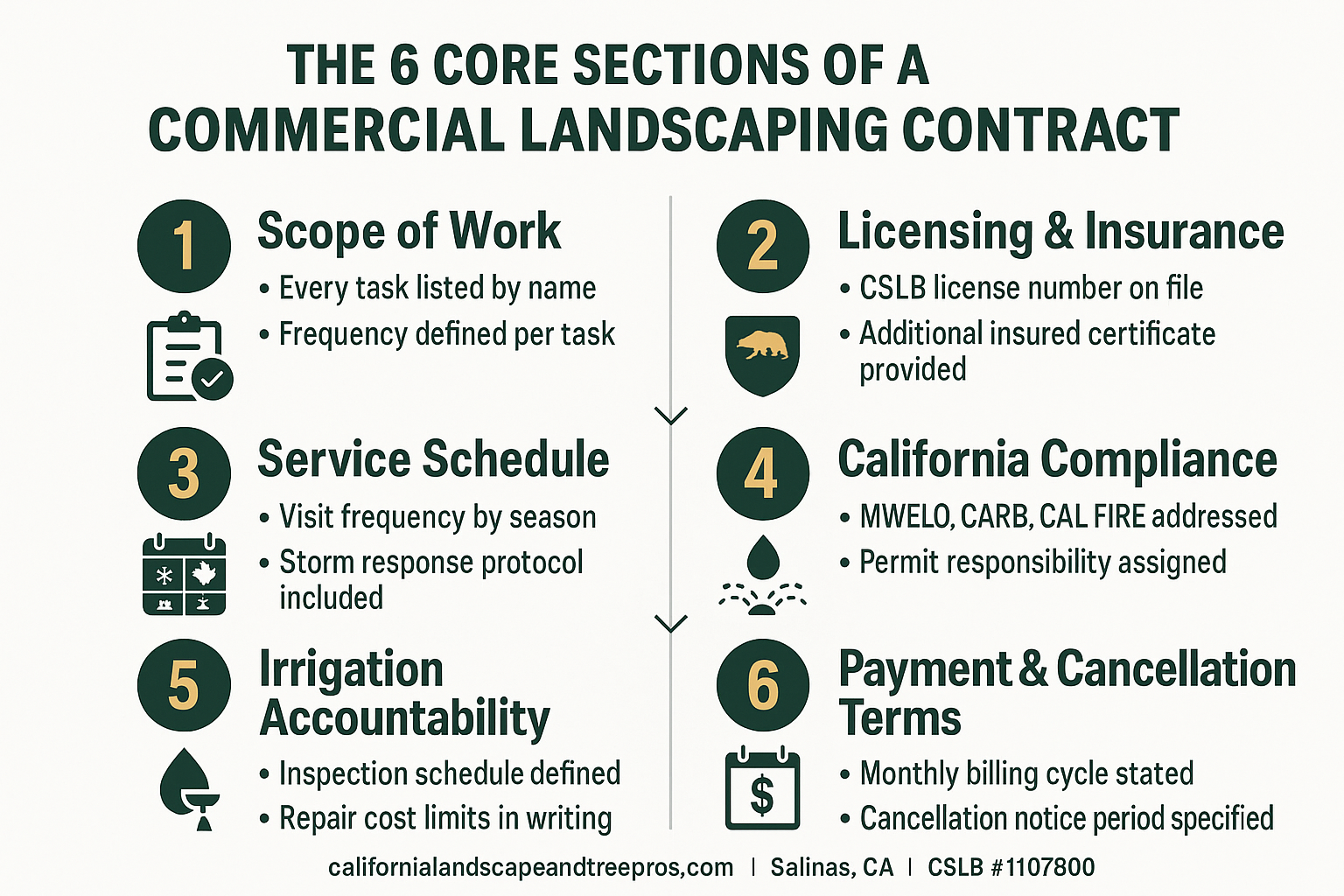
The 6 Core Sections of a Solid Commercial Landscaping Contract
This breakdown shows the six sections every commercial landscaping agreement should contain and what each one protects.
Irrigation Accountability: A Section Most Contracts Ignore
Irrigation is the single most common source of billing disputes on commercial maintenance contracts. A system fails, water bills spike, turf dies — and then the argument starts over whose job it was to catch the problem.
A clear contract puts this in writing before it becomes an issue:
- Scheduled inspection intervals — monthly at minimum during summer, quarterly in cooler months
- Who authorizes repairs — a dollar threshold (e.g., repairs under $250 are made same visit; above that requires written approval) prevents both neglect and surprise invoices
- Controller programming — who adjusts seasonal run times, and how often
- Leak reporting — contractor obligation to notify the client within a defined timeframe, not just fix and bill
In Monterey County, the Monterey Peninsula Water Management District offers rebates for qualifying water-efficient upgrades including smart controllers and drip conversion. If your contract is up for renewal, that’s worth building into the scope.
For property owners thinking about a full irrigation overhaul, what Salinas homeowners should know before changing their irrigation system covers the planning side before a contractor gets involved.
Contract Term, Cancellation, and What Happens When Work Isn’t Done
Most commercial landscaping contracts run 12 months with an auto-renewal clause. That’s standard. The problem is when the cancellation notice period is buried — often 30 to 60 days — and the property manager misses it by a week.
Before signing, confirm these terms in writing:
- Contract start and end date
- Auto-renewal notice window — when you must notify to exit without penalty
- Cancellation for cause — what constitutes a material breach (missed visits, failed compliance, unlicensed subcontractors)
- Performance documentation — does the contractor provide visit logs, photos, or digital reports?
- Dispute resolution process — binding arbitration or a written cure period before termination
A contractor who tracks visits and provides documentation isn’t just being thorough — they’re protecting both parties. If a client claims work wasn’t done, a timestamped visit log answers that immediately.
For property managers who’ve already had this problem, how to know if your commercial landscaper is doing the work goes deeper on accountability and verification.
Frequently Asked Questions About Commercial Landscaping Contracts
How much does a commercial landscaping contract typically cost in Monterey County?
Monthly rates vary widely based on property size, service scope, and visit frequency. A mid-size commercial property in Salinas typically runs $400 to $1,200 per month for standard maintenance. Properties with significant tree canopy, irrigation systems, or defensible space requirements will run higher. Get itemized proposals — not flat-rate quotes — so you can compare what’s actually included.
Does a commercial landscaping contractor need a special license in California?
Yes. Any contractor charging over $500 combined for labor and materials must hold an active CSLB license. For landscaping, that’s a C-27. If tree work is included — pruning, removal, palm trimming — the contractor also needs a C-49 Tree and Palm Contractor license. You can verify any license number for free at cslb.ca.gov.
What’s the difference between a commercial maintenance contract and a one-time landscaping job?
A maintenance contract is an ongoing service agreement — recurring visits, seasonal adjustments, and a defined scope over a set term. A one-time job is a single-scope project with a start and end. Both need written contracts, but maintenance agreements require much more detail around frequency, cancellation terms, compliance responsibilities, and who handles problems between scheduled visits.
Can I require my commercial landscaper to use electric equipment in Monterey County?
Yes, and in many cases it’s already required. CARB’s SORE regulations banned the sale of new gas-powered small off-road equipment in California starting January 1, 2024. Commercial contractors operating in Monterey County should be transitioning to battery-electric mowers, blowers, and trimmers. You can write electric-equipment requirements directly into a new contract as a compliance condition.
What happens if a commercial landscaper damages my property or a tree without a permit?
Liability depends on who the contract assigned responsibility to. If the contract says the contractor is responsible for permit compliance and they skip it, they carry the liability. If the contract is silent, it gets messy. Always assign permit responsibility in writing before any removal or major pruning work begins on a commercial property in Monterey County.
Ready to Review Your Commercial Landscaping Agreement?
California Landscape & Tree Pros works with commercial property owners, HOA boards, and property managers across Monterey County — from Salinas and Seaside to Carmel and Pacific Grove. If you’re evaluating a current contract or putting together a new one, CLTP offers transparent, itemized proposals that address scope, compliance, and accountability from the start. Reach out at californialandscapeandtreepros.com/request-a-quote, or call the Salinas office directly at 831-998-7964.