
Residents of Monterey, Salinas, and the Central Coast know that marine fog, damp mornings, and cool evenings are part of daily life. Yet, many contractors market outdoor living spaces without addressing these coastal conditions, leading to disappointed homeowners and short-lived installations. Coastal-smart design isn't an upgrade; it's the only way to build an outdoor living space that thrives in our unique climate.
Why Generic Outdoor Designs Fail In Salinas
The dream of a perfect backyard retreat can quickly sour when it meets the reality of the Central Coast environment. Too many contractors sell designs and materials better suited for dry, inland parts of California, which leads to failing projects and frustrated homeowners. This approach completely ignores the specific challenges we face every day here in the Salinas Valley.
The real culprits are the things that make our region special: the persistent marine layer, damp mornings, and salty sea breeze. These elements create an incredibly harsh environment for the wrong materials.
- Constant Moisture: That lingering dampness from the fog and morning dew is a nightmare for wood, causing it to rot. It also encourages mildew to grow on porous stone and can compromise the foundation of poorly sealed hardscapes.
- Salty Air: Salt is incredibly corrosive. It relentlessly attacks standard metals, causing rust to bloom on outdoor grills, patio furniture, and railings, drastically cutting their lifespan short.
- Temperature Swings: Our days often cycle from cool, damp mornings to warmer, sunnier afternoons. This causes materials to expand and contract, which gradually weakens joints, cracks surfaces, and degrades seals.
The Coastal-Smart Solution
At California Landscape & Tree Pros, we design outdoor living spaces with Central Coast conditions in mind—selecting materials, layouts, and features that hold up against moisture, salt air, and temperature swings. It's a thoughtful approach that confronts these challenges head-on.
Think of it as building for the backyard you actually have, not the one you see in a generic home improvement magazine. Understanding this is crucial, and it's a big part of why most plans fail in California yards.
By embracing a proactive strategy and exploring specific coastal style landscaping techniques, you're not just building a patio—you're making a lasting investment. The result is a comfortable, durable extension of your home that you can enjoy through foggy mornings and cool coastal nights, year after year.
Understanding The Salinas Coastal Climate
What makes building an outdoor space on the Central Coast so tricky? It’s not just one thing. It's a unique cocktail of local climate factors—the persistent marine layer, the high humidity, and the salty ocean breezes all working together. This environment can be incredibly tough on everything from wooden decks to metal fixtures.
Unlike hotter, drier inland areas where the blistering sun is the main enemy, the Salinas Valley deals with a constant, lingering dampness. This moisture is what accelerates rot in untreated wood, invites mildew onto stone patios, and can slowly eat away at the foundation of a poorly planned hardscape.
The Science Behind Our Microclimate
Our daily weather patterns are almost entirely dictated by our proximity to the Pacific Ocean. The best way to think about the marine layer is as a giant, cool, damp blanket that rolls in from Monterey Bay each day. This process creates a very specific set of conditions that directly impact any material you use outside.
- Persistent Humidity: Even when the sun is out, the air here is heavy with moisture. This means materials never really get a chance to dry out completely.
- Corrosive Salt Air: Those lovely ocean breezes? They carry tiny salt particles that settle on every single surface, relentlessly corroding standard metals and fasteners.
- Narrow Temperature Swings: We don't get the wild temperature swings of other regions. The consistent coolness means morning dew and fog tend to hang around, keeping surfaces damp for hours on end.
When you put these elements together, you get a climate where only the toughest materials and smartest designs will survive. Getting a handle on these details is the first step toward building a space that lasts, a topic we explore more in our simple guide to landscape design for coastal homes.
A Climate That Demands Forward-Thinking Design
Salinas sits just eight miles from the ocean, and that marine influence defines everything. According to data from ClimateCheck, a surprising 77% of buildings in Salinas are at some risk of wildfire, highlighting the need for fire-wise material choices alongside coastal-durable ones. This dual threat of moisture and fire risk makes professional, locally-aware design non-negotiable.
Local homeowners often search with intent like “patio design Monterey” or “outdoor living Salinas,” favoring providers who clearly understand why coastal design differs from inland California trends. By referencing fog, drainage, material longevity, and evening comfort, contractors serving the Monterey Bay can improve local relevance and search visibility, connecting with clients who need specialized solutions. You can dig into more data on Salinas' unique climate patterns on Wikipedia.
By understanding the specific challenges—the salt in the air, the morning dew, the foggy afternoons—homeowners can see exactly why coastal-smart material and design choices are non-negotiable for creating a truly resilient outdoor oasis. This proactive approach prevents the disappointment of a failing installation and protects your investment for the long term.
Choosing Materials That Thrive On The Coast
Once you understand that persistent moisture and salty air are the biggest enemies of outdoor structures in Salinas, the next logical step is picking the right materials to defend your investment. It’s a bit like dressing for the weather. You wouldn’t wear a thin cotton jacket in a downpour, and for the same reason, you need to select materials specifically designed for a coastal environment. This is all about ensuring durability and protecting your home's long-term value.
This isn't a matter of sacrificing style; it's about making smart, informed choices that prevent premature rust, decay, and the headaches of expensive repairs down the road. It’s a common mistake to assume materials that work well in dry, inland climates will perform the same here. They often fail fast, which makes coastal-specific material selection one of the most critical parts of the entire design process.
The diagram below really breaks down the three core environmental factors in Salinas that explain why some materials hold up beautifully while others just don't stand a chance.
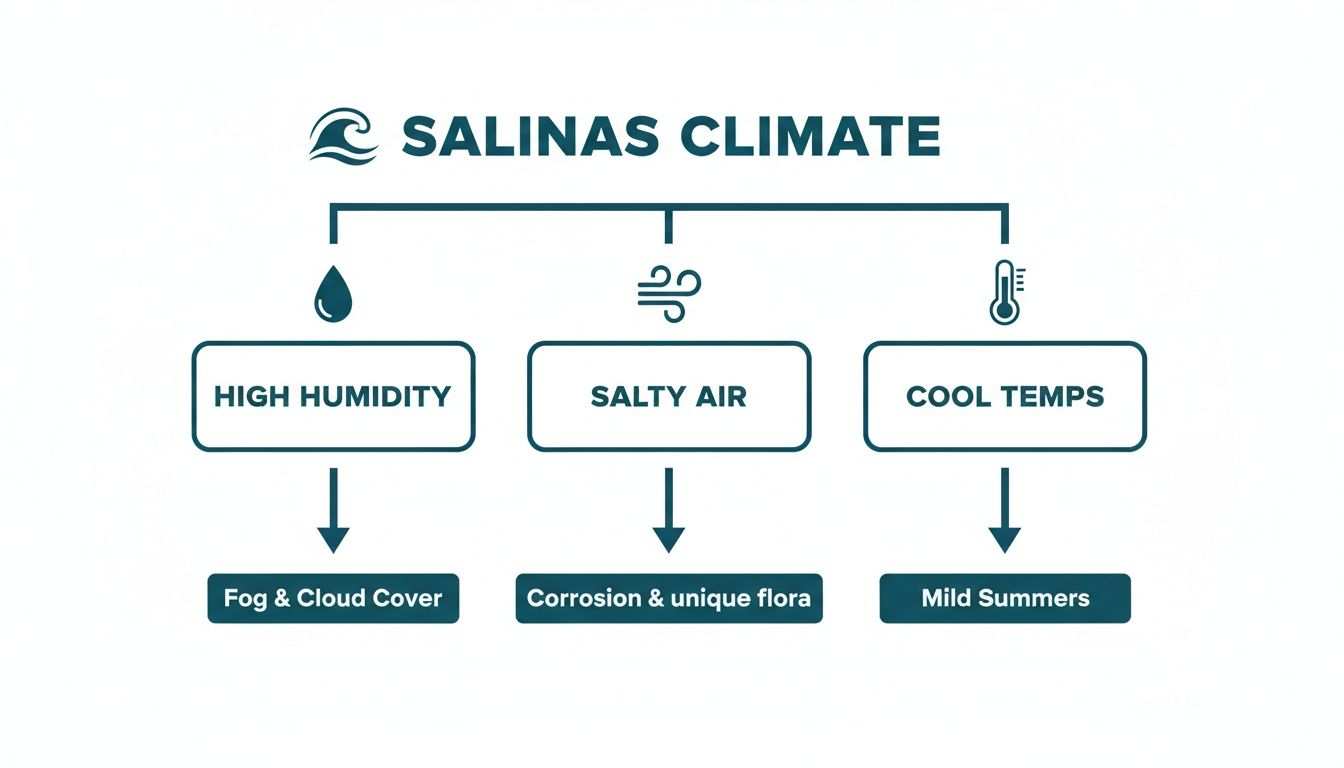
As you can see, the combination of high humidity, salty air, and consistently cool temperatures creates a uniquely tough environment for anything left outdoors.
Metals And Woods Built For Marine Conditions
When you're looking at metals for things like outdoor kitchens, railings, or structural supports, it's crucial to know that not all are created equal. Basic steel, for instance, will start showing signs of rust almost immediately when exposed to our salty air.
Here are the go-to choices for our climate:
- Marine-Grade Stainless Steel (316): This is really the gold standard for any coastal project. It contains an element called molybdenum, which gives it incredible resistance to the corrosion that salt exposure causes.
- Powder-Coated Aluminum: Aluminum is naturally rust-resistant, but adding a high-quality powder coating gives it a nearly bulletproof outer layer. It's a fantastic choice for patio furniture, modern pergolas, and fencing.
The constant dampness is also a major problem for any wood features, especially decking. Untreated softwoods like pine will quickly begin to rot and warp, sometimes in just a couple of seasons.
The better move is to choose materials engineered to repel that moisture from the start. Composite decking, which is made from a mix of wood fibers and recycled plastic, is a top performer here. It naturally resists rot, mold, and insects, and you never have to worry about sealing it.
Hardscaping That Resists Moisture And Staining
For your patios, walkways, and retaining walls, the most important characteristic to consider is porosity. Think of a sponge. Porous stones act just like that, soaking up moisture from the fog and daily dew. This makes them highly susceptible to mildew, ugly stains, and even cracking when temperatures fluctuate.
Choosing dense, low-porosity materials is one of the most effective strategies for building outdoor spaces that last. These materials naturally repel water, preventing the slow degradation that plagues so many coastal hardscapes.
That’s why dense options like granite and modern porcelain pavers are far better choices for the Salinas climate. They absorb very little water, meaning they dry out faster, are far less likely to grow mildew, and can easily resist stains from wet leaves and soil.
The following table breaks down how common materials stack up against the challenges of our local environment.
Material Performance In A Coastal Salinas Climate
| Material | Coastal Durability | Maintenance Level | Best Use Cases |
|---|---|---|---|
| Marine-Grade Steel (316) | Excellent | Low | Grills, railings, structural hardware |
| Powder-Coated Aluminum | Excellent | Low | Pergolas, furniture, fences, decorative screens |
| Composite Decking | Excellent | Low | Decks, stairs, benches, cladding |
| Porcelain Pavers | Excellent | Low | Patios, walkways, pool surrounds |
| Treated Pine | Poor | High | Not recommended for long-term applications |
| Standard Steel | Poor | High | Not recommended; will rust quickly |
| Natural Stone (Porous) | Fair to Poor | Medium to High | Use with caution; requires regular sealing |
Making these material choices upfront is a core principle of building a resilient outdoor area. You can learn more about this in our advanced guide to building outdoor spaces that last. By prioritizing these high-performance materials from day one, you’re not just getting a beautiful space—you’re getting one that will stand strong against our coastal elements for years to come.
Designing for Water and Drainage Challenges
In a coastal town like Salinas, water is a constant companion. It’s not just about the rainy season; it's the persistent moisture from our famous fog and the heavy morning dew that settles on everything. This dampness means you have to be smart about drainage from day one. Without a solid plan, you're looking at pooled water, which quickly leads to rotted decks, mildew on the patio, and even foundation problems down the road.
Managing water intelligently is at the heart of any good coastal design. The goal isn't to fight the water, but to work with it—to gently guide it where it needs to go. The best solutions are the ones you don't even notice, blending right into the landscape to prove that a functional space can still be a beautiful one. Skip this step, and even the most gorgeous outdoor living area is destined for an early demise.
Smart Solutions for Managing Coastal Moisture
Great drainage begins before a single paver is set. The most fundamental tool in our arsenal is proper site grading. This is all about subtly sculpting the land to slope away from your home's foundation and hardscapes. It's a simple concept, but it's incredibly powerful for preventing water from lingering where it can cause the most harm.
Beyond grading, we rely on a few key features to build a truly resilient Salinas landscape:
- Permeable Pavers: Traditional concrete or stone slabs create a ton of runoff. Permeable pavers, on the other hand, have small gaps between them filled with fine gravel. This clever design allows rainwater to filter through naturally into the ground, reducing puddles and helping to recharge the groundwater.
- French Drains: Think of these as hidden channels that work behind the scenes. We place a perforated pipe in a gravel-filled trench in strategic spots to intercept excess water and carry it safely away from sensitive areas like patios and retaining walls.
- Catch Basins and Channel Drains: These are the workhorses for hardscapes like driveways and patios. They act like grates, collecting surface water and funneling it into an underground pipe system, keeping your surfaces dry, safe, and ready to use right after a storm.
These aren't just bells and whistles; they're essential for handling the everyday dampness from the marine layer and are becoming even more critical as our weather changes.
Planning for Intense Rainfall Events
Getting water management right is more important than ever. While Salinas only gets about 15.38 inches of rain a year, we're seeing that rain arrive in more intense, concentrated bursts. Local data indicates that about 57% of buildings in Salinas are already in a flood-risk zone, a statistic that underscores why a professional drainage system is no longer a luxury—it’s a necessity. You can dig deeper into Salinas precipitation patterns and climate data to see the trends for yourself.
A well-designed drainage system does more than just move water—it protects the structural integrity of your entire outdoor living space. By planning for moisture from the start, you prevent the costly cycle of repairs that plagues so many generic installations in our coastal environment.
This proactive approach to water is a cornerstone of modern landscaping, especially as regulations get tighter. To learn more, take a look at our article on how new water rules are changing landscape design. By building smart drainage into your project, you're making a long-term investment in a stable, beautiful, and enjoyable outdoor space.
Creating Comfort For Cool Evenings And Foggy Mornings
What good is a beautiful patio if it's just too cold to use? Here in Salinas and along the Central Coast, those cool evenings and foggy mornings are just part of the deal. But that doesn't mean you should be chased indoors. The trick is to plan for comfort right from the start, transforming what could be a damp, chilly patio into a cozy retreat you can enjoy all year long.
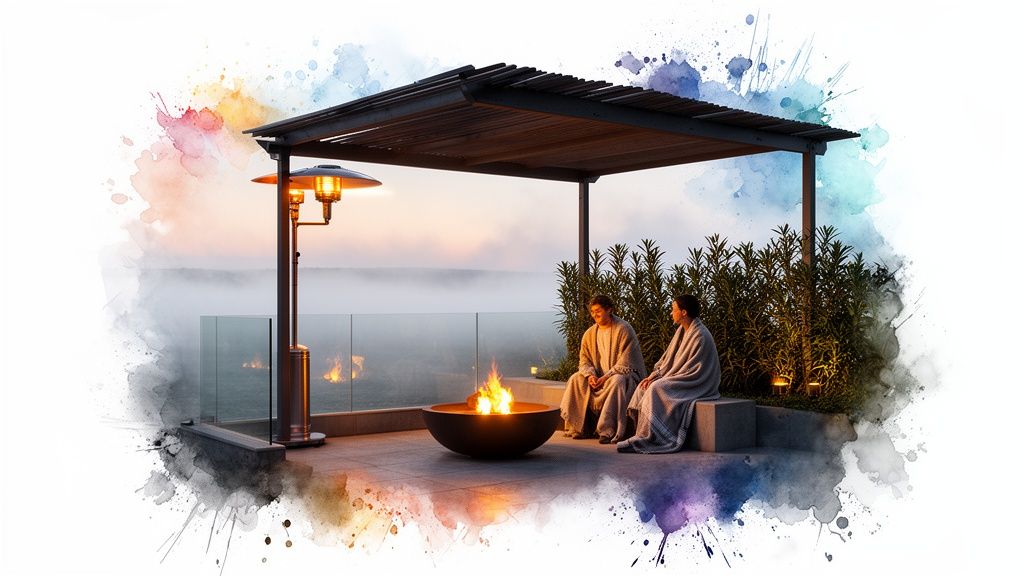
This is where a coastal-smart design really proves its value, extending the time you can actually use your investment. It’s not just about picking tough materials; it’s about creating an atmosphere where you, your family, and your friends genuinely want to gather, no matter what the marine layer is doing.
Layering Warmth and Light
The best way to fight back against that coastal chill is to layer different sources of warmth and light. Just one heat lamp or a single string of lights usually isn't enough. Instead, a smart combination of features works together to create a comfortable little microclimate in your own backyard.
- Radiant Heat Sources: Think about strategically placed fire pits, a classic outdoor fireplace, or even mounted radiant heaters. They provide that direct, ambient warmth that makes people want to pull their chairs in closer and stay awhile. These features quickly become the heart of your outdoor space.
- Layered Lighting: Fog has a way of making everything feel a bit gloomy. A well-thought-out lighting plan can cut right through that, mixing overhead lights with path lighting and subtle accent lights. It’s not just for safety—it creates a warm, welcoming glow that makes the space feel like a true room of your house.
Blocking Wind And Dampness
Even a slight breeze can make a cool evening feel frigid. And we all know that persistent dampness from the fog, which leaves cushions feeling soggy and unappealing. This is where smart structural elements come in.
A covered structure like a pergola or a solid patio roof is one of the most valuable additions you can make to a coastal outdoor space. It offers crucial protection from that morning dampness, letting you enjoy your coffee outside without sitting on a wet chair, and it provides shelter from any passing drizzle.
Windbreaks are another fantastic tool, and they don’t have to be view-blocking walls. You can use elegant glass panels or plant a dense row of native, salt-tolerant shrubs to cut down on those chilly ocean breezes while keeping the open feel you love.
We dive deeper into these strategies in our guide on 5 ways to boost outdoor comfort. By putting these elements together, a coastal-smart design turns your outdoor space from something you only use on perfect days into a true year-round asset.
Integrating Wildfire Safety Into Your Landscape
Living on the coast, we're always thinking about fog and ocean breezes. But here in Salinas, like everywhere in California, we also have to be smart about the very real risk of wildfire. A truly coastal-smart design doesn't ignore this; it builds fire safety right into the plan from day one. This isn't about creating a barren, sterile yard—it's about making intelligent choices that protect your home and family while enhancing your landscape's beauty.
The key idea here is creating defensible space. Think of it as a protective buffer zone between your home and the wilder parts of your property or the surrounding area. The most important part of this buffer is the area immediately around your house.
Building Your First Line of Defense
This first zone, which should extend at least five feet out from your foundation, needs to be completely free of anything flammable. Forget the wood mulch and dense, oily shrubs right up against the house. This is the perfect spot for beautiful, fire-resistant hardscaping.
- Gravel and Decomposed Granite: These simple materials are fantastic at stopping a low-burning ground fire before it can even reach your walls.
- Stone and Paver Patios: A well-placed patio does more than just give you a great spot for a BBQ; it acts as a major fuel break, effectively starving a fire of anything to burn.
This might seem like an extra precaution, but it's a critical one. You can dig deeper into the data by checking out the local wildfire risk assessments on ClimateCheck.com.
Smart Planting and Maintenance
Once you move past that initial five-foot zone, your plant choices become incredibly important. You’ll want to lean heavily on high-moisture, fire-resistant native plants that are already well-suited to our climate. Anything with waxy leaves or succulent properties is usually a great bet.
Defensible space is not about clearing your land entirely. It’s a strategic approach to landscape design that reduces flammable fuel sources, giving firefighters a crucial advantage and making your property more resilient to embers.
Finally, you can't just plant it and forget it. Ongoing maintenance is non-negotiable. This means keeping trees pruned (especially any branches overhanging your roof), clearing out dead leaves and branches, and making sure you haven't accidentally created a "fire ladder" that could guide flames right to your home.
When you bring these principles together, your outdoor space becomes more than just a beautiful coastal retreat—it becomes a safer, more resilient one.
Your Questions About Coastal Outdoor Living Answered
When you're planning an outdoor project here on the Central Coast, it’s natural to have questions. We hear a lot of the same concerns from homeowners in Salinas and Monterey, so we’ve put together some straightforward answers to help you understand what makes a coastal-smart design so important.
What Are The Best Plants For A Salinas Garden That Can Handle Salt Air?
The smartest move is to work with our local environment, not against it. That means focusing on native and coastal-adapted plants that are already built to thrive here.
Think about species like the sturdy Coast Live Oak, the beautiful California Lilac (Ceanothus), and a whole variety of succulents and ornamental grasses. These plants look fantastic, but more importantly, they’re tough enough to handle the salt spray and constant moisture with far less fuss and maintenance.
Is It Really Worth The Extra Cost For Marine-Grade Materials?
Absolutely, 100%. It’s easy to get sticker shock when you see the price of materials like marine-grade (316) stainless steel or high-quality composite decking.
But think of it as a long-term investment. Paying a bit more upfront for materials that won’t rust, rot, or fall apart saves you from the headache and recurring expense of replacing fixtures and warped wood every few years. You’re buying durability and peace of mind.
How Can I Prevent Rust On My Outdoor Furniture And Grill?
The first line of defense is choosing the right materials from the start. Look for furniture made from powder-coated aluminum, teak wood, or high-density recycled plastics, as they stand up well to moisture.
For your grill and other metal hardware, always insist on 316 stainless steel. A simple habit of rinsing off salt deposits with fresh water and using protective covers will also go a long way in keeping everything looking new.
Do I Need A Covered Patio Or Pergola In The Salinas Climate?
While you can certainly live without one, a covered structure like a patio or pergola is a game-changer for how often you'll actually use your outdoor space.
It gives you a perfect retreat from that classic morning marine layer and provides welcome shade when the afternoon sun finally breaks through. More than just shelter, it defines a cozy gathering spot—especially when you add a fire pit or outdoor heater to the mix.
What Is The Most Common Mistake People Make With Outdoor Design Here?
By far, the biggest mistake we see is underestimating the relentless impact of moisture. People fall in love with a look they saw in a magazine or a design meant for a dry, inland climate, and they try to replicate it here.
The result is almost always a disaster. Materials that aren't meant for our damp air quickly succumb to rot, mold, and corrosion. The key to a successful project in this area is making smart drainage and moisture-resistant materials the absolute top priority.
For homeowners across Salinas, Monterey, and the greater Central Coast, outdoor living spaces designed for coastal conditions can turn foggy mornings and cool nights into usable, comfortable extensions of the home—year after year. Let the experts at California Landscape & Tree Pros build a beautiful space that truly lasts.
Ready to build your coastal-smart outdoor oasis? Contact us today for a consultation.